Most people stall at the same moment: the shirt is in their hands and there is no rule to apply. Here is how to decide what to keep when decluttering clothes: sort every item into three labeled piles, judge it on evidence rather than memory, and move the released items out of the house the same day. Evidence means how often you reach for it, whether it fits and feels good now, how many outfits it actually works in, and what it really costs per wear. A full wardrobe edit takes two to three hours spread over a few evenings, and the physical part is easy. The hard part is applying one rule consistently instead of negotiating with every piece individually.
I have run this edit on my own closet and on friends’ closets, and the same thing happens both times. Nobody ends up with too little. They end up with a smaller closet that actually functions, plus a donation bag that quietly tries to creep back into the bedroom a week later.
Table of Contents
- What You Need
- Step-by-Step
- 1. Set Up Separate Piles Before You Judge Anything
- 2. Keep the Clothes You Actually Reach For
- 3. Check Fit, Condition, and Comfort in the Mirror
- 4. Count the Ways You Can Wear Each Piece
- 5. Apply a Simple Cost-Per-Wear Test
- 6. Make the Call and Capture the Reason
- 7. Follow a No-Second-Guess Exit Plan
- Common Mistakes
- Frequently Asked Questions
- What if I love a piece of clothing but rarely wear it?
- Should I declutter seasonal clothes I have not worn this year?
- How do I decide whether expensive clothes are worth keeping?
- Is it wasteful to donate clothes that are still in good condition?
- What should I do with clothes that have sentimental value?
- How can I stop buying clothes right after decluttering?
- Conclusion
What You Need
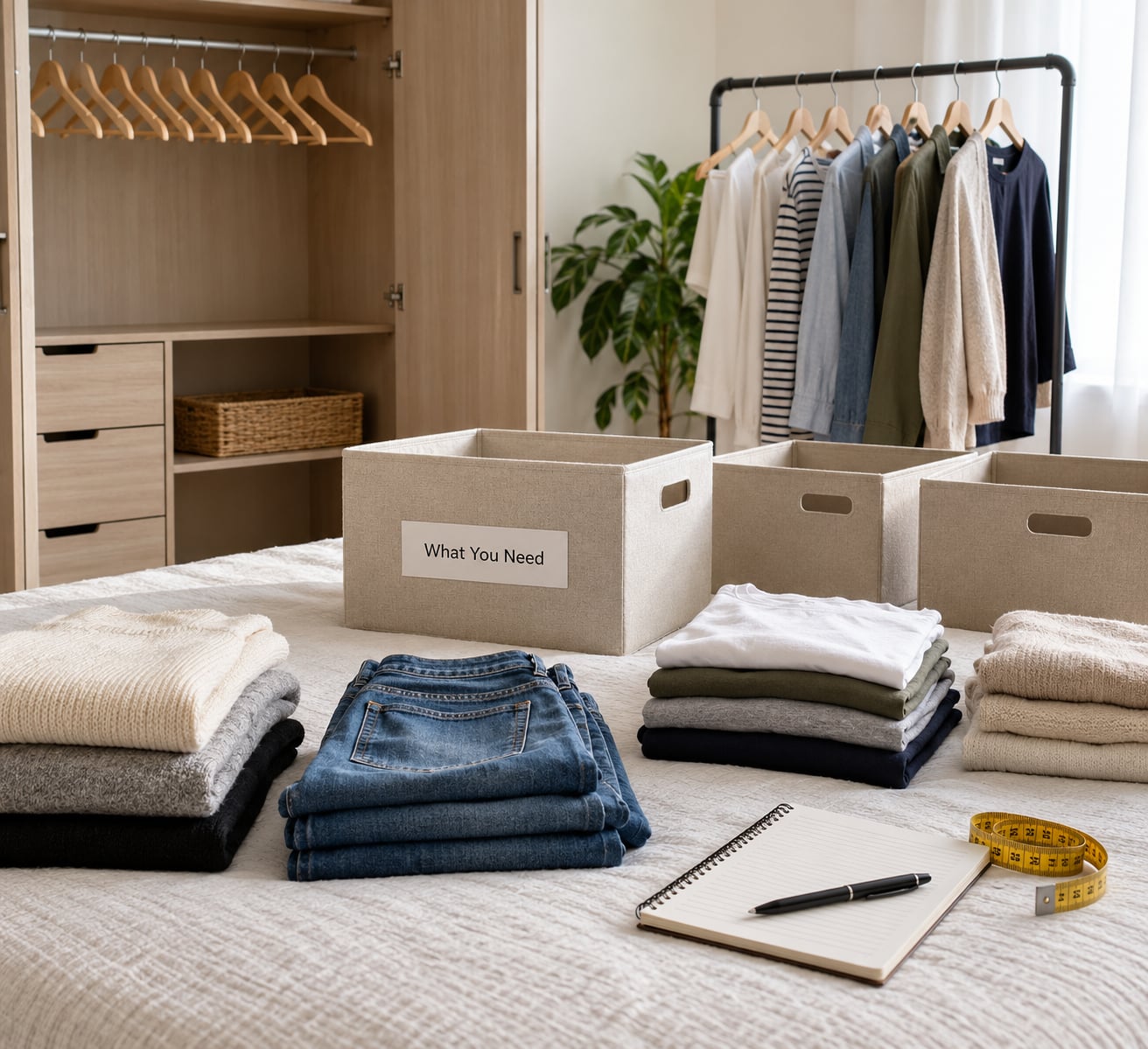
Six things, and none of them expensive. Set them up before the first garment comes out, because the whole method depends on not stopping to improvise halfway through.
- Access to the whole wardrobe. Take the contents of every closet, dresser, storage box, and laundry basket in your home. A declutter done section by section is really just a reshuffle, and the things you skipped are the ones causing the crowding.
- Labeled categories. Six containers or floor piles, each marked: KEEP, MAYBE, SELL, DONATE, REPAIR, and DISCARD. Label them before sorting, not after, so every garment has a home waiting for it.
- A wear-tracking method. A notebook and pen, a notes app, or a photo of your outfit log. The cheapest option is a small tally mark next to each hanging item; the most accurate is a photo of what you actually wore each day.
- A try-on area with a mirror you can see your whole body in. A full-length mirror, ideally near the sorting space. Fit and drape cannot be judged on a hanger.
- Notes. Paper or a phone. Write one line per garment you release. The reason matters later, when doubt shows up three weeks after the bag is sealed.
- Destinations for the released piles. Know before you start where SELL goes, which donation organizations accept your area and condition, whether your city has textile recycling pickup, and whether a tailor can mend anything worth mending.
Two constraints worth deciding in advance. If you have nowhere to store a MAYBE container, cap the pile at one small box and give yourself a date. And if your time is limited, plan on 10-minute increments rather than a weekend; sorting one drawer fully beats abandoning a closet halfway on a Saturday.
Step-by-Step
1. Set Up Separate Piles Before You Judge Anything
Sorting becomes exhausting when the piles are ambiguous, so make them physical and write them down. Six labeled groups, placed where you can reach them without walking across the room, remove the decision about where a garment goes and leave only the decision about the garment itself.
You will know the system worked when a garment never sits in your hands. Everything moves straight from the hanger to a pile, and the pile, not your mood, decides where it lives. This is also the fix for the person who wants to keep everything: the choices are made in advance, when you are calm, rather than one desperate item at a time.
2. Keep the Clothes You Actually Reach For
Wear history beats every other signal, and it is the one most people skip. Hang everything you own for two weeks and mark each piece the first time you wear it, or photograph your outfits daily for a month. Thirty days is enough to separate clothes that live in your life from clothes that live in your closet.
Genuine use means the piece appears in an outfit you actually finished, on an occasion that happened. An item worn once in four months is not a wardrobe piece, it is a memento. If a garment was never worn because it needs ironing, is fussy to care for, or makes you feel self-conscious, that is useful information, and it counts as not worn.
This step catches the items you feel guilty about. Someone with three similar pairs of winter boots rarely wears all three in one season, so a season’s worth of evidence immediately picks a winner. Trust the tally, not the memory of the day you bought them.
3. Check Fit, Condition, and Comfort in the Mirror
Try on every questionable item. Look at how the shoulders sit, whether it pulls across the back, whether the hem falls where you want it, and whether you would sit down and cross your legs in it.
Then check condition, because a garment that needs work is a different decision from one that cannot be saved. Pilling, fading, a missing button, a blown-out underarm seam and a small stain are all repairable. Structural damage, a persistent odour, or a stain that has gone through the fabric usually is not.
Rule of thumb: if the problem is fixable and the piece fits, move it to REPAIR and give it a real deadline, two weeks or a month, because repairs you never pick up are just a second kind of clutter. A repairable flaw is not a reason to release something you love. Uncomfortable is a reason on its own, regardless of the fabric.
4. Count the Ways You Can Wear Each Piece
Build three to five real outfits around the garment using pieces you already own. If you cannot get to three without inventing a hypothetical piece you do not own, the garment is a one-outfit item and it has to justify its space on charm alone, which rarely survives contact with a full closet.
Be careful not to force this into a single silhouette. A wardrobe of soft, relaxed, neutral pieces is a legitimate choice, and so is a wardrobe built around one hobby. The test is whether you can build credible combinations from what you own, not whether your closet matches anyone else’s idea of a capsule wardrobe.
The failure mode here is the item waiting for its perfect partner. If a garment has been on the hanger for a year and the partner never arrived, the answer is already known. Versatility is the single best predictor of an item earning permanent space.
5. Apply a Simple Cost-Per-Wear Test
Divide what you paid by the number of times you have worn it, then divide by the number of times a year you expect to keep wearing it. The result is your real annual cost of owning the piece, and it is far more honest than the tag.
Use the number as context, not as an automatic verdict. A structured coat you wear every winter for eight years is one of the cheapest things in your closet per wear, even if it was expensive. A tailored trouser you bought on impulse and wore twice is the most expensive thing you own, no matter how good it looks on the hanger.
What the test reliably surfaces is the pattern. If one item comes out expensive and another nearly identical item in the same fabric has been worn twice as often, keep the one with the track record. This is also the cleanest counter to sunk cost, since the money is already spent and no decision today gets it back.
6. Make the Call and Capture the Reason
Work through this sequence in order, and stop at the first yes. Do you reach for it? Does it fit and feel good on? Is it in good condition or cheaply fixable? Can you build three outfits from it? Does it match your life now, including your job, climate, schedule, and how much care it needs? And does it carry real emotional weight, a specific person or memory, rather than a vague fondness? Any yes on the first five is a keep.
Write one line explaining every release. The note is what stops doubt from reopening the decision later, and it takes fifteen seconds per item. For duplicates, the note is the tie-breaker: the one you reach for more often wins, and the other goes, even if you feel slightly more attached to it. Sentimental pieces need a different test, and one is coming in the steps below.
7. Follow a No-Second-Guess Exit Plan
The edit is not finished when the bag is full, it is finished when the bag is gone. Schedule the drop-off, the consignment appointment, or the textile recycling pickup for a day within the week, and write the date down.
Know the routes in order of effort and return. Sell or consign pieces in good condition with strong labels and a designer or premium fabric. Donate good condition pieces that will not sell. Send damaged and worn textiles to a recycling program, and check your local area for pickup services, since some operate on a set schedule. Keep the rest as cleaning rags. For pieces with a size you might return to, cap storage at one container with a written review date instead of a vague promise, and a reader is right to warn that the box itself becomes the problem once there is no space for it.
For sentimental items, photograph the garment on you, or in the place it came from, then release it. Keeping the image takes a fraction of the space and most of the memory, and it is the technique several readers describe as the only thing that made a sentimental pile possible to empty. Whatever comes out of the house does not come back. If doubt arrives in week three, read the note you wrote instead of re-opening the bag.
Common Mistakes
Six habits account for most failed wardrobe edits, and each has a straightforward fix.
Sorting by category instead of by evidence. Working through blouses, then trousers, then jackets feels productive and produces a reorganized closet, not a smaller one. Judge on wear history first, then group the survivors by category when you put them back.
Keeping aspirational purchases out of guilt. The coat for a future job, the outfit for a trip that has no date. Guilt about money is real, but the money is already gone. If a garment has no scheduled occasion, it is a cost with no return, and keeping it is the most expensive option available to you.
Releasing items out of emotional overspending. A bad purchase is not a reason to make more purchases. The honest calculation is what the wardrobe needs going forward, not what you meant to spend.
Filtering only by color or season. An entire sorted section of pale neutrals or winter gear can still be full of things you never wear. Use color and season to organize the survivors, never as the reason to keep.
Buying replacements before the review is finished. This is the cycle that keeps closets full: release, feel bare, refill. Sort everything first, shop only for the specific gaps you found, and give yourself a no-buy month so the edit has a chance to prove itself.
Letting MAYBE become permanent. A maybe pile without an expiry date is a closet you moved into a box. Cap it, date it, and on the review date anything untouched goes without another conversation.
Two smaller habits help more than they should. Decide on each item in under a minute, because an hour of deliberation reliably produces a coin flip. And if you notice yourself reopening a sealed donation bag, treat that as a signal to pause shopping rather than as proof you were wrong to declutter.
Frequently Asked Questions
What if I love a piece of clothing but rarely wear it?
Love is a real reason to keep something, but love is not a use. If you can build three outfits around it and it fits and feels good, keep it and accept that it is a special-occasion piece. If you cannot build those outfits, keeping it means storing a feeling rather than wearing a garment. Photograph it, name the memory, and release it. A closet should hold things you reach for, and one cherished item you never reach for is a poor trade for the whole edit feeling like a loss.
Should I declutter seasonal clothes I have not worn this year?
One unworn year is a signal, not a verdict, because heavy coats and winter boots are not competing with a full calendar. Look at the last two seasons instead. If a seasonal piece has been unworn across two full cycles and it fits now, it is not seasonal, it is aspirational. Keep it only if you can name the real occasion you expect to wear it. Anything else in that category goes into the seasonal release pile with the rest.
How do I decide whether expensive clothes are worth keeping?
Ignore the price tag and calculate the cost per wear instead: what you paid divided by the number of times you have worn it. That number is your real annual cost of ownership. A structured coat worn every winter for eight years becomes one of the cheapest things you own per wear, while an expensive piece worn twice is the most expensive. The test also settles duplicates: between two similar items, keep the one with the better track record, not the one with the bigger receipt.
Is it wasteful to donate clothes that are still in good condition?
Not if you choose the right route. Good condition with strong labels and premium fabric can go to consignment or a resale shop, which pays you and keeps the garment in circulation longer. Pieces that will not sell but are still wearable go to donation, Buy Nothing groups, or a community clothing exchange. Worn, damaged, or stained textiles belong in textile recycling rather than a donation bin, where they are often sorted out anyway. Knowing where each pile goes before you start makes letting go feel considerably easier.
What should I do with clothes that have sentimental value?
Separate the memory from the garment. Photograph the piece, ideally in the place or moment it comes from, and write one line about why it matters. That gives you nearly all of the emotional value at almost none of the physical cost. Then keep at most a small, chosen set of truly irreplaceable items, and release the rest. If you can only take a few, take the ones tied to a person rather than a purchase, because a specific person is a harder thing to replace than a good coat.
How can I stop buying clothes right after decluttering?
Give yourself a no-buy period of at least sixty days, and write down the specific gaps you found during the edit before the period starts. Shopping without that list is how a sorted closet refills. A second buffer is one-in-one-out: nothing new comes in until the last release has actually been worn a dozen times. If you miss a replacement badly enough after two months, buy that one item secondhand first, which is cheaper, often better quality, and the most reliable way to break the buy-and-purge loop.
Conclusion
Start with the wardrobe section that is hardest to reach, because the part you avoid is usually the part causing the crowding. Hang everything for a month, judge each piece on wear, fit, comfort, outfit potential and cost per wear, and give it one decision with one written reason. Then move the released items out of the house before you shop for anything. Once you know how to decide what to keep when decluttering clothes, the edit stops being a test of willpower and becomes a repeatable routine you can run twice a year.