Learning how to size clothing for a new brand comes down to five decisions: which sizes you will offer, how each garment is measured, how those measurements change from size to size, how much deviation your factory may use, and how you test everything on real bodies. Most first-time founders make those calls in the wrong order and find out at fit-check time, when the samples are already cut.
Get the order right and sizing stops being guesswork. Get it wrong and you carry two problems: returns, and a size run you can never reproduce exactly on a reorder. Both are expensive, and the second one is worse, because a run that was never properly graded cannot simply be ordered again.
Table of Contents
- What You Need to Size Clothing for a New Brand
- Step-by-Step
- Choose your sizing standard
- Define the fit and measurements that matter
- Create your first size range
- Test samples on different body types
- Grade and refine the size run
- Publish a shopper-friendly size guide
- Common Mistakes
- Frequently Asked Questions
- What size range should a new clothing brand launch with?
- Should my size chart show body measurements or garment measurements?
- How do I add extended or inclusive sizes without raising my minimum order?
- How should I size stretchy fabric differently from woven fabric?
- What is the difference between a grade rule and a size chart?
- How much can a finished garment differ from the size chart?
- Start with one garment, one fit, and a small test run
What You Need to Size Clothing for a New Brand
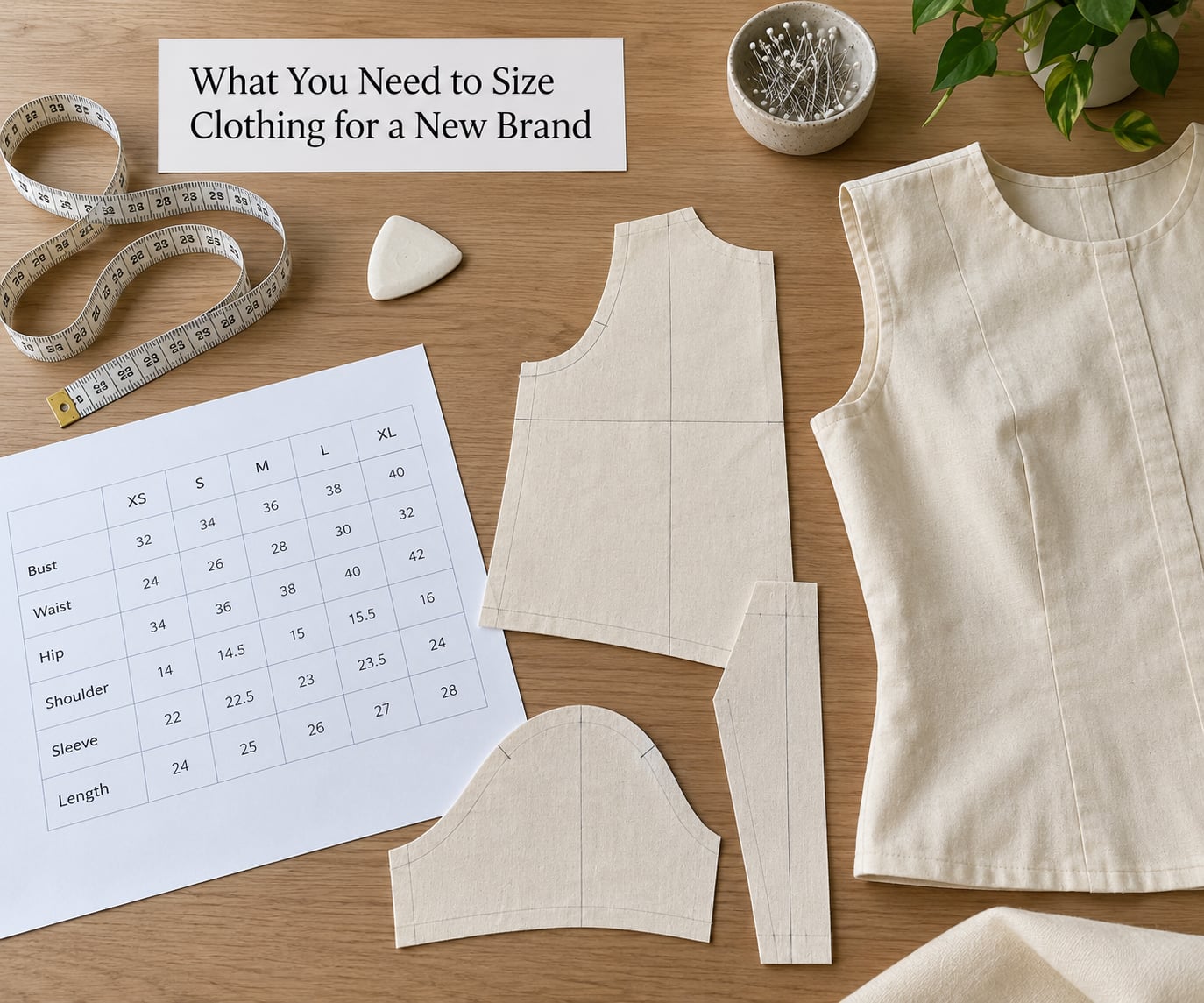
Gather the real objects before you gather the opinions. Half the sizing arguments in a first collection come down to two people measuring the same garment in two different ways.
- A flexible tape measure for body measurements, plus a rigid ruler or seam gauge for flat garment measurements.
- A paper measurement sheet with one row per point of measurement and one column per size.
- Two or three reference garments you already know fit well, so you have a target instead of an opinion.
- A muslin or cheap test garment in your base size, made before anything is graded.
- The factory’s size set, if a manufacturer is already involved. Ask which standard they grade from and get the numbers in writing.
- At least three people in different sizes who will try the samples on and say what they feel.
- A correction worksheet with named columns: POM, measured value, target value, correction issued, revised value.
Fabric matters too. A measurement taken on a washed, relaxed sample tells you something different from the same measurement on a stiff, newly cut one. Note the fabric weight in GSM and whether the fabric shrinks, because both change the finished numbers later.
Step-by-Step
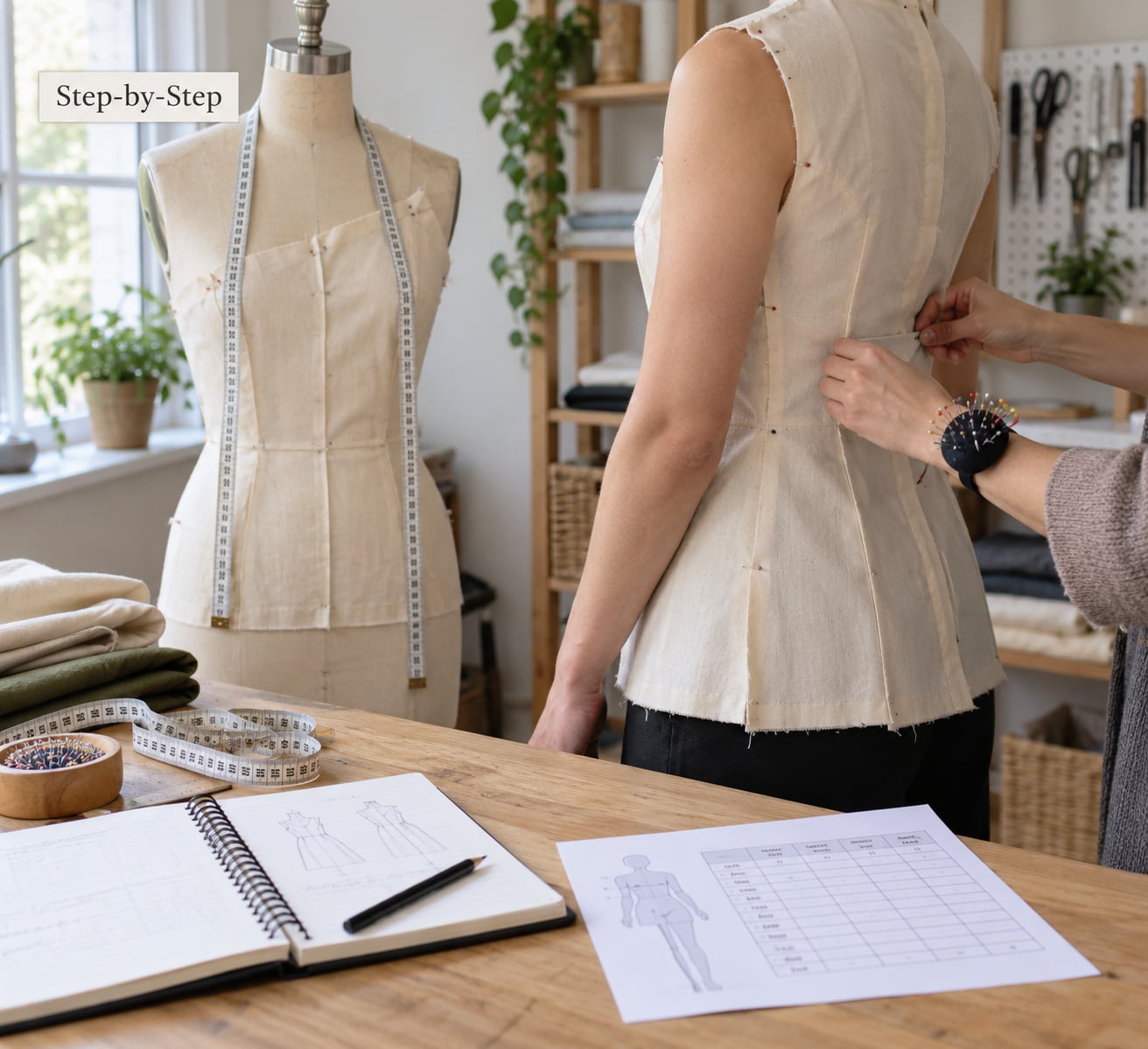
Choose your sizing standard
Pick one of three approaches, and be honest about which one you are choosing. Using an established size set such as ISO 8559 or the factory’s own block gets you to samples faster and costs you less, because grading is already set up. Creating a body-measurement system gives you the widest fit coverage but takes far longer, because every garment needs its own relationship to the body. A garment-measurement system is the fastest to launch and the least generous to customers, since it describes the clothing without describing the person wearing it.
For a first collection, most brands do best with a hybrid: grade from an established size set, then publish garment measurements. It is what shoppers on r/sewing and r/printful keep asking for, because body-to-size translation is exactly the step nobody can do reliably from a label.
Define the fit and measurements that matter
Before measuring anything, write down the fit you are actually making. A relaxed cotton tee and a slim jersey tee are the same pattern shape with different ease, and they need different measurements even when the sizes share names.
Then choose your points of measurement. A basic tee usually needs half chest, body length, shoulder width, sleeve length and neck width. Every point of measurement needs three things recorded: the exact place on the garment, the finished value in centimetres, and the tolerance you allow around it.
| Record | What it describes | Example value for a base Medium |
|---|---|---|
| Body measurement | The person wearing the garment | Bust 92 cm, waist 76 cm |
| Finished garment measurement | The flat garment as it ships | Half chest 56 cm |
| Tolerance | How far the factory may sit from spec | Plus or minus 1 cm |
Keep those three columns separate in every document you produce. Conflating them is the single most common reason a size chart cannot be used to diagnose a fitting problem.
Create your first size range
Decide the range before you design. XS to 2XL serves more customers but every extra size increases the graded pattern work, marker planning and size balancing your factory has to absorb, which usually pushes the minimum order quantity up. S to XL is cheaper to run and leaves the ends of your market unserved, and customers who cannot find their size simply do not buy.
Split the run across sizes rather than ordering a flat ratio. A typical first run for a five-size top looks closer to XS 5, S 15, M 25, L 25, XL 20, 2XL 10 than to ten of each. Your sales data will tell you the real curve later; this is just a defensible starting point.
| US | UK | EU | Alpha | Bust (cm) |
|---|---|---|---|---|
| 4 | 6 | 36 | XS | 80-84 |
| 6 | 8 | 38 | S | 84-88 |
| 8 | 10 | 40 | M | 88-94 |
| 10 | 12 | 42 | L | 94-100 |
| 12 | 14 | 44 | XL | 100-108 |
Two cautions. A US 8 is frequently labelled M and L by different brands, so publish the bust range with every alpha size rather than the letter alone. And regional body standards are genuinely different: the reference body behind a Medium in the US is fuller through the bust than the reference body behind a Medium in much of Asia, which is exactly why a size you copied from another brand will not fit your customer.
Test samples on different body types
Fit the base size, then the smallest and largest size in your run, on people who represent those sizes. One tester cannot tell you whether a size run works. Note shape as well as size: a taller tester in an M and a shorter tester in an M will tell you immediately whether your length measurements are right.
Record observations in plain language, then separate the diagnosis. If the garment hangs correctly but the underarm seam pulls, that is a pattern problem, not a sizing problem. If every tester says the shoulder is too wide, that is a grade rule problem. Fixing the wrong one costs you a full sample round.
Grade and refine the size run
A grade rule states how much each measurement changes between two adjacent sizes. A grade increment is that number for one measurement. A tolerance is the deviation the factory is allowed from the spec. These are different quantities and mixing them up is the most common grading mistake.
| Point of measurement | Base M spec | Grade increment to L | Tolerance | Acceptable M range |
|---|---|---|---|---|
| Half chest | 56 cm | 4 cm | +/- 1 cm | 55-57 cm |
| Body length | 71 cm | 1.5 cm | +/- 0.7 cm | 70.3-71.7 cm |
| Sleeve length | 62 cm | 0.7 cm | +/- 0.5 cm | 61.5-62.5 cm |
Note how the increments differ by measurement. Chest moves in bigger steps than length, and sleeve length barely moves, because arms do not grow the way torsos do. Grade proportionally rather than adding the same number to everything, and let the fabric’s stretch or shrinkage adjust the finished result after washing.
Worked numbers like these are illustrations, not a spec. Your own values come from your base size and your target customer.
Publish a shopper-friendly size guide
The internal spec sheet and the customer-facing chart are different documents. The internal one is written for a factory in centimetres with tolerances attached. The customer one is written for someone comparing your tee to a favourite one at home.
Give shoppers finished garment measurements in both inches and centimetres, a how-to-measure diagram, the fit model’s measurements for each size shown, and a plain fit note describing the intended silhouette. Say whether the garment runs small or large and why. Shoppers on r/womensfashion are blunt about generic advice: “size up” with no reason is worthless, so give the reason. Add the tolerance to your internal notes rather than the public chart, but state plainly that small measurement differences between production runs are normal.
Standards get revised, so check the current edition of the sizing standard you reference as you build the run for 2026.
Common Mistakes
Copying another brand’s chart is the first mistake and the most expensive. That chart describes their block, their ease and their customer. Use it as a reference point for range and naming, never as your spec.
Mixing body measurements and garment measurements on the same page makes the chart unusable. A shopper with a 92 cm bust and a 56 cm half chest needs to know which column answers their question, and you need to know which one to quote to the factory.
Ignoring stretch and shrinkage is the third. A fabric with meaningful recovery will measure differently on the hanger, on the body and after ten washes. Decide whether your numbers describe the relaxed garment, and write that on the spec.
Relying on one fit tester hides everything that happens between sizes. Minimum three bodies, minimum three sizes, and record who they are on the worksheet so the next round can repeat the test.
Promising an exact fit is how returns start. A garment is fabric shaped by machines and worn by people. Say what the garment will do, not what it will be.
Two habits fix most of this. Write one correction worksheet and use it for every sample round, so nothing gets fixed in someone’s memory instead of on paper. And keep a single measurement dictionary that defines each point of measurement in words, with a photo, so a factory on another side of the world measures the same place you do.
Frequently Asked Questions
What size range should a new clothing brand launch with?
Most first collections start at XS to 2XL for anything aimed at a broad audience, and S to XL when you are testing a single style with limited budget. Every extra size adds grading, marker and size-balancing work at the factory, which usually raises your minimum order quantity. Choose the range your actual customer needs, then split units across sizes using a realistic sales curve rather than equal amounts of each.
Should my size chart show body measurements or garment measurements?
Show both, clearly labelled and never on the same row. Body measurements describe the person: bust, waist, hip. Garment measurements describe the flat finished item: half chest, body length, sleeve length. Shoppers use garment measurements to compare your piece with a favourite one they already own, and body measurements to understand who each size suits. Mixing them is what makes charts unusable.
How do I add extended or inclusive sizes without raising my minimum order?
Add sizes to the ends of the run rather than inserting new ones in the middle, since grading moves outward from a base size most easily. Start with two extended sizes at low quantities so the factory still balances the size run, then increase those quantities once you have real sales data. The machinery cost is mostly in the pattern work, which you pay once at development regardless of how many sizes you order.
How should I size stretchy fabric differently from woven fabric?
Decide whether your numbers describe the garment relaxed or stretched, and say which on the spec sheet. Knits need more negative ease in the chest than wovens because they recover, and they need a shrinkage allowance if the fabric is untreated. Measure a washed and relaxed sample, not a freshly cut one, or your finished garments will come out smaller than the chart promises.
What is the difference between a grade rule and a size chart?
A grade rule is the rule: how much each measurement changes between two adjacent sizes. A size chart is the result: the finished measurements for every size in your run. The chart tells a factory what to hit. The grade rule tells it how to get from your approved base size to the sizes next to it without guessing, which is what makes your reorder reproducible.
How much can a finished garment differ from the size chart?
Small differences are normal because sewing and finishing vary by machine and by operator. Most work specifies roughly plus or minus 1 cm on body and chest measurements and closer to half a centimetre on sleeve and detail measurements, but your factory may quote different figures. Publish those tolerances in your internal spec so they can be enforced rather than argued about after delivery.
Start with one garment, one fit, and a small test run
Pick the style most likely to sell, define the fit you want in words, and build one base size properly before grading anything. Document the points of measurement and the tolerances, fit at least three sizes on three bodies, correct what the samples show, and only then order the wider run.
That sequence is the whole of how to size clothing for a new brand. Do it once, carefully, and every collection after it gets faster because you already own the block, the grade rules and the measurement dictionary.