Boutique buyers run every style through the same short filter before they commit: does it fit the customer, has anything like it sold before, does it clear the margin the store needs, and can the vendor deliver it on terms the cash flow survives. Those four questions, tested in that order, decide almost every order that gets written. Here is how boutique buyers decide what to order, in the sequence they actually use it.
Table of Contents
- How Boutique Buyers Decide What to Order
- What Does a Boutique Buyer Look at First?
- Who actually shops here
- Where the store sits on the map
- What the store already owns
- Whether the brand belongs in the shop
- How Do Previous Sales Affect the Next Order?
- How Do Buyers Read Customer Demand?
- How Do Trends and Seasonality Change Buying Decisions?
- How Do Buyers Balance New Products Against Core Best Sellers?
- What Product Information Helps a Buyer Order Confidently?
- How Can a Fashion Brand Make Its Products Easier to Buy?
- Frequently Asked Questions
- How do boutiques get their inventory?
- How do retailers know how much product to order in the first place?
- How do buyers decide which styles are worth reordering?
- What is a good MOQ for a small boutique?
- How do you buy inventory for a boutique without sales history?
- What does boutique mean in the context of a business?
- Conclusion
How Boutique Buyers Decide What to Order
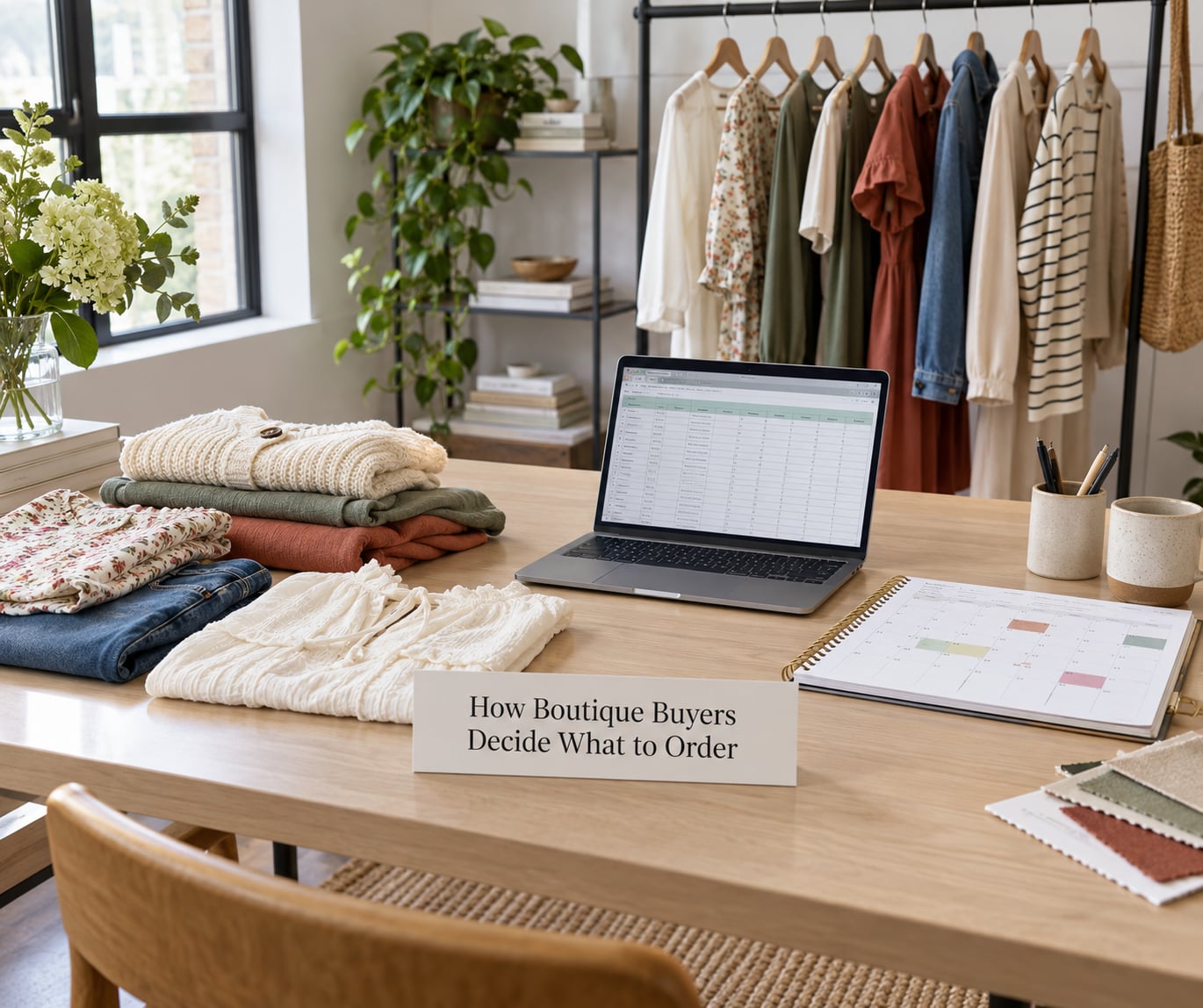
The direct answer: a boutique buyer starts from a fixed budget, not from a wish list. That budget, called the open-to-buy, is the total dollar value of inventory the store can commit this season, and every style competes for a slice of it.
The filter runs in this order:
- Customer fit. Does this style suit the women or men who actually walk through the door of this specific store?
- Sell-through history. Has anything comparable moved here in the last six to twelve months, and at what rate?
- Size curve and size run. Can the buyer get the mix the store’s customers actually wear, or is it a broken curve?
- Gross margin. After markdown and shrink, does the style still pay for the space it takes?
- MOQ and minimum order quantity. Is the cash commitment small enough to survive a slow season?
- Delivery window. Will it arrive before the season it is meant to sell in?
- Seasonality and calendar. Which buy is this: a spring buy landing in January, or a holiday buy landing in August?
- Taste and brand fit. The judgment call, made last, once the numbers have narrowed the field to a handful.
Almost nobody follows a formula for all eight. Experienced buyers carry them in their head and skip the ones that have not changed since last season. The order matters because it is cheapest to get wrong early: a style that fails the customer test costs nothing, but a style that fails the cash test costs the whole store.
| Criterion | What the buyer checks | Kill signal | Where the data comes from |
|---|---|---|---|
| Customer fit | Age, lifestyle, price comfort, what she already owns | The look reads younger or more expensive than the shopper | Fitting-room talk, personal-shopping notes, receipts |
| Sell-through | Percent of pieces sold in 30, 60 and 90 days | Under 25% after two full selling cycles | Point-of-sale reports |
| Size curve | Allocation across sizes versus local demand | Curve cannot be broken or adjusted | Past size sales, vendor size-run chart |
| Margin | Gross margin after markdown and shrink | Under about 50% at full price | Line sheet cost versus retail |
| MOQ | Minimum pieces per style and per colorway | More than the store can absorb in one season | Vendor terms sheet |
| Delivery window | Ship date, in-store date, cancel deadline | Arrives after the selling window opens | Vendor order form |
| Seasonality | Weather, holidays, local events, tourist season | Season has effectively passed at arrival | Calendar plus local knowledge |
| Taste | Runway, fabric hand, whether the store looks like itself | It does not hang well or photograph well | The sample rack and the mirror |
What Does a Boutique Buyer Look at First?

The first pass is commercial, and it happens before the buyer touches a single garment. Most work at a line-sheet review, a showroom appointment or a trunk show, and the buyer already knows the store they are buying for.
Who actually shops here
A buyer with three years of sales history knows things a spreadsheet cannot show. She knows the customer who drives forty minutes for an appointment, knows the one who buys a scarf to go with a dress she already owns, and knows which one returns everything. Those patterns set the price architecture and the category mix long before a vendor shows up.
Where the store sits on the map
Location drives a surprising amount of the buy. A store near office towers peaks on weekday evenings and needs polished, layered separates. A resort town needs breathable fabric in May and heavy knits in October. A tourist street needs something she can carry onto a plane.
What the store already owns
The floor and the stockroom get audited before new money is committed. Gaps get filled, proven performers get replenished, and anything that sat past its window gets marked down or pulled. A buyer who skips this audit ends up with three of the same dress in the same size.
Whether the brand belongs in the shop
Price, aesthetic and exclusivity decide the rest. Vendors commonly expect boutiques to buy at roughly half of retail, and most limit how low that same style can be priced online. A buyer who skips that conversation discovers the conflict from a customer screenshot.
How Do Previous Sales Affect the Next Order?
Past sales set the size of the order, not just the decision to make it. A style that sold 18 of 20 pieces in six weeks in size 6 does not get ordered again because it was nice; it gets ordered because the data says demand was higher than the buy allowed.
Four numbers do most of the work:
- Sell-through rate, the share of what arrived that sold in a given window. Most boutiques plan against a 30-day and a 60-day number, and treat anything under 25% after two cycles as a warning.
- Weeks of supply, which is how long current inventory will last at the current rate. Two weeks means reorder now; ten weeks means the shelf is over-covered and the money is better spent elsewhere.
- Stockout and broken-size count, the sales that never happened because the size was gone. This is the number most often ignored, and it is the one that justifies doubling the top of the curve.
- Return and exchange rate, especially on fitted pieces. A knit that sells well but comes back four times is not a winner.
Then the buyer adjusts for what changed. A style that sold out at 70% sell-through in a warm month looks very different from one that did the same in a cold one. Most buyers pull the report by month rather than by season for exactly this reason.
The reorder rule that holds up most often is simple: repeat the winner, but only after the second cycle, and never deeper than the demand the store actually demonstrated. Owners on small-business forums describe the same habit from the other side, ordering the full shop up front and then reordering whatever visibly moves, while admitting the method works until the first bad season.
How Do Buyers Read Customer Demand?
Numbers tell a buyer what already happened. Customers tell them what will happen, and most of that arrives verbally.
- Fitting-room and front-desk feedback. The staff hear the requests repeatedly: a harder-wearing fabric, a longer inseam, a color that is missing from the wall. Three mentions in a week is a signal; one is noise.
- Specific requests. “Do you have it in a 10” is the most useful sentence in retail. Buyers keep a written list, because memory drops half of it by the next market.
- Social engagement. Saves and shares on the store’s own posts tell a buyer which silhouettes are landing before the orders come in.
- Local calendar. Weddings, a school reopening, a festival, a tourist season, an opening across the street. Calendars are public and free, and they beat a spreadsheet forecast more often than buyers admit.
- Complement and attachment. What sells together. If the wrap dress moves, the sandal and the earring move with it, and the buy should reflect that cluster rather than three separate categories.
Style buyer forums are full of owners saying they wish they had recorded the requests the first season. A simple shared note on the shop phone, updated by whoever is on the floor, costs nothing and becomes the most useful demand document in the store by month two.
How Do Trends and Seasonality Change Buying Decisions?
Seasonality sets the date. Trends set the risk. A buyer handles them as two separate problems.
Seasonality is largely calendar and climate. The in-store date matters more than the order date, so a spring buy has to land in the store six to eight weeks before the weather turns, and a holiday buy lands in August for December. Backorders that push a spring delivery into June usually mean that style sells next year at half its value, and buyers either cancel early or write the order down to a lesson.
Trend interest is harder. A runway look that appears in every magazine is not automatically a demand signal for a small shop in a specific town. What buyers look for instead is repeat evidence: does the silhouette keep showing up across several brands, does it work with what already sells in the store, and does the fabric behave in the store’s climate.
Buying markets and trunk shows compress this into a few days, which is both useful and dangerous. Showrooms are where newness is judged fastest, and they are also where the temptation to overcommit is strongest. Buyers who do well there pre-commit their budget before they travel.
How Do Buyers Balance New Products Against Core Best Sellers?
Most stores land near a split where roughly two thirds of the buy goes to proven categories and one third goes to something new, and then move it by season. In a strong season the newness share grows; in a weak one it shrinks.
Two buying modes make the split work:
| Mode | Used for | Typical depth | Decision point |
|---|---|---|---|
| Test buy | New vendor, new category, unproven silhouette | Three to five pieces per style, held to the store’s normal size curve | Two weeks of sell-through decides the reorder |
| Deep buy | Proven styles from vendors who have earned trust | Enough to cover the season plus the reorder window | Prior sell-through and no recent stockouts |
The test batch number is a floor, not a ceiling. Three to five pieces of a knit in every core size gives a buyer two weeks of honest information. What matters is writing the reorder decision down before the buy, because enthusiasm at the market and honesty at the back table are very different moods.
A common starting heuristic for a new store is to put about half the first buy in the top half of the body, since those pieces get more compliments, style easily and tend to move faster. It is a rough guide, and it breaks down when a store’s customer is clearly bottom-heavy.
What Product Information Helps a Buyer Order Confidently?
Buyers decide fast and they are unforgiving about missing information. A line sheet that answers the questions below turns a maybe into an order; one that leaves them open usually becomes a no.
- Cost and suggested retail per style, per colorway. Without both numbers there is no margin calculation at all.
- A real size curve with breakable sizes. The buyer needs to know which sizes can move and which are locked.
- Minimum order quantity per style and per colorway, plus the MOQ for new styles versus carried-over styles. Vendors routinely quote a lower floor on carryovers.
- Delivery window in dates, not weeks, with the in-store date and the cancel deadline.
- Fabric content, weight and hand, plus care instructions. This drives returns more often than price does.
- Fit notes and a model’s measurements, including how the garment fits on a real body rather than a size zero.
- Imagery on a body and on a hanger, in natural light, because that is how the store will photograph it too.
- Styling notes and product affinity, which tell the buyer what to put next to it on the floor.
- Payment terms, shipping responsibility and return terms, including how online pricing conflicts are handled.
How Can a Fashion Brand Make Its Products Easier to Buy?
A brand cannot control what a store orders, but it can make a yes cheaper to say. Four things move the needle more than the rest.
State the position in one line. If a buyer cannot finish “this is for the woman who…” in a sentence, the assortment will be judged on fit alone, and fit is where most buys go wrong.
Send the complete file before the market. Line sheet, size curve, MOQ, delivery dates, payment terms and imagery, all in one message, sent early enough that the buyer can think about it before the sample arrives.
Build a coherent mini-assortment rather than a long list. Six styles that clearly work with each other are easier to place than twenty that compete.
Make the first order small and reversible. A 3-to-5 piece minimum with a reorder window gives the buyer a way to say yes without risking the season.
Answer fast after the order. Most buyers lose confidence over logistics silence, not over a delivery slipping by a week.
Frequently Asked Questions
How do boutiques get their inventory?
Most boutiques buy wholesale from independent brands and manufacturers, either through a vendor representative who calls on the store, at a buying market or trunk show where many brands show a full seasonal line at once, or through online wholesale platforms that work like a showroom. A few run on consignment or buy from local makers directly. The common thread is a line sheet and a minimum order quantity that must be met before anything ships.
How do retailers know how much product to order in the first place?
They start from a fixed open-to-buy budget and test each style against a fixed set of filters: customer fit, sell-through history from comparable styles, size curve, gross margin after markdown, minimum order quantity, delivery window and seasonality. Styles that clear every filter get depth. Styles with no track record get a small test buy, usually three to five pieces, with a reorder decision set before the order is placed.
How do buyers decide which styles are worth reordering?
They watch sell-through over two full cycles and check whether the style ran out of its best sizes before it ran out of time. A style that sold out early, at a healthy rate, with no heavy returns is a reorder. A style that sold slowly, or sold well only in one size or one month, is not. Buyers also check that the delivery will land before the same season next year.
What is a good MOQ for a small boutique?
For an independent store, a workable minimum is two to four pieces per style per colorway, so the buy can be split across sizes instead of forced into one size. Most new brands set higher minimums but will often lower the floor for a carryover style or a first order. Ask early, ask in writing, and test the vendor by ordering the smallest allowed amount first.
How do you buy inventory for a boutique without sales history?
Buy small and buy adjacent to your category, not experimental. Keep the first buy concentrated on pieces similar to what already sells for you elsewhere, split it roughly half into tops and bottoms with a bias to the top half of the body, and set a reorder date before you order. The first season exists to tell you who your best sellers are, and that answer often changes within twelve weeks.
What does boutique mean in the context of a business?
In retail, a boutique is a small store, usually under about three thousand square feet, that carries a narrow, curated assortment rather than a broad department-store range. It competes on taste, service and fit rather than price and volume. That is why the person buying for it is often the owner, and why the buying decision weighs brand fit so heavily alongside margin.
Conclusion
How boutique buyers decide what to order comes down to a sequence: customer fit, then sell-through history, then size curve, margin, vendor terms and the calendar, with taste making the final call. Brands rarely lose on the product itself; they lose on missing information, tight minimums and a delivery date that lands too late.
Start with one thing. Pull the last twelve months of sales, sort by style and size, and find the three gaps and the three proven performers hiding in that report. That is the same work a buyer does before opening a line sheet.