
If you publish one substantial article a week and still feel like you never have enough to post, the problem usually isn’t effort. It’s that the article goes out once, gets buried by day three, and then you start from scratch on the next idea with nothing to reuse.
Knowing how to repurpose one article into many posts comes down to breaking that article into its smallest useful ideas, then rebuilding each one as a separate asset built for a specific platform. A 1,500 to 2,500 word article typically produces 10 to 15 pieces: one long LinkedIn or newsletter post, one carousel, three to five short social posts, one or two short videos, an email, a quote graphic, and several question-answer pieces. The whole system takes one working session, about three hours for most creators.
What follows is the workflow I watch working for solo creators and small personal brands: what to gather first, six steps in order, the mistakes that flatten a voice, and how to tell whether any of it landed.
Table of Contents
- What You Need
- The source article
- The audience and the outcome
- A channel list you can keep up
- A small tool stack
- Step-by-Step: How to Repurpose One Article Into Many Posts
- Choose One Core Idea
- Build a Content Atom List
- Match Each Idea to the Right Format
- Change the Angle Instead of Copying the Words
- Create a Publishing Sequence
- Measure What Earns Attention
- Common Mistakes
- Frequently Asked Questions
- Is repurposing my own article considered copyright infringement?
- How many posts can I realistically make from one article?
- How long should I wait between repurposed posts?
- What is the difference between repurposing, reposting and cross-posting?
- How do I post the same idea to several platforms without it sounding repetitive?
- Is there a posting ratio I should follow instead of reposting one article many times?
What You Need
You need four things before you cut anything: a source article worth reusing, a clear idea of who you’re speaking to, one outcome, and a short list of channels you actually post on.
The source article
Any article over about 800 words that you still stand behind works. Length matters less than structure. Look for pieces with a numbered process, a myth they correct, a personal story, or a FAQ section at the bottom.
Read through it once and mark anything you said twice or explained unusually well. Those are your atoms, and they’re usually hiding in plain sight.
The audience and the outcome
Write down who reads your work in one sentence, then pick the single thing you want from this content cycle. Reach, newsletter subscribers, inbound inquiries, and client conversations are four different goals.
The outcome decides what you keep. If you want subscribers, you cut the pieces that make people curious enough to sign up. If you want inquiries, you cut the pieces that show how you think.
A channel list you can keep up
Most creators who burn out are trying to feed nine platforms. Pick two where your audience already spends time, plus one list you own, usually an email newsletter. That’s it for the first cycle.
A small tool stack
Free options cover most of this. A scheduling tool handles the calendar, Canva handles quote and stat graphics, and a phone on a tripod handles short video. Transcription services that turn a voice memo into a rough draft save an hour per video piece.
Paid tools earn their keep only when volume gets high, and most creators hit their ceiling on effort long before they hit a tool limit. Add tools later, once the workflow is boring and repeatable.
Step-by-Step: How to Repurpose One Article Into Many Posts
Break the article into atoms, match each atom to a format, change the angle, then schedule the release over two weeks. The order matters, because skipping straight to publishing is what produces twelve posts that all say the same thing.
Choose One Core Idea
The single audience problem your article solves is the promise everything else hangs on. Write it in one line before you extract a single atom, because that line becomes your hook for each post.
Not every article deserves this. Strong candidates are evergreen pieces, posts that already earn steady search traffic, articles where readers leave comments asking follow-up questions, and anything that answered a repeated question from clients.
Skip anything time-sensitive, anything you no longer believe, and anything that only made sense inside a season you have moved past. Reusing stale thinking is worse than publishing nothing.
Build a Content Atom List
Content atomization means pulling the small self-contained pieces out of the article so each can stand without the original. Most people stop at summarizing paragraphs, and summaries read like summaries. Atoms do not.
Open a blank document and go through the article once, dropping each useful fragment into its own line. From a typical article you’ll pull statistics, mistakes you warned against, tips, definitions, examples, opinions, step-by-step instructions, FAQ answers, and one or two lines worth quoting on their own.
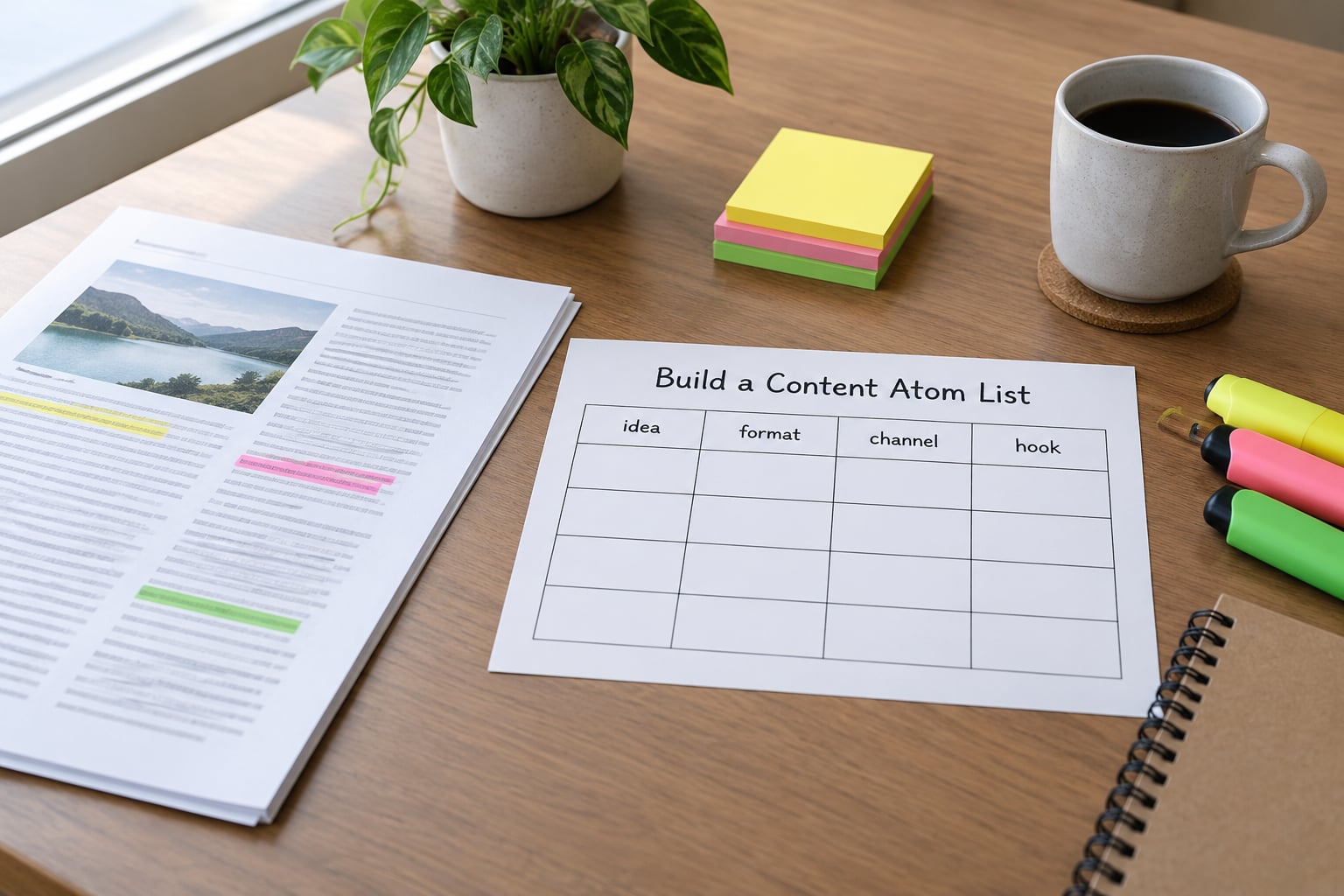
A 2,000 word article usually yields 18 to 25 atoms. Some are strong, most are fine, and a few are duds. Keep them all in the list and let the matching step do the filtering.
Add three columns next to each atom: which format it suits, which channel it belongs on, and the hook you’ll open with. That grid is the whole system, and it’s the part most people skip.
Match Each Idea to the Right Format
Match by what the reader needs at the moment they meet the idea. A statistic works as a graphic or a single-line post. A process works as a carousel, a short video, or a checklist. An opinion works as a talking-head clip or a contrarian post.
Here is what one solid article typically yields once the atoms are matched:
- Long-form LinkedIn or newsletter post built from the argument’s spine, roughly 600 to 900 words, one idea, no link in the body.
- Carousel from the numbered steps, one slide per step, the last slide holding the takeaway.
- Three to five short social posts, each carrying one mistake, one tip, or one statistic with a line of context.
- One or two short videos from the steps people most often get wrong, filmed talking, not read.
- One email to your list that frames the article as a resource rather than a sales pitch.
- One quote graphic built from the line you rewrote three times before it landed.
- Three question-answer posts answering the comments and questions that article keeps producing.
That is a realistic two weeks of content from a single source, and it leaves room for your original ideas in between.
Change the Angle Instead of Copying the Words
Derivative posts fail when the words stay the same and the angle doesn’t move. Rewriting a paragraph into a shorter paragraph still reads as a blog excerpt, and readers notice immediately.
Work through these angles instead. Take the article and cut a beginner’s version, where you remove every step that assumes experience. Take the contrarian version and argue against the piece’s own common advice. Take the story version and lead with the moment something went wrong. Take the checklist version and turn advice into something tickable. Take the mistake-correction version and open with what readers get wrong most often. Take the behind-the-scenes version and show the process you skipped in the polished version. Take the question version and answer one objection per post.
On LinkedIn, write like a person talking to a colleague and put the payoff in the first two lines before the see-more cut. On Instagram, the caption supports the graphic and doesn’t repeat it. On TikTok and Reels, speak at a normal pace and write your hook on the first screen in large type. On X, a thread earns reads only if post one is worth reading on its own.
Create a Publishing Sequence
A publishing sequence spaces one topic across two to three weeks so it stays visible without feeling repetitive. If everything ships the same week, you burn the whole subject at once.
Day one goes to the article itself. Days two and three hold the two strongest short posts. Day five is the carousel or the video. Day seven is the email to your list, and by then you have a second angle to reference. Days nine through fourteen release the question-answer posts, spaced so each one stands alone.
Batch the work instead of the posting. One ninety-minute session produces the full list of drafts, and scheduling handles the rest. This is the single biggest change most solo creators make, because it removes the daily decision of what to post.
Measure What Earns Attention
Track signals that match each channel’s job, not vanity totals. On social, saves and replies tell you more than impressions, since both show someone did something with the idea. On short video, watch time and completion rate matter more than views.
For your list, track new subscribers and email forwards rather than opens. For your site, watch search impressions on the source article after the derivative posts go out, since social links and comment activity often nudge articles that already rank well.
Low traffic makes this harder, and guessing is the usual result. Keep a simple log of format, channel, date, and outcome, and after three cycles you’ll see patterns even with small numbers. One thread beating three carousel posts is a real signal, not a fluke.
Common Mistakes
Most repurposing failures come from skipping adaptation and rushing to volume. Here are the eight I see most, with the fix for each.
Pasting the same text everywhere. Change the hook, the format, and the reader task for every platform. If a LinkedIn post would still make sense on Facebook, it isn’t adapted.
Summarizing instead of atomizing. A shorter version of a paragraph is still a paragraph. Extract the single claim inside it and build outward from that.
Dropping the context. A tip without the reason behind it reads as generic advice. Keep one sentence of the why, then cut everything else.
Publishing the whole batch at once. Space it over two to three weeks. Same topic, new angle each time, no audience fatigue.
Repurposing articles that underperformed. A weak source usually produces weak derivatives. Check which of your posts already earn replies or search traffic and start there.
Hiding the link. Reach and clicks pull against each other, so give the value away first and put the link where it earns the click rather than forcing it.
Letting AI write in a voice that isn’t yours. Use it for the first draft, then rewrite the opening and the transitions by hand. The voice lives in the sentences you keep.
Copying your own blog into community spaces. Drop the link and answer the question in your own words. Read each community’s self-promotion rules before you post, since most of them treat pasted blog text as spam.
Frequently Asked Questions
Is repurposing my own article considered copyright infringement?
No. You own the rights to work you created, so reshaping it into posts, emails, and videos is your call. Copyright applies when you reuse someone else’s text, images, or footage without permission or a licence. If a piece quotes a source or includes a chart you did not make, check that the source allows reposting or credit it clearly and link back.
How many posts can I realistically make from one article?
A well-structured article of 1,500 to 2,500 words usually yields 10 to 15 usable pieces: one long LinkedIn or newsletter post, one carousel, three to five short posts, one or two short videos, one email, one quote graphic, and a few question-answer posts. Shorter pieces of 800 words give you closer to six. Quality drops fast after that, so stop when the atoms run out.
How long should I wait between repurposed posts?
Two to three days between social posts on the same topic usually works, and two weeks for the full set. If your audience is small and niche, stretch that further. The goal is that each post arrives when the previous one has faded, not that they form an obvious sequence nobody asked for.
What is the difference between repurposing, reposting and cross-posting?
Repurposing means reshaping one idea into a new format, such as turning a blog post into a short video. Reposting means putting the identical asset back up on the same channel, which usually reads as spam. Cross-posting means sending the exact same asset to several different platforms without edits. Only the first one adds reach for the work involved.
How do I post the same idea to several platforms without it sounding repetitive?
Keep the idea and change the execution. Different hook, different format, different length, and a different reader task per platform. Write the LinkedIn version as argument, the Instagram version as graphic with a short caption, and the TikTok version as something you say out loud. Same thought, three different pieces.
Is there a posting ratio I should follow instead of reposting one article many times?
A ratio like five posts to three shared media items to two promotional posts is often used as a rough balance for original posting cadence, and it works well for what you create yourself. Repurposed assets sit in the promotional column because they point back to something you made. Use it as a sanity check rather than a rule, since a personal brand usually benefits from more original posts than that ratio allows.
Start with the article you wrote most recently that still makes you proud. Pull twenty atoms out of it, pick the eight strongest, and schedule them across the next two weeks. One article, one focused session, and two weeks of posts that don’t repeat themselves.