How to do a closet cleanout in one weekend comes down to three things: a fixed schedule, four possible destinations for every item, and a stop time. Plan about six focused hours across Saturday plus two on Sunday and a genuinely full closet is done by Sunday evening, not the following month.
The method below works because you never make a big decision. You make a fast one, hundreds of times, and each item lands in keep, sell, donate, repair, or discard. Weekend decluttering projects fail when the closet goes empty in one heroic Saturday and the deciding runs out of steam. This one works in short blocks you can stop anywhere.
Table of Contents
- What You Need
- Step-by-Step: How to Do a Closet Cleanout in One Weekend
- Friday: Set the Rules and Clear the Surface
- Saturday: Sort, Try On, and Make Decisions
- Saturday Afternoon: Build a Small Working Capsule
- Sunday: Clean, Organize, and Finish the Edges
- How to Know the Cleanout Worked
- Common Mistakes
- Frequently Asked Questions
- How long should a one-weekend closet cleanout take?
- What should I do with sentimental clothes during a closet cleanout?
- Should I repair clothes while cleaning out my closet?
- How do I organize a walk-in closet without feeling overwhelmed?
- How often should I do a closet cleanout?
- Where do donated clothes actually go?
- Start With the Item You Will Not Wear Next
What You Need
Gather these before you start, because walking out mid-session to find a trash bag is how cleanouts stall on Friday night.
- Four containers: one for donations, one for resale listings, one for items needing repair or alteration, and one trash bag. Label them with masking tape and a marker right away.
- Sturdy bags or boxes: donation bags should hold weight without splitting when you lift twelve tees at the top. Cardboard boxes work if you plan to carry items to a resale drop-off.
- A measuring tape: only if you are reorganizing by fit. A thirty-second check on your best jeans tells you more than an hour of trying things on.
- Cleaning supplies: a damp cloth for the shelf, a lint roller for the rail, and a vacuum for the floor you are about to cover in clothing.
- A timer you can hear across the room. Phone alarms work. The sound matters, because it tells you a block is over even when you are mid-decision and enjoying it.
- All-empty velvet or slim hangers in one color, plus a few spare boxes for folded knits and jeans.
- A destination, chosen in advance. Pick the donation center, the textile recycling drop-off, or the resale platform before the first item lands in the bag. An undecided bag becomes a doom pile, which is just the closet spilling onto your floor and staying there.
If your closet is a shared one, recruit the other person before you start rather than during. Body doubling, cleaning alongside someone else, is the most common request in decluttering forums and it works because nobody likes quitting out loud.
Step-by-Step: How to Do a Closet Cleanout in One Weekend
The schedule below spreads the work across three days on purpose. Friday is fifteen minutes of rules, Saturday is the bulk of the sorting, and Sunday is cleaning and putting things back. Stop Saturday even if you are on a roll; momentum built on a Friday decision is usually regret by Sunday.
| When | Block | Task | Categories |
|---|---|---|---|
| Friday evening | 20 min | Label containers, set the rules, pick donation and resale destinations | None, this is setup |
| Friday evening | 30 min | Empty one zone completely and assign every item a temporary destination | Whatever is closest to the door |
| Saturday morning | 90 min | Sort, no deliberation beyond three questions per item | Tops, then bottoms |
| Saturday morning | 60 min | Try on and check fit, photograph resale items as you go | Fitted pieces, outerwear |
| Saturday lunch | Break | Leave the room. Genuinely leave it | None |
| Saturday afternoon | 90 min | Build the working capsule, then the donation and resale bags | Everything remaining |
| Saturday evening | 45 min | List or bag the resale items, put a date on the donation drop-off | Resale bag only |
| Sunday morning | 45 min | Clean the closet: shelves, rail, floor | None |
| Sunday morning | 90 min | Put the capsule back by use, reach for high-wear pieces | Everything you kept |
| Sunday afternoon | 30 min | Handle accessories, shoes, and the review pile | Accessories |
Friday: Set the Rules and Clear the Surface
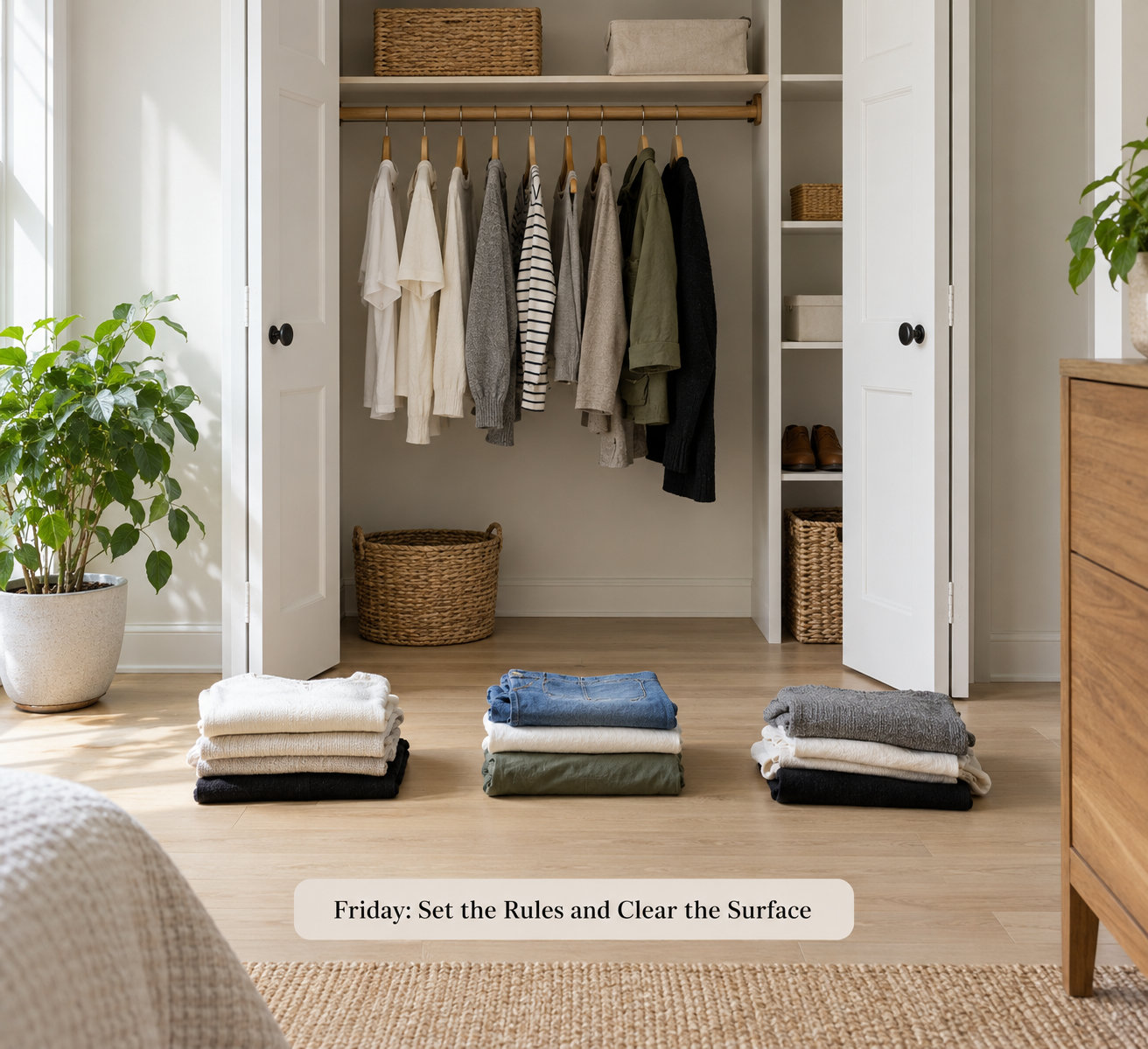
Estimating is the first task, and the estimate is easy: count the hangers and multiply by the average wear time per item. Two minutes per garment is a fair number for sorting, trying on, and deciding. That number tells you how many Saturday blocks to block out, and it tells you whether a walk-in closet needs two weekends instead of one.
Next, write the four decisions on the back of a piece of paper in your own handwriting: keep, sell, donate, repair, discard. Five, actually, but repair is the one people forget, and it turns a pilled hem into a decision you do not have to make today.
Then empty one zone and nothing else. Not the whole closet, just the section nearest the door. Assign every visible item a temporary destination before you move on: a bag, a corner of the floor, the bed. Friday is not for deciding. Friday is for clearing the surface so Saturday starts with decisions instead of logistics.
Saturday: Sort, Try On, and Make Decisions
Work one category at a time in a fixed order: tops, bottoms, dresses, outerwear, shoes, accessories. Fixed order kills the wandering that turns a two-hour block into four.
Each item gets three questions, asked in this order:
- Does it fit right now? Try it on. Not a mental check, an actual try-on with the shoes you would wear with it. If the waist pinches when you sit down, it goes. Body changes make clothes emotionally unfit long before they are physically unusable.
- Have you worn it in the past twelve months? Not thought about, worn. If you cannot place a specific occasion on it, it is not a casual item anymore.
- Will you wear it in the next three months? The forward-looking test. Seasonal clothes fail this honestly, then go to storage instead of the donation bag.
| Your answer | Where it goes | Why |
|---|---|---|
| Fits, worn, wearing again | Keep | The only three-part pass. Everything else is a variation on a no |
| Fits, brand still desirable, condition good | Sell | Worth the listing time only if the piece moves quickly |
| Fits, low resale value, wearable | Donate | Once the resale number is too small to cover packing and listing, donation pays you in time |
| Fails fit or condition, fixable cheaply | Repair | A loose hem or a missing button is a ten-minute job, not a purge candidate |
| Fails fit, damaged beyond use, worn out | Discard or textile recycle | Do not send worn-out clothing to donation expecting it to be used |
The selling decision is where weekends die, so set a threshold and stop thinking. If the resale value is small enough that the listing, the packaging, and the shipping cost more of your Sunday than the item is worth to you, donate it instead. Plenty of people use a round number here and never look back.
Photograph resale items as they pass through your hands, not later. Twenty seconds of listing photos on the spot beats a Saturday spent hunting for a good shot of a top you already bagged.
Saturday Afternoon: Build a Small Working Capsule
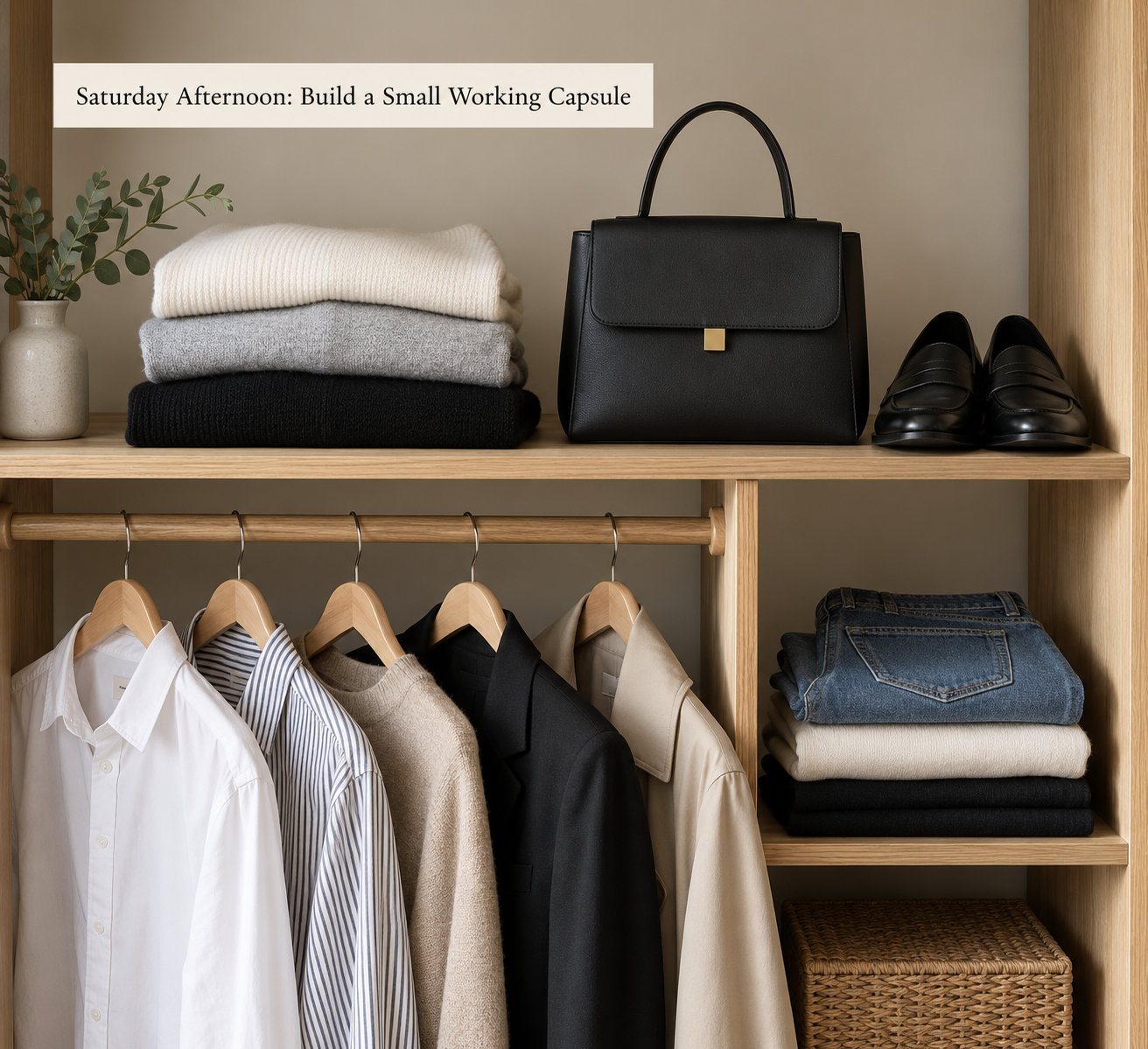
Everything that passed the three questions now becomes a working wardrobe: the pieces you can actually assemble an outfit from on a Tuesday. Pull out the everyday tops you have worn repeatedly, two or three bottoms per week of wear, your layers, the shoes that are actually resolable, and the accessories that finish an outfit in under a minute.
That is your capsule, and it should be small enough to see across the rail in one glance. The temptation to put everything back is the whole reason a cleanout reverses in six months. If a piece is not in the capsule, it does not go back on the rail; it goes to a bin under the bed for seasonal storage or straight into the donation bag.
Close the donation and resale bags before you leave the room. An open bag at the end of a sorting session is the single most reliable way to end up with a pile on the floor that says it is still being decided on.
Sunday: Clean, Organize, and Finish the Edges
Start with the closet itself, because putting clean clothes onto a dusty shelf feels like wasted effort. Wipe the shelves, run the lint roller along the rail, vacuum the floor, and check the back corners for the lone sock and the dry cleaning receipt from a life you are not currently living.
Then load the capsule back in by use, not by color alone. Group the things you reach for every morning at eye level and in one spot. Group the things you wear weekly just below. Weekend organization that puts the rarely worn pieces at eye height and the workhorses in the back means you will rebuild the old pile within weeks.
Shoes go low and in pairs you can see. Accessories go in one shallow bin near the door so jewelry and belts do not dissolve into the bottom of the closet. Knits fold, they do not hang, and the folded ones sit on a shelf where you can count them at a glance.
Finish the review pile now, with a hard stop. Anything you have not resolved by the end of Sunday goes into the donation bag without another conversation. You are allowed to change your mind later, but you are not allowed to reopen the project this weekend.
How to Know the Cleanout Worked
You will know because of these five things, not because the closet looks empty.
- The total item count dropped, and you could tell that number from a photo of the before.
- You can see your whole working wardrobe in a single glance, with the door open.
- The donation and resale bags are closed, dated, and on their way.
- Your daily pieces are all reachable without moving anything else.
- You have a ten-minute weekly maintenance habit, written down.
Take one photo of the empty rail before you reload it. Future you will be the one standing in a store with an item that has no home, and a photo ends that argument faster than a rule does.
Common Mistakes
- Emptying the entire closet at once. You will run out of decision energy before you reach the back row. Fix: one zone per block, finished zone stays finished.
- Sorting by size before checking fit. Sizing labels stop meaning anything after a few body changes. Fix: try on first, then sort.
- Declaring a bag final, then reopening it. That is how a cleanout becomes a six-month project. Fix: close the bag, date it, and do not open it during the weekend.
- Letting sentiment override every rule. One item at a time, with a real limit. More on that below.
- Reorganizing without reducing. If the same number of garments comes out as went in, nothing changed. Fix: the bag count is the scoreboard.
- Setting the resale threshold at nothing. Listing everything means listing nothing. Fix: pick a number before you start and hold it.
For maintenance, the ten-minute rule is enough. Every Sunday, put anything on the floor back where it belongs and pull out one piece you have not worn in a year. That single weekly removal keeps the closet from creeping back, and it costs a fraction of what a weekend cleanout does.
Frequently Asked Questions
How long should a one-weekend closet cleanout take?
Roughly eight hours total across two days: about six focused hours on Saturday for sorting and decisions, and two on Sunday for cleaning and putting things back. Add fifteen minutes on Friday for setup. A very full walk-in closet needs two weekends, and that is fine. Trying to force a huge closet into one weekend is the most common reason people quit halfway and restart next month.
What should I do with sentimental clothes during a closet cleanout?
Limit sentimental items to one small box and skip them during the sorting. Wedding dresses, heirloom coats, and gifted pieces usually cost more closet space than wearing value, so store them out of the daily rotation. Gifts are the hardest category because the feeling belongs to the giver, not the garment. Keep the gift if you would wear it today, photograph it if you only want the memory, and let it go if keeping it costs you peace every time you open the door.
Should I repair clothes while cleaning out my closet?
Sort repair candidates into their own container during the weekend rather than repairing on the spot. Mending interrupts momentum, and a loose hem on a shirt you love should not cost you the whole Saturday. Deal with the repair bag afterwards: anything fixable in under fifteen minutes gets fixed immediately, anything expensive gets a deadline, and anything you have not touched in a month goes to donation. Fixing it is only worth it if you would then actually wear it.
How do I organize a walk-in closet without feeling overwhelmed?
Divide it into zones and give each zone its own Saturday block, such as one block for the hanging clothes on the left wall and one for shelving. A walk-in feels bigger because you can see all of it at once, so the fix is narrower vision rather than more effort. Cleaning alongside someone helps because the work becomes shared rather than solitary. Photograph each zone as you finish it so progress is visible instead of buried under the volume of what remains.
How often should I do a closet cleanout?
A full cleanout twice a year, aligned with the seasonal change, plus a ten-minute weekly reset. The weekly habit is what actually matters, because it removes single items before they migrate to the floor and become a pile you dread. The twice-yearly cleanout handles the slower drift: pieces that no longer fit, categories that quietly doubled, and storage bins that have not been opened since last year.
Where do donated clothes actually go?
Sorting happens first: clothing in good condition is usually resold or exported for reuse, while worn-out, damaged, or unsellable textiles are often shredded into rag material or insulation rather than reused. Many donation centers will not even accept items they cannot sell, so check their guidelines before the drop-off trip. For the worst-condition pieces, textile recycling programs and brand take-back schemes usually accept items donation centers refuse, and that is the more honest destination.
Start With the Item You Will Not Wear Next
Do not wait for a free weekend to appear. Open the closest door tonight, pick the section you have been walking past for months, and set a thirty-minute timer.
When it goes off, close whatever bags you filled, even the partial ones. One finished zone is proof that the method works, and that is enough to book Saturday for the rest.