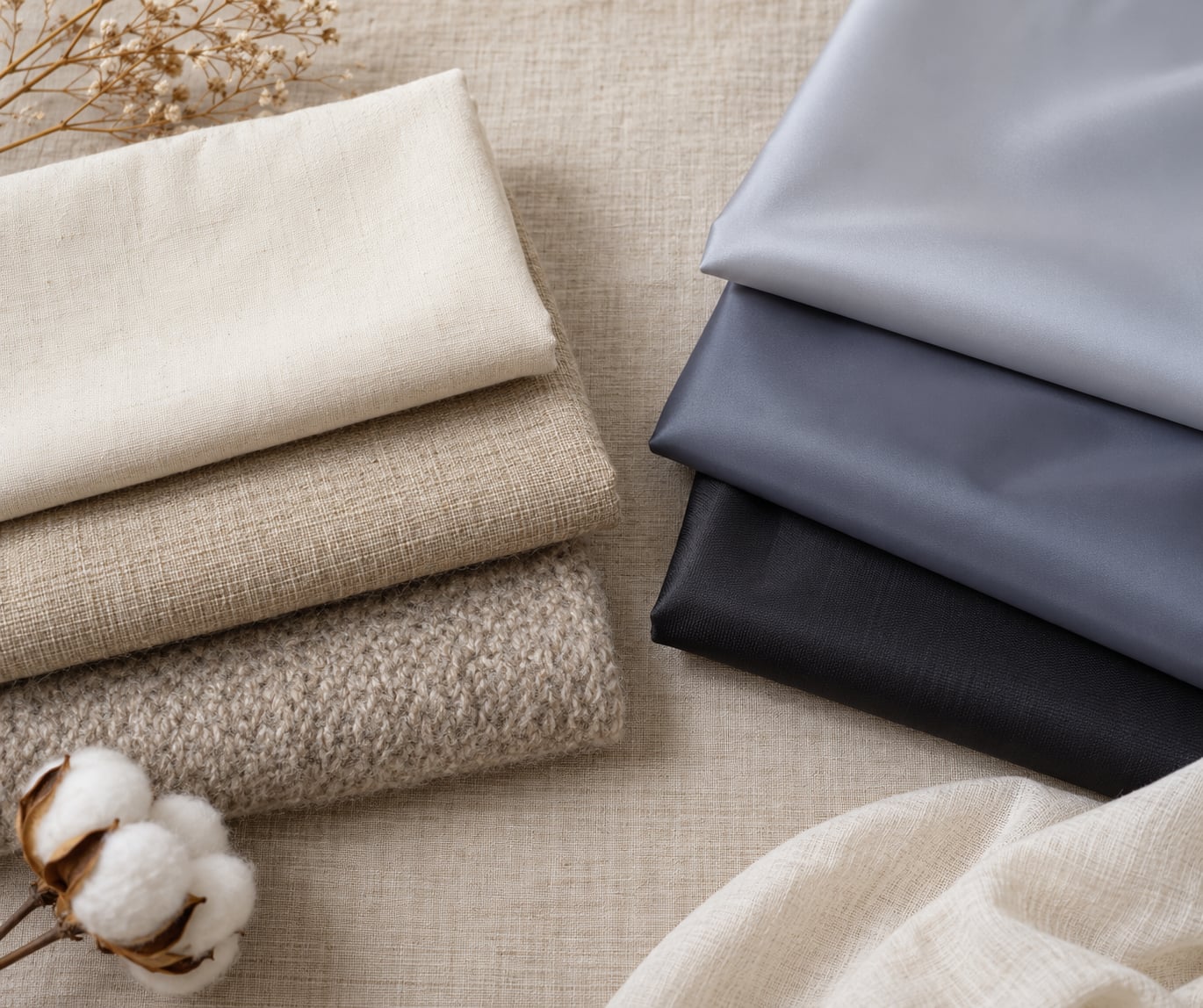
Natural fabrics come from plants, animals or minerals, while synthetic fabrics are man-made from petroleum-based polymers like polyester, nylon and acrylic. Natural fibers breathe and feel soft against skin. Synthetic fibers dry fast, hold their shape and cost less to buy. Neither wins outright, and the better choice depends almost entirely on what you are buying the garment for.
The frustrating part is how confidently both camps talk. People say 100 percent natural is a quality marker, and other people say polyester gets a bad reputation it does not deserve. Both are partly right, which is why natural vs synthetic fabrics pros and cons arguments tend to end in shrugs.
Here is what actually separates the two families, fiber by fiber and use case by use case, so you can stand in front of a rack and know which label serves you.
Table of Contents
- Natural vs Synthetic Fabrics at a Glance
- How Do Natural and Synthetic Fabrics Feel?
- Moisture absorption versus moisture wicking
- Drape, static and odour
- Which Type Is More Durable and Easier to Care For?
- What actually causes pilling
- Care differences that decide whether a garment survives
- Natural vs Synthetic Fabrics: Cost and Environmental Impact
- Where regenerated cellulose sits
- Which Fabric Is Best for Everyday Wear?
- Which Should You Choose?
- Frequently Asked Questions
- Are natural fabrics always better than synthetic fabrics?
- What is the most breathable natural fabric?
- Which synthetic fabric is best for hot weather?
- Do natural or synthetic fabrics last longer?
- Is a fabric blend better than a single fiber?
- How can I tell whether a garment is natural or synthetic?
Natural vs Synthetic Fabrics at a Glance
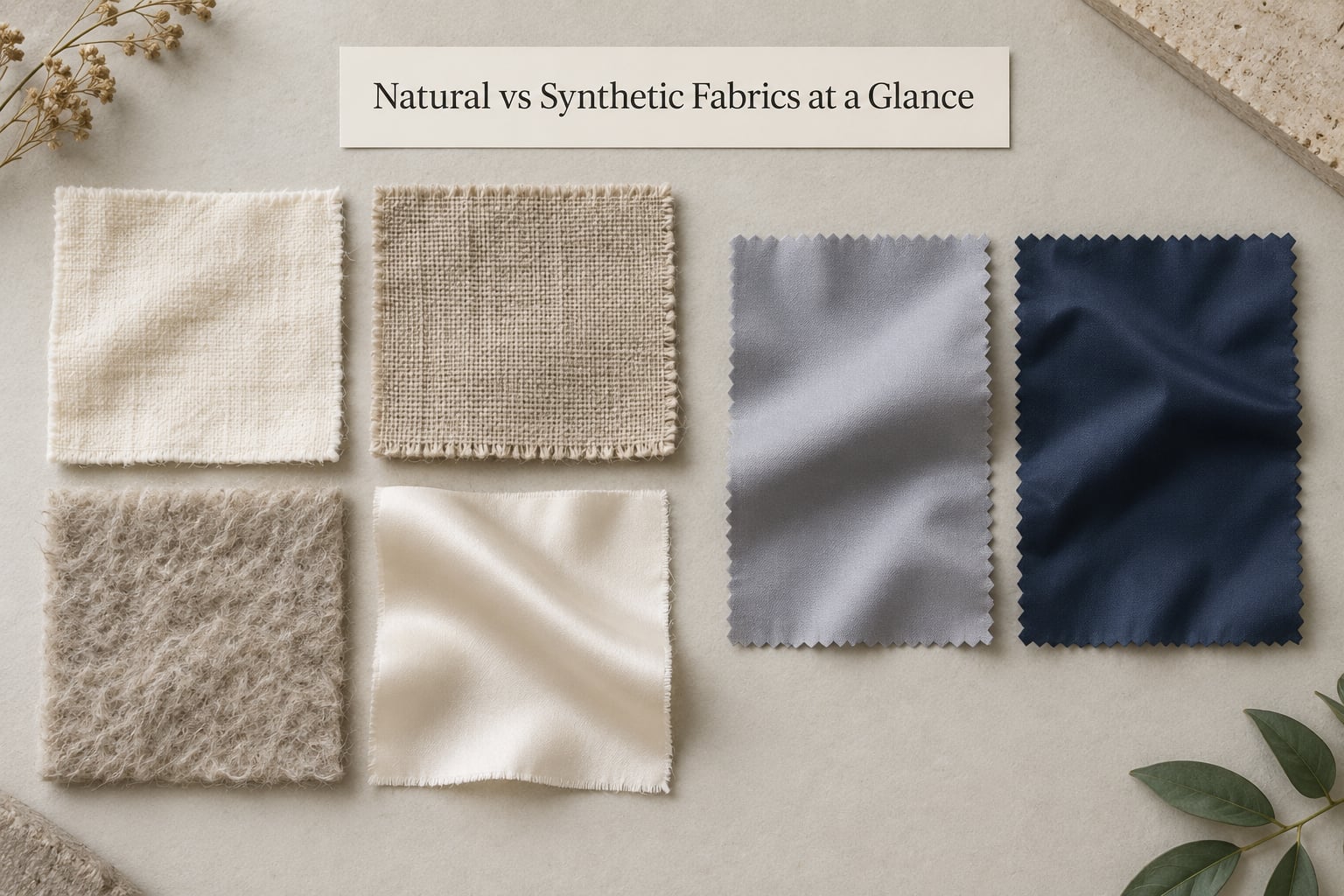
| Feature | Natural Fabrics | Synthetic Fabrics |
|---|---|---|
| Source | Cotton, flax, hemp, wool, silk, alpaca | Polyester, nylon, acrylic, elastane, polyamide |
| How it is made | Fiber is grown or sheared, then cleaned and spun | Petroleum is polymerized into continuous filament |
| Feel | Softens with washing, varies by fiber | Consistent and smooth, sometimes slick |
| Breathability | High, air passes through the yarn | Low to moderate, air passes around the yarn |
| Moisture | Absorbs into the fiber and evaporates slowly | Sheds water to the surface and dries fast |
| Insulation | Good when damp, wool leads the category | Low unless lofted or brushed |
| Drape | Flows, can be fluid or crisp depending on weave | Holds shape, can cling or feel stiff |
| Durability | Good with abrasion, weak to pilling if short fiber | Excellent abrasion resistance, weak to pilling and heat |
| Stretch and recovery | Little stretch, snaps back well | Built-in stretch, returns to shape |
| Shrinkage | Cotton, linen and rayon shrink if untreated | Minimal shrinkage |
| Wrinkling | Wrinkles readily, silk most of all | Resists wrinkles, holds a pressed look |
| Care | Often cold wash and hang dry, some need ironing | Machine washable, quick dry, low ironing |
| Static cling | Rare, except in very dry air | Common, especially acrylic and nylon |
| Cost | Wide range, premium fibers get expensive | Generally the cheapest per garment |
| Best for | Everyday wear, bedding, hot weather, sensitive skin | Activewear, travel, outerwear, low-maintenance wardrobes |
How Do Natural and Synthetic Fabrics Feel?
Comfort comes down to one physical difference. Natural fibers are irregular and slightly hollow, so they pull moisture inward and let air move through the yarn. That is why a linen shirt in July feels different from a polyester shirt in July, even when both are loose and light colored.
Synthetic fibers are smooth and uniform. Their structure pushes water to the surface instead of drinking it, which is exactly what makes a gym shirt work. It also means sweat sits on your skin rather than evaporating through the cloth, and heat has nowhere to go.
Moisture absorption versus moisture wicking
Absorption and wicking are opposites, and shoppers mix them up constantly. Cotton absorbs roughly its own weight in water and holds it, so a soaked cotton tee stays heavy against the skin. Polyester moves that moisture outward across the fabric surface where air can reach it, so it dries in a fraction of the time.
For hot, humid weather and long days in the sun, absorption wins. For a bike ride or a sweaty commute, wicking wins. Wet wool is the outlier: it keeps you warm while damp, which is why it still turns up in base layers and hiking socks.
Drape, static and odour
Drape is where preference splits fastest. Linen and Tencel fall away from the body. Polyester holds a silhouette, which is useful in a blazer and less useful in a loose dress. Static cling runs the other way: synthetics generate it, particularly acrylic and nylon in dry air, and it makes a skirt stick to your legs.
Odour is the most misreported item on the whole list. Polyester holds smell because it does not absorb sweat and does not let the skin breathe, so bacteria sit closer to the fabric. Wool resists odour for the opposite reason, absorbing moisture away from skin. But a cheap acrylic jumper smells after one wear just as badly as a cheap polyester shirt, and heavy wool worn against the skin for a week needs airing. Fiber grade and wash frequency decide more than the fiber family does.
Which Type Is More Durable and Easier to Care For?
Synthetics win on abrasion and shape retention. Polyester and nylon are the standard choice for climbing pants, swimwear and luggage fabric because they take scuffing and repeated washing without thinning. They also spring back from stretching, so a fitted top keeps its line after a year of wear.
Natural fibers win for a different reason: they are mendable. A hole in a cotton or linen garment can be patched invisibly and then worn for years more. A run in a fine-gauge polyester knit usually ends the garment’s life, because the yarn is smooth and slippery and the fibres separate rather than raveling into a repairable stitch.
What actually causes pilling
Pilling is the surface fuzz that turns a shirt into disappointment, and it is the failure people most often blame on fiber type. Short fibers work loose at the surface and tangle under friction. Cotton in a poly-cotton blend pills quickly because the cotton fibers separate from the smooth polyester and float free. Acrylic is the worst offender in practice. Long-staple cotton, linen and wool pill far less.
Weave and knit matter as much as the fiber. An apparel designer in a long-running Reddit thread on this exact debate put it plainly: there is no hard and fast rule about what will pill, and the type of knit and how the fibers were spun decide it. Denim, being a dense twill of long-staple cotton, is widely considered the sturdiest low-maintenance fabric you can wear.
Care differences that decide whether a garment survives
- Washing: Synthetics tolerate warm machine cycles and mild detergent. Cottons and linens do better cold, and wool usually wants hand washing or a wool cycle on a delicate setting.
- Drying: Hang-drying is the single biggest garment-life extender most people skip. It costs nothing and prevents both shrinkage and fibre weakening.
- Ironing: Synthetics rarely need more than a low setting. Cotton and linen need medium heat and a press. Silk and wool need steam or a press cloth.
- Shrinkage: Untreated cotton shrinks most, and viscose and rayon are notorious for coming out of the wash smaller than they went in. Pre-washed linen skips the shrink entirely.
- Storage: Synthetics can go in a plastic bin. Wool and silk need a breathable bag, not plastic, to avoid trapped moisture.
Natural vs Synthetic Fabrics: Cost and Environmental Impact
On sticker price, synthetics win almost every comparison. A cotton shirt costs more to make and sells for more, and premium naturals like cashmere and silk sit far above that. On cost per wear, the gap narrows fast. A polyester top that pills into nothing after four months costs more per wear than a cotton shirt you keep for three years, which is the argument people in secondhand and low-waste communities make constantly.
The environmental case is more tangled than either side admits. Conventional cotton is a thirsty, pesticide-using crop, and cotton is often dyed and finished with a heavy chemical load. On the other side, estimates commonly cited in textile research put synthetic clothing behind roughly a third of the microplastics entering water, and around 700000 fibres released in a single wash load. Synthetics do not biodegrade; they fragment.
Neither category is automatically sustainable, and buying secondhand synthetic instead of new organic is a defensible position many people hold for exactly those reasons. The strongest environmental case goes to the longest-wearing garment, whatever it is made of, and to recycled polyester or regenerated cellulose over virgin petroleum plastic.
Where regenerated cellulose sits
Viscose, rayon, modal, lyocell and Tencel are the confusing middle. They come from plant wood pulp, so they are plant-based, but they are chemically processed into regenerated cellulose, which is why they are called semi-synthetic rather than natural. Modal is a refined second-generation viscose with better shrinkage behaviour. Lyocell, sold as Tencel, is made in a closed-loop solvent process that recovers over 99 percent of the solvent.
In a wardrobe this is a genuinely useful category: the hand of a natural fiber, the drape and quick-dry of a man-made one, and a much better environmental profile than viscose made the old way. Bamboo fabric is usually viscose by another name, so read the label rather than the marketing.
Which Fabric Is Best for Everyday Wear?
Match the fiber to the job rather than to a category.
- Hot weather: Linen, lightweight cotton or lyocell for a loose drape. Cotton and linen breathe where polyester traps. For a humid climate, anything with a high synthetic content will feel worse by afternoon.
- Office wear: Merino wool, wool-silk or a cotton-linen blend. Wool resists creasing through the day, which is why office trousers have almost always been wool or a wool blend.
- Travel: Polyester and nylon. They wrinkle far less, dry overnight in a hotel room and survive a suitcase, which is why most travel shirts are synthetic or heavily blended.
- Activewear and swimwear: Polyester with elastane, or nylon with elastane. Nothing natural performs at that level; the fiber has to move sweat off skin and survive chlorinated or salt water.
- Sensitive skin: Cotton, fine merino, cashmere or alpaca, and skip 100 percent sheep’s wool, which itches. Avoid elastane-heavy blends against skin if you react to tight, warm fabrics.
- Layering: Wool or merino for warmth, silk or a light cotton for the base layer. Polyester in a base layer works only if you are working hard enough to sweat.
- A low-maintenance wardrobe: Synthetics, without apology. Machine wash, hang dry, no iron, and the clothes still look fine.
- Underwear, socks and bedding: Cotton or modal for breathability against skin, with elastane only where stretch is essential.
Which Should You Choose?
If your priority is comfort in heat and against sensitive skin, buy natural. Cotton, linen, merino and lyocell cover almost every everyday case, and they age better.
If your priority is performance, low maintenance or a tight budget, buy synthetic. Engineered polyesters are good fabric, not a compromise, and they set the standard for anything meant to survive sweat, salt or travel.
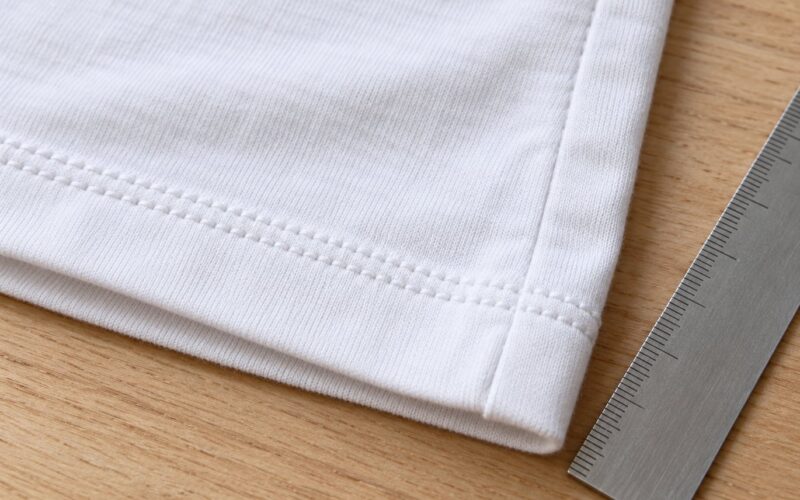
If your priority is longevity, stop reading the fiber label and start reading the garment. Fiber grade, weave density and construction tell you more than the fiber name. Check the fiber percentage first, then look for even hems, tight weave and clean seams. Natural fibers photographed in studio light can be short-staple and poor quality, and a well-made synthetic will outlast both of them.
For most people a blend is the practical answer. Around 20 percent synthetic added to a natural fiber is the sweet spot people in sewing and knitting circles land on again and again: enough to add strength, shape retention and hole resistance, not enough to change the feel. Above 50 percent synthetic, most people stop being interested in the natural side at all, and they are usually happy with that in socks, sportswear and rain gear.
Read labels as blends rather than purity tests. A 70 cotton and 30 recycled polyester shirt is a sensible garment, not a failure of commitment.
Frequently Asked Questions
Are natural fabrics always better than synthetic fabrics?
No. Natural fabrics are usually better for comfort, breathability and long-term feel, while synthetics are better for performance, wrinkle resistance and low-maintenance care. A cotton shirt and a polyester shirt are only as good as the grade and construction behind them. Pick per garment rather than declaring a side.
What is the most breathable natural fabric?
Linen is generally the most breathable natural fiber, because its yarns are stiff and loosely woven, letting air move through easily. Lightweight cotton and lyocell are close behind and drape better. Wool breathes too but adds insulation, so it suits cooler conditions. Breathable means air passes through the cloth, not that it absorbs sweat fastest.
Which synthetic fabric is best for hot weather?
Loose polyester or nylon in a lightweight weave performs best, because those fibers wick sweat outward and dry quickly instead of absorbing it. Avoid anything dark, tight or elastane-heavy for hot weather, since those trap heat. For very hot humid days a loose linen or lyocell garment usually feels better than any synthetic.
Do natural or synthetic fabrics last longer?
Synthetics resist abrasion and stretching better, so they last longer in high-friction uses like swimwear, outdoor gear and luggage fabric. Naturals last longer in ordinary wear because they can be mended, washed repeatedly and softened over years. A well-made cotton garment frequently outlives a cheap polyester one. Fiber grade and construction decide more than the category.
Is a fabric blend better than a single fiber?
Usually, yes. A blend around 20 percent synthetic added to cotton, wool or linen adds shape retention, strength and resistance to pilling and holes while keeping most of the natural feel. Blends also simplify care. Very high synthetic blends are useful for socks and activewear, where moisture management matters more than hand feel.
How can I tell whether a garment is natural or synthetic?
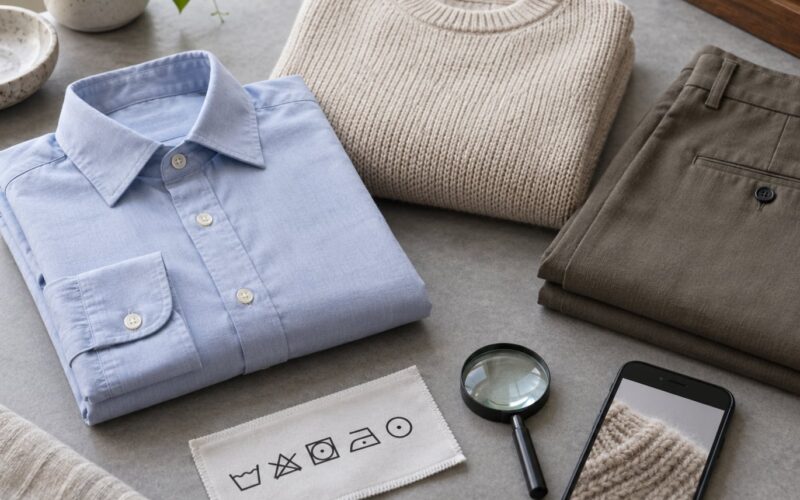
Check the fiber content label, which lists percentages in descending order by weight. A garment listed as 100 percent cotton is entirely natural, while anything naming polyester, nylon, acrylic, elastane or polyamide contains synthetics. Viscose, rayon, modal, lyocell, Tencel and cupro are regenerated cellulose, so they are plant-based but chemically processed rather than truly natural.
Start with the garment you are about to buy, not with a fiber allegiance. If it is a shirt you will wear all day in warm weather, go linen or cotton. If it is for the gym, a suitcase or a job that involves a lot of washing, go polyester or nylon. And when the label lists a blend with a fifth of it synthetic, that is usually the smartest option on the rail.