Business casual is office clothing built from polished but relaxed pieces: tailored trousers or a knee-length skirt, a blouse, closed-toe shoes, sometimes a blazer. Smart casual is the looser of the two, built for dinners, creative workplaces and social events where dark denim, knitwear and clean sneakers are still acceptable. Both sit between business professional and full casual, and the difference comes down to strictness and setting rather than a hard garment list.
Most of the confusion around business casual vs smart casual for women comes from invitation wording that sounds specific and means almost nothing. “Casual” covers anything from a matching set to gym clothes, and office dress codes shift from one company to the next. So this guide gives you working rules rather than a dress code philosophy: what each code looks like, which pieces move an outfit from one to the other, and what to do when the label on the invite tells you nothing.
Table of Contents
- Business Casual vs Smart Casual for Women at a Glance
- What Is Business Casual?
- What Is Smart Casual?
- How the Two Dress Codes Compare
- Business Casual vs Smart Casual: Which Pieces Change the Look?
- Business Casual Outfit Examples for Women
- Smart Casual Outfit Examples for Women
- How to Dress for the Actual Workplace
- Which Should You Choose?
- Frequently Asked Questions
- Is smart casual more formal than business casual?
- Can I wear jeans for a business casual office?
- What does smart casual mean for women at work?
- Is a dress business casual or smart casual?
- Can I wear sneakers with a business casual outfit?
- What should I wear if the dress code is unclear?
- Conclusion
Business Casual vs Smart Casual for Women at a Glance
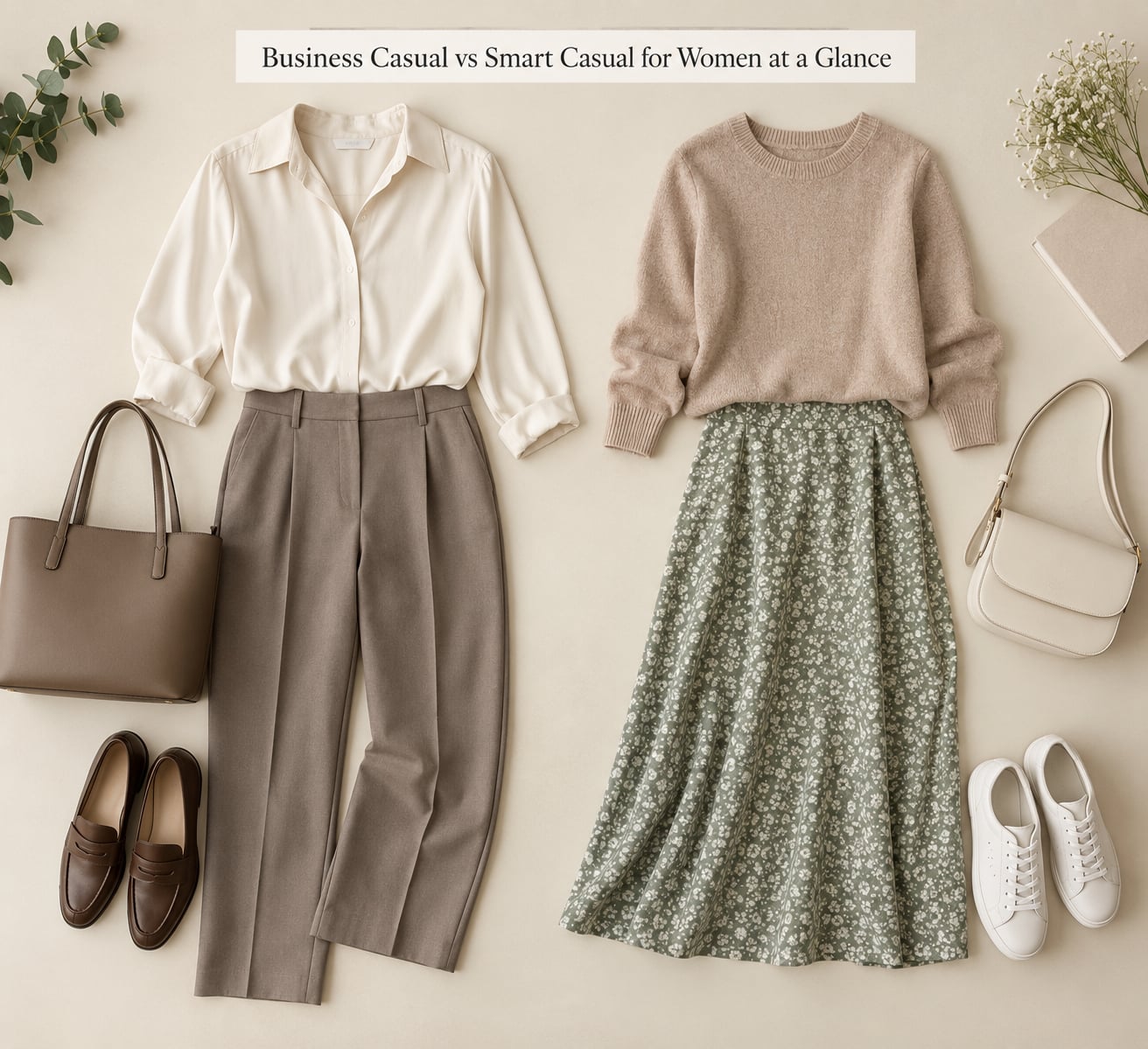
Business casual is the stricter of the two and belongs to the workplace. Smart casual is more relaxed and travels well into evenings. Here is how they separate line by line.
| Criterion | Business casual | Smart casual |
|---|---|---|
| Formality level | Conservative, office-bound | Relaxed but deliberately polished |
| Typical setting | Daytime office, client meetings, interviews, presentations | Creative workplaces, dinners, networking events, gallery openings |
| Tailoring | Defined waist, clean lines, blazers common | Relaxed fits, softer silhouettes |
| Fabrics | Cotton poplin, wool, crepe, silk blends, wrinkle-resistant cloth | Linen, jersey, fine knitwear, denim, light wool |
| Color range | Neutrals: navy, black, charcoal, beige, cream | Neutrals plus color: olive, cobalt, rust, mocha, denim |
| Bottoms | Tailored trousers, chinos, knee-length or midi pencil skirts | Dark jeans, wide-leg trousers, midi and slip skirts |
| Tops | Collared shirt, button-down, silk or crepe blouse, knit vest over shirt | Fine knitwear, cashmere crew, blouses, tucked tees |
| Footwear | Loafers, flats, low heels, ankle boots, closed-toe pumps | Loafers, ankle boots, block heels, clean minimal sneakers, elegant sandals |
| Denim | Dark, clean-cut denim only if the office allows it | Dark or medium wash, straight or wide leg, more routinely welcome |
| Accessories | Structured bag, watch, understated jewelry, tailored outerwear | Leather bag, gold jewelry, scarf, watch, statement piece |
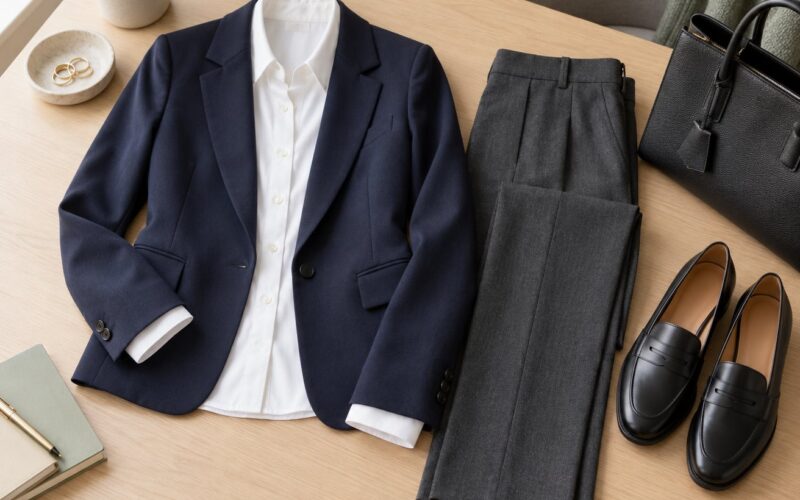
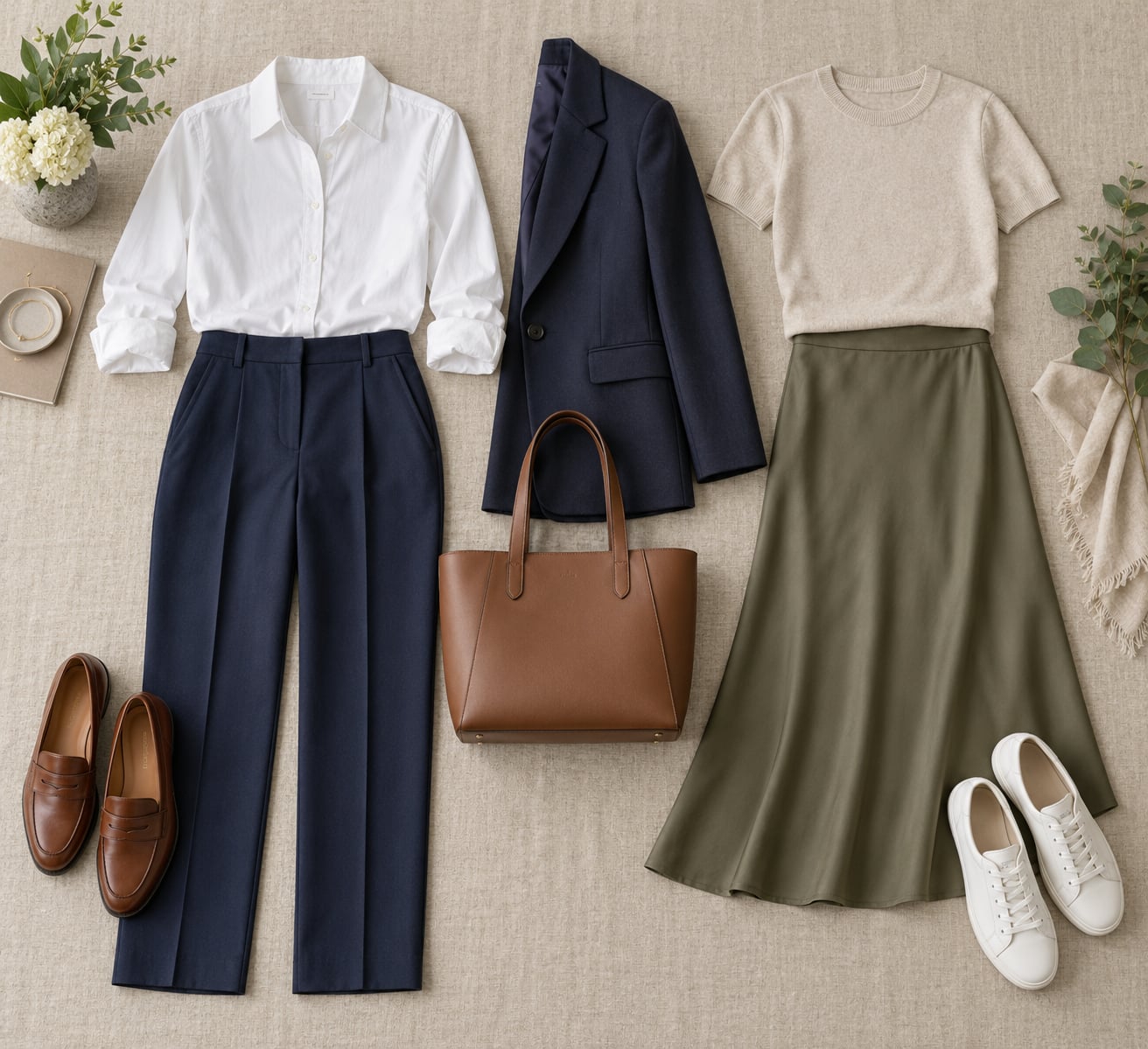
Read that table and one rule falls out: the garment list overlaps almost completely. The difference lives in the finish. A navy blazer and closed-toe loafers read business casual. The same blazer over dark jeans and clean sneakers reads smart casual, and reads well at a dinner that has nothing to do with work.
What Is Business Casual?
Business casual is a workplace dress code defined by neatness and restraint rather than by a suit. You are expected to look put-together and job-ready, without looking like you are attending a board meeting.
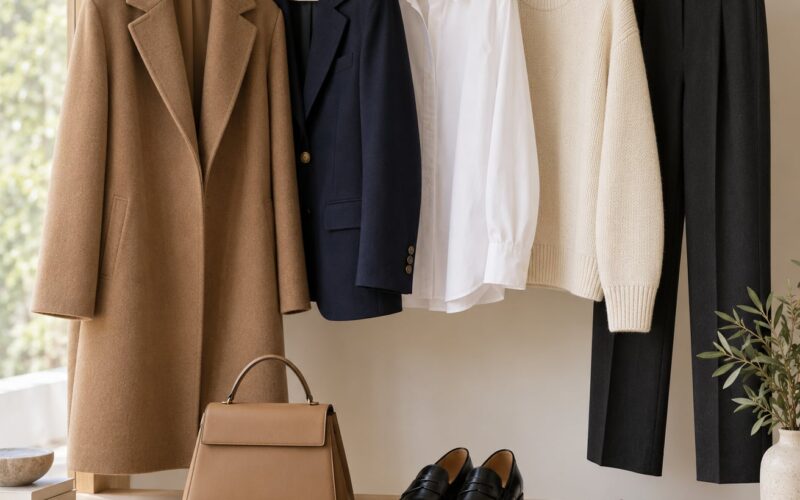
The reliable building blocks are a collared shirt or blouse, tailored trousers, chinos or a knee-length skirt, a knit layer or blazer on top, and closed-toe shoes. Fabrics lean toward cotton poplin, wool, crepe and silk blends, usually in neutrals. Dark denim works in some offices and reads as too relaxed in others.
Here is how it differs from business professional, the more formal tier above it. Business professional expects a matching suit or a coordinated jacket-and-trouser or jacket-and-skirt combination in a suit-weight fabric, worn with dressier shoes. Business casual drops the matching requirement. You can wear a navy blazer with grey trousers on one day and no blazer at all the next, and both still land inside the code.
Women get a thinner wardrobe for this tier than most reference guides suggest, largely because women’s retail rarely stocks a good collared shirt outside of a novelty. One reader described going in search of collared shirts for a first day in an IT job, finding a full aisle of them in the men’s section, and coming back with a men’s oxford tucked into women’s trousers. It worked, and it is a common workaround for anyone starting a job where the stated code turned out to be stricter than the actual office.
That experience explains the other half of business casual pain: the same office can ask for a collared shirt on Monday and approve a plain tee with a cardigan on Thursday. Hold the details loosely and anchor on polish. A clean silhouette in a neutral color is almost always right.
What Is Smart Casual?
Smart casual is dressing well without dressing for work. The definition everyone quotes is that it is casual but well thought out: nothing baggy, nothing sloppy, nothing that looks borrowed from the gym.
Typical pieces are fine knitwear, blouses, unstructured or unlined blazers, dark jeans, midi dresses, slip skirts, relaxed trousers and clean sneakers or loafers. The silhouette does more work than the color. A relaxed-fit trouser in a good fabric with a tucked knit top looks intentional. The same trouser with a hoodie looks like the hoodie won.
Smart casual also has more room for color and print than business casual. Olive, rust, cobalt, mocha and denim all work here. Accessories can be warmer too: gold jewelry, a silk scarf, a watch, a leather bag with hardware. One good piece of jewelry carries more weight in smart casual than in a business casual outfit, where the overall effect should stay quiet.
Because smart casual is defined by taste rather than rules, it suits women whose work is creative, whose office has no written policy, and anyone hosting dinner, a gallery opening or a networking evening. It is also the easiest code to dress for repeatedly, since the same pieces move from Friday afternoon to a 7 pm table without a full change.
How the Two Dress Codes Compare
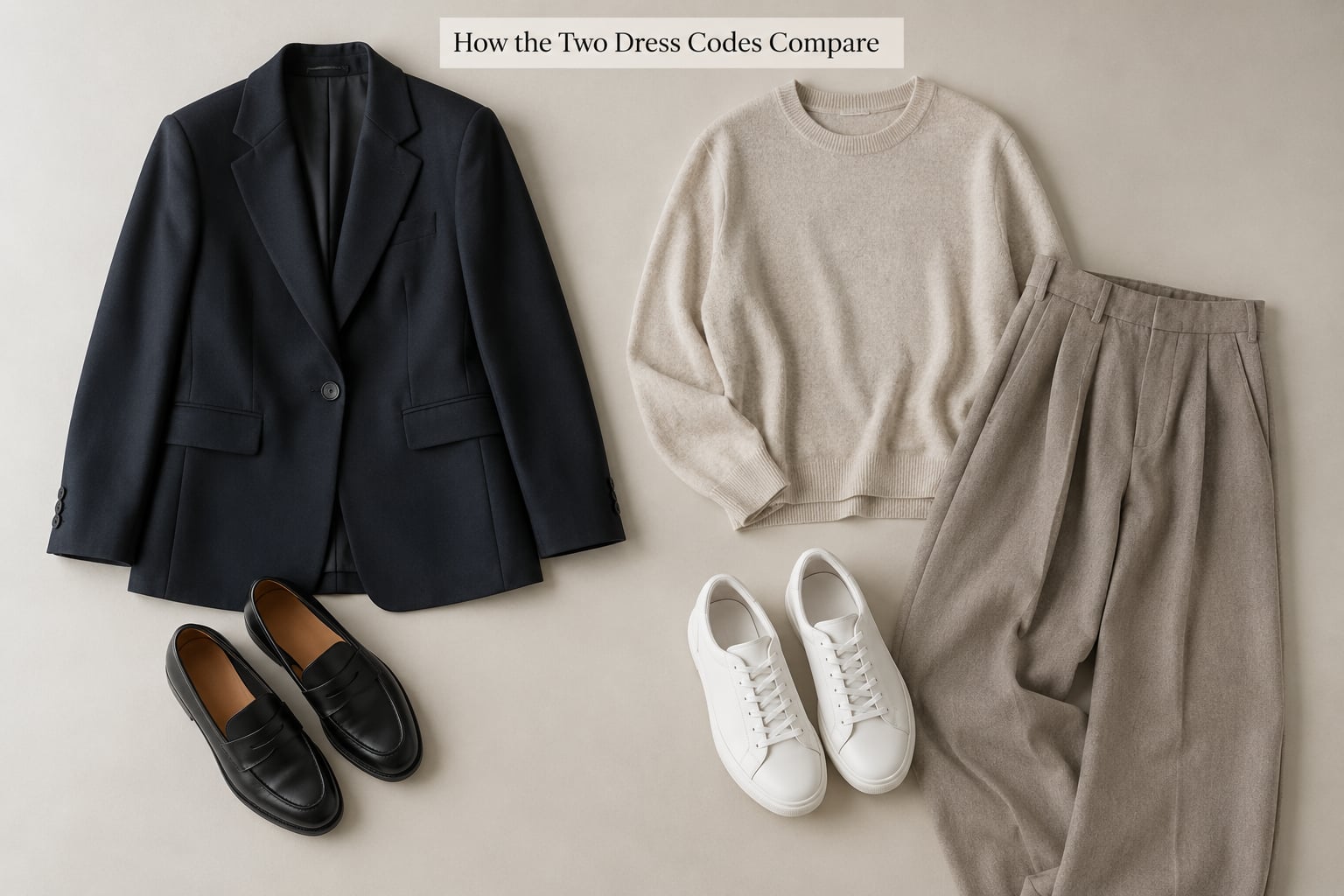
The codes diverge on structure first and everything else follows. Business casual is built on shape: defined shoulders, a waist that reads, hems that hold. Smart casual is built on fabric quality and proportion, which is why a soft knit with wide trousers can look more expensive than a stiff shirt with ill-fitting pants.
Structure and tailoring. Tailoring is the fastest lever between the two codes. Add a fitted blazer and closed-toe shoes and a base outfit climbs toward business professional. Remove the jacket, swap the trousers for dark jeans, and it settles into smart casual. Unlined and unstructured jackets read more relaxed; lined shoulders and notch lapels read more formal.
Color. Business casual lives in navy, black, charcoal, grey, beige and cream. Two neutrals plus one accent is plenty. Smart casual holds the same neutrals but adds room for color, denim and print. Darker and cooler is the general direction of increasing formality, but fabric finish matters more than the shade.
Fabric. Business casual favors cloth with structure: poplin, twill, wool, crepe, silk blends, anything crease-resistant that still looks like tailoring. Smart casual favors hand: linen, fine jersey, cashmere and cotton knitwear, denim, light wool. Sheer, shiny and clingy fabrics trend away from both codes.
Footwear. Closed-toe, polished, and quiet is the business casual test: loafers, flats, low heels, ankle boots. Smart casual adds clean minimal sneakers, block heels and elegant flat sandals. The determining factor is condition, not the label. A worn sneaker reads casual; a spotless leather sneaker reads smart casual.
Setting. Business casual assumes an office, a meeting room or a conference room. Smart casual assumes a restaurant, a reception, an exhibition, a casual Friday office. Most real invitations sit somewhere in between, which is why looking at what the event actually is beats memorizing the code name.
Evening flexibility. Smart casual transfers to dinner, drinks or a gallery opening with a swap of shoes and one added layer. Business casual transfers to an evening event by adding a blazer, switching to a heel or a boot, and changing the bag. Both work. Smart casual simply needs less effort to get there.
Business Casual vs Smart Casual: Which Pieces Change the Look?
Garment by garment, a single swap moves an outfit across the line. These are the changes that do the most work.
- The blazer. Fitted or lined, business casual. Unlined, soft-shouldered, worn without a tie or blouse underneath, smart casual.
- The dress. A knee-length sheath in crepe or wool is business casual. A midi shirt dress, a wrap dress or a slip dress in silk or viscose is smart casual.
- The skirt. A knee-length pencil skirt in suiting fabric is business casual. A bias-cut midi or pleated skirt is smart casual.
- The trousers. Pressed tailored trousers or chinos are business casual. Wide-leg, fluid or elastic-waist trousers are smart casual.
- The knitwear. A thin knit worn under a shirt reads business casual. A chunky or fine-gauge knit worn on its own reads smart casual.
- Denim. Dark, straight-leg, rinse-finish denim in a conservative office is business casual on a good day and a risk on a bad one. The same denim with sneakers and a leather jacket is firmly smart casual.
- The shoes. Loafers and closed-toe heels push toward business casual. Clean sneakers and flat sandals push toward smart casual.
- The bag. A structured tote says business casual. A soft shoulder bag or a small leather crossbody says smart casual.
Pick one category and change it. That is usually enough, which is handy when you are standing in front of a wardrobe with eleven minutes before a call.
Business Casual Outfit Examples for Women
These five combinations cover most conservative and mid-tone workplaces. Each one uses pieces you can buy once and wear for years.
1. The standard office combination. White cotton button-down tucked into navy tailored trousers, a navy or charcoal blazer over the top, and black leather loafers. Add a structured tote and small stud earrings. This is the safest business casual outfit there is and it works in finance, law, healthcare administration and most corporate offices.
2. The client meeting outfit. A cream silk blouse with charcoal wide-leg trousers that break just above the ankle, a fitted camel blazer, and low block-heeled leather boots. The polish comes from the fabric rather than the color, which keeps it from looking like a uniform.
3. The creative-office outfit. Dark straight-leg jeans, a fine-gauge merino turtleneck in a warm neutral, and a black leather ankle boot. Add a longline open blazer if a meeting is on the calendar. This reads business casual in a casual office and edges toward smart casual the moment you add jewelry.
4. The interview outfit. A knee-length skirt in a suiting fabric with a tucked blouse and a fitted blazer, finished with closed-toe pumps or very low heels. Interviews reward the more formal tier, so dress one step above the role you are interviewing for. Skip anything you would not wear to a wedding.
5. The business-casual event outfit. A midi knit dress in navy with a waist belt, a cropped blazer or a clean cardigan, and closed-toe loafers or low block heels. It reads relaxed without reading underdressed, which is the balance business-casual networking events ask for.
Conservative industries share a common baseline: cover shoulders, closed-toe shoes, no visible logos, and colors that stay quiet. Creative workplaces relax that baseline considerably. When in doubt, dress for the room you are walking into, not the one described on the company page.
Smart Casual Outfit Examples for Women
Smart casual covers more of your week than business casual does, from client lunches that turn into dinners to gallery openings on a Friday. These combinations are built so nothing needs to change twice.
1. Dinner with colleagues. A fine knit top tucked into dark high-waisted jeans, a relaxed blazer, and clean leather sneakers. Swap the sneakers for a low heel if the table is somewhere you’d rather make an impression at. The jeans and knit do the work either way.
2. Gallery opening or cocktail reception. A bias-cut midi slip dress under a cropped structured jacket, with block-heeled sandals and a small leather clutch. The jacket keeps the silhouette from drifting too soft, which is the one rule smart casual cannot skip.
3. Networking evening. A tucked button-down with the sleeves rolled once, tailored trousers in a lighter neutral, and loafers. Add a silk scarf at the neck and you are dressed for the reception and the late dinner without a bag full of extras.
4. Relaxed workplace day. A midi shirt dress with a wide leather belt and clean low-top sneakers. Comfortable enough for a full day, tidy enough for a stand-up, and it reads as considered rather than dressed up.
5. Work-to-evening transition. A tailored trouser and fine knit in the office, then swap the flats for a heeled ankle boot, add earrings and a bolder lip, and pull the hair back. Two changes, about three minutes, and the outfit moves two dress codes. Keeping a heeled boot in your desk drawer does the same job permanently.
Fit is where most smart casual outfits fail. Relaxed should mean the fabric drapes rather than the garment hanging off you. If the shoulder seam sits past your actual shoulder, the outfit reads as borrowed, whatever the pieces cost.
How to Dress for the Actual Workplace
Written dress codes describe a company, not the room. The people in that room on that day are the better guide, and there is a reliable sequence for reading them.
Start with what is written. Check the employee handbook, the intranet, or the email that announced the code. Look for a clothing policy PDF or an onboarding page with examples. If you find actual photographs from inside the company, those beat any article, including this one.
Then read the room in layers. The most senior woman in your office is the strongest single signal, followed by the newest colleagues. One reader described being told collared shirts were required on her first day and being told a plain tee with a cardigan was fine by the following week. Ask directly instead. “Is denim okay on Fridays?” gets a better answer than a week of guessing.
Adjust for the industry. Finance, legal, government and education sit closer to business professional. Technology, media, design and most startups sit closer to smart casual. Healthcare and trades vary locally. The label on your offer letter tells you nothing about how people actually dress on a Tuesday.
Match the day to the audience. Internal days can be one tier lower. Client-facing days, presentations, interviews and board meetings should be one tier higher. Most mistakes happen because a comfortable internal outfit gets worn to a meeting it wasn’t built for.
Handle video calls separately. Remote work has its own norm and nobody writes it down. Choose a piece with a visible neckline and structure, since a neckline and shoulder line carry further on camera than fabric quality does. Most people look sharper from the waist up, which is exactly the half the camera shows.
Watch the seasonal shift. In summer, linen and lightweight cotton handle heat, but a crepe or cotton blend resists wrinkles better through a full day of sitting. In winter, layering is fine as long as the base layer stays simple; a bulky cardigan under an oversized blazer reads untidy by 4 pm. Keep one coat that closes properly and skip anything with a large printed logo.
On a limited budget, buy in this order. A good pair of trousers in a neutral, a fitted blazer, a collared shirt or two, a fine knit, closed-toe leather shoes, then a second pair of shoes. That six-piece order carries more days than a large rack of trend pieces bought in the wrong sequence.
Fit deserves its own mention, particularly for petite and plus-size wearers. Petite frames, around five foot three, suit higher waistlines, cropped hems and defined sleeve length, since a midi skirt that lands mid-calf can shorten the line. Fuller figures suit structured shoulders, a defined waist and wrap or A-line silhouettes; close-fitting knitwear across the middle is the item most likely to read uncomfortable rather than polished. None of this requires a different dress code, only different proportions within the same one.
Which Should You Choose?
Match the code to the event and the cost of being wrong. Being slightly too polished is usually forgiven; being underdressed at a client meeting is not.
- Conservative office, day to day: business casual, with a blazer on presentation days.
- Creative or tech workplace: smart casual, adding one tailored layer for client-facing days.
- Job interview: the top of business casual, or business professional if the industry is formal. Nothing more relaxed.
- Client meeting: business casual. Closed-toe shoes, structured bag, quiet colors.
- Conference or long off-site day: business casual with comfortable closed-toe shoes and a wrinkle-resistant fabric. You will be on your feet more than you expect.
- Conference reception or awards dinner: smart casual, with a dress or a midi skirt and a heeled sandal.
- Wedding, engagement party, christening: read the invite first. Cocktail or semi-formal means a dressier interpretation than either code here; “casual” at a wedding still excludes jeans in most cases.
- Dinner, drinks, gallery opening: smart casual. This is the code’s home territory.
- Saturday lunch with friends who happen to work together: smart casual, or plain casual if nobody is representing anyone.
If two people give you conflicting advice, the shorter horizon wins. What the invitation says beats what a colleague wore last year.
Frequently Asked Questions
Is smart casual more formal than business casual?
No. Business casual is the stricter of the two and is generally considered the more formal of the pair for women. It assumes an office setting, structured tailoring and closed-toe shoes, while smart casual allows dark denim, knitwear, clean sneakers and relaxed silhouettes. Smart casual is often more fashion-forward, but less formal.
Can I wear jeans for a business casual office?
Sometimes, and it depends on the wash, the cut and the industry. Dark, clean, rinse-finish straight-leg denim with a collared shirt and a blazer can pass in many offices, especially on casual Friday. Bright, distressed or ripped denim rarely does. Conservative fields like finance and law tend to say no. If denim matters to you, ask in writing and get the answer you can rely on.
What does smart casual mean for women at work?
Smart casual at work means polished but relaxed clothing: fine knitwear, blouses, unlined blazers, dark jeans, midi dresses, relaxed trousers, loafers, ankle boots or clean minimal sneakers. The silhouette should still be deliberate, and nothing should read as gym wear, loungewear or beachwear. Many relaxed workplaces run on this code by default.
Is a dress business casual or smart casual?
Both, depending on the cut. A knee-length sheath or A-line dress in crepe, wool or a suiting fabric is business casual. A midi shirt dress, a wrap dress or a slip dress in silk or viscose is smart casual. Fabric, hem length and shoes decide it more than the fact that it is a dress. A midi dress with sneakers is smart casual; the same dress with closed-toe pumps reads business casual.
Can I wear sneakers with a business casual outfit?
Clean, minimal leather sneakers can work in relaxed and creative offices, paired with tailored trousers and a knit or blazer. They are a poor fit in conservative industries, at interviews and at client meetings. The sneaker has to look new and leather, not canvas and athletic. If your office is unsure about them, loafers are never a mistake.
What should I wear if the dress code is unclear?
Dress one step more polished than the environment seems to require, then match the room. Look at what the most senior woman present is wearing and follow that. For an unknown workplace, start at the top of business casual: tailored trousers or a knee-length skirt, a collared shirt, a blazer and closed-toe shoes. You can remove a layer after the first week.
Conclusion
Business casual is structured, office-bound and conservative; smart casual is relaxed, flexible and slightly more expressive. Both are built from similar clothes, and the difference shows up in tailoring, footwear and how deliberate the silhouette looks.
Start by naming the setting rather than the label. If the dress code stays unclear, dress one step more polished than the room appears to require, watch what the most senior woman is wearing, and adjust from there. A loose rule I keep coming back to: if you would be comfortable being photographed on the way in, the outfit is fine.