To dress for your body shape without rules, treat proportion as a set of tools rather than a dress code. Notice where clothes sit comfortably, mix volumes so an outfit reads balanced, adjust fit at the seams, then ignore any guideline that leaves you adjusting your clothes all day. You need about thirty minutes and a few garments you already own.
That is the whole method. There is no body classification to pass first, and no shape you have to be before certain clothes are allowed to work on you.
Table of Contents
- What You Need
- Step-by-Step
- Start With Your Body, Not a Label
- Using Proportion to Dress for Your Body Shape Without Rules
- Fit the Places You Notice Most
- Choose Silhouettes You Can Move In
- Treat Colour and Pattern as Tools, Not Rules
- Build a Personal Formula
- Common Mistakes When You Dress for Your Body Shape Without Rules
- Frequently Asked Questions
- What is the hardest body shape to dress?
- How do I dress if I am between two body shapes?
- Do body shape rules work for plus-size and petite bodies?
- How does body shape change with age, weight or pregnancy?
- Is body shape more useful than size?
- What should I fix first when nothing in my wardrobe works?
- Conclusion
What You Need
Four things, and you already own three of them.
- A baseline outfit that fits. One top and one bottom you can wear for hours without tugging, adjusting or checking a mirror. This is your control sample, the outfit everything else gets compared against.
- A full-length mirror or your phone camera. Hangers lie. A photo from arm’s length shows shoulder placement and hemline honestly, and a three-second video shows how a skirt moves when you walk.
- A notes app. Every useful observation goes in as one line: top, what worked, what did not. This is the habit that stops shopping feeling like starting over each time.
- A measuring tape, if you want one. Optional. Four numbers — shoulder width, natural waist, fullest hip, inseam — describe a frame well enough to compare with a garment’s measurements. Nothing more than that is needed.
What you do not need is a label. Plenty of people land between two shapes, change shape over a few years, or simply refuse the vocabulary. The steps below work either way.
Step-by-Step
Start With Your Body, Not a Label
Spend two weeks paying attention before you change anything. Wear the baseline outfit on different days, then swap one garment at a time and notice what shifts.
Keep an eye on necklines, sleeve lengths, waistlines and hems. Which neckline leaves your shoulders looking comfortable? Does a sleeve end at a spot where your arm actually wants it to, or where the pattern happened to finish?
Forum threads about body shape keep circling one useful idea: analyse the three to five clothes you already reach for, then find the pattern in them. A reverse check is just as revealing. Pull out the pieces labelled as flattering that you never wear. They usually tell you something you did not want to know.
How to judge it: an outfit works if you can sit, stand and walk in it for two hours without fixing anything.
Using Proportion to Dress for Your Body Shape Without Rules
Proportion is simply the balance between volumes. Two full volumes in one outfit compete and usually look heavy. One volume with one straight, narrow counterweight looks deliberate.
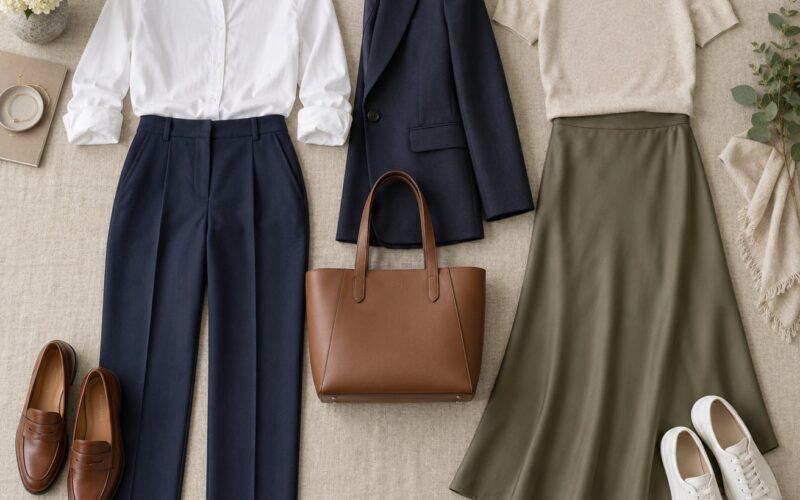
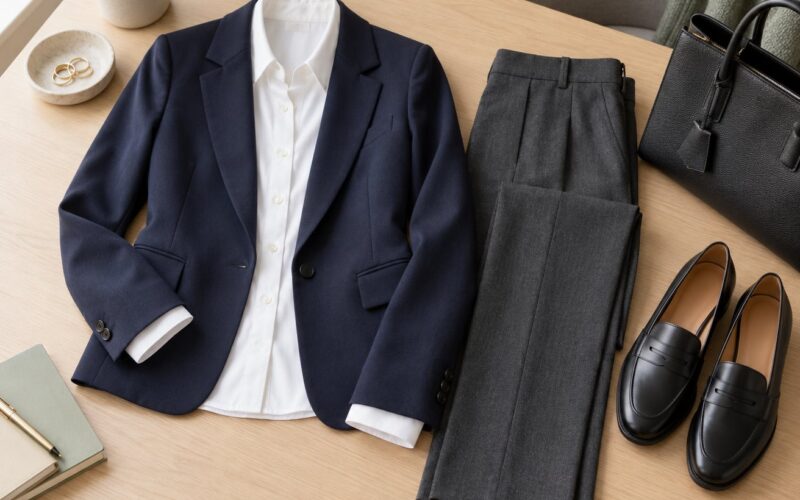
So a relaxed top works with a straight or tapered bottom. A fuller skirt works with a simpler top and a defined waist. Structured shoulders work with a soft, fluid bottom. None of that requires you to match a particular body shape; it requires you to decide what you want the eye to do first.
Vertical lines lengthen, horizontal lines widen. A near-monochrome column, a long open layer over a straight column, or a centre-front opening all draw the eye downward. Wide horizontal elements at the shoulder line push the other way, which is occasionally exactly what you want.
How to judge it: hold the finished outfit up to the mirror at arm’s length and ask where your eye lands first. If that matches your intent, you are done. If not, the fix is usually one garment, not a new wardrobe.
Fit the Places You Notice Most
Fit matters more than any category label. Almost every disappointing outfit is a proportion problem at one of the seams below.
| Checkpoint | What to look for | Simple fix |
|---|---|---|
| Shoulder seam | Sits on the edge of your own shoulder, not past it | Shorten or take in at the seam |
| Armhole and sleeve | Lets you lift your arm fully without the shoulder riding up | Choose a shallower armhole; shorten sleeve to the wrist bone |
| Bust | No pulling across the front, no gaping at the waist | Adjust the side seam, add a dart, or size up for a fluid cut |
| Waist | Seam sits at or near your natural waist | Move the seam, or add a belt or tie |
| Hip and seat | Fabric skims without clinging or gaping | Bias or fluid fabric; take in the side seam |
| Hem length | Finishes at a deliberate point on the leg or ankle | Have it hemmed; shoes change the answer |
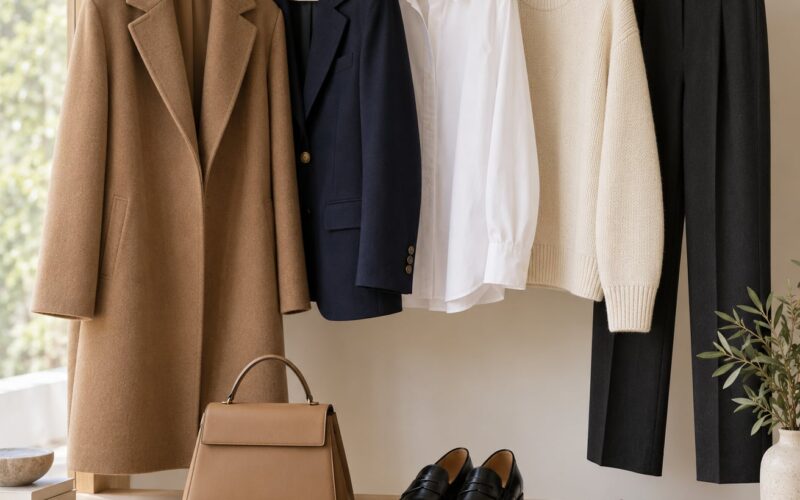
Layering is the cheapest adjustment tool there is. A longline cardigan, an open overshirt or a vest adds a vertical line without touching a single seam.
Fabric behaviour is the second one. Stiff, structured cloth holds whatever shape the hanger gave it. Fluid cloth like viscose, jersey or a soft wool crepe skims and moves, which is why the same cut can look wrong in one fabric and easy in another. Alterations are normal, not a failure. Taking in a shoulder seam is cheaper than replacing a jacket.
Choose Silhouettes You Can Move In
There are seven worth knowing, and they suit different days rather than different bodies.
- A-line — opens from waist or hip, easy on movement, forgiving across the seat.
- Straight — falls from shoulder to hem, minimal seam, reads clean and long.
- Bias cut — cut on the diagonal, so it skims instead of clinging.
- Column — narrow from shoulder to floor, one continuous line.
- Gathered — fullness drawn into a seam, room built in at the top.
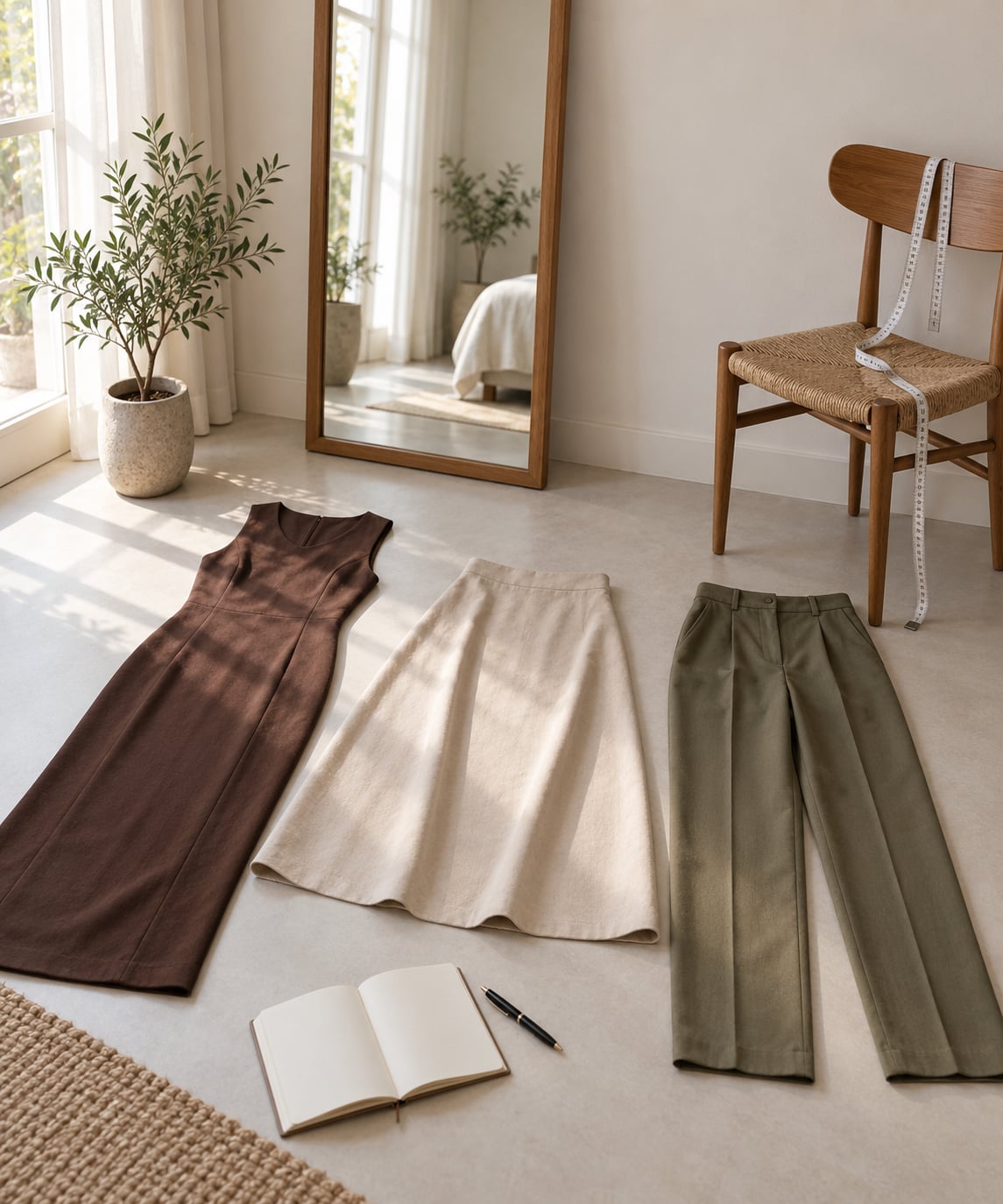
- Tailored — shaped, usually with structure at the shoulder and a suppressed waist.
- Fluid — no strong shape at all; depends entirely on fabric.
How to judge it: sit down, walk across the room, reach both arms overhead, bend forward. A garment that survives all four in the fabric you bought is a working silhouette. Everything else is decoration.
Treat Colour and Pattern as Tools, Not Rules
Colour controls attention. A lighter or more saturated block where you want the eye to land pulls it there. Tonal outfits in shades close to each other read as one long shape. High contrast between top and bottom draws a clear horizontal line at the waist.
Pattern scale works the same way. A small print on a large block of fabric looks refined; the same small print on a small block looks busy. If you love a bold print, let it be the only focus in the outfit and keep everything else quiet.
What to skip is the idea that any colour or print flatters one body shape only. Some people read a dark column differently from others, some wear colour close to the face and love it. Nobody has ever been assigned a colour by a chart. Use colour where it makes you feel like yourself, then use contrast to create the proportion you want.
Build a Personal Formula
Now combine what you found. Your formula is four parts: a silhouette, a fit, a colour approach and a level of structure.
Write it as one sentence. Something like a fluid A-line in a mid-weight fabric, a defined waist, one tone-on-tone block, and one structured layer for cooler days. Short, specific and repeatable.
Test it properly: wear five outfits built from that formula in five different settings, such as a work day, a weekend at home, an evening out, travel and one meeting on camera. Note which felt easiest to repeat and which made you think about your outfit instead of the conversation.
Then edit. Anything you have not worn in a year either gets altered, gets donated, or goes back on the rail with a plan attached.
Common Mistakes When You Dress for Your Body Shape Without Rules
Forcing a label. People who fit two shapes feel like failures at both. Fix: treat the label as a starting note, not a verdict. Re-check it once a year, or after any change that matters to you.
Copying a trend without checking the seam. A trend is a silhouette idea. The shoulder seam and rise still have to match you. Fix: check those two points before anything else when a trend is doing the shouting.
Treating size as a style category. A size is a rough number on a label. Two garments in the same size can be cut completely differently. Fix: compare actual measurements against your four numbers, not against the size tag.
Buying for aspirational proportions only. Saving a shape for someday means you live in clothes that do not fit now. Fix: buy for today, and alter where you want the aspirational version.
Ignoring comfort. A garment you cannot sit in is not flattering, whatever the chart says. Fix: test the four movements, every time, and let the answer end the discussion.
A few confidence habits that cost nothing: wear the outfit that works instead of the one that is nearly right. Keep one photo of a good fit for reference when shopping. Re-measure shoulders to hips yearly, because that relationship matters more than any category you have been assigned.
Frequently Asked Questions
What is the hardest body shape to dress?
Most guides name the rectangle or the inverted triangle, but difficulty is rarely about shape on its own. It is shape plus fabric plus shoulder placement. A rigid cut in a stiff cloth has nowhere to move, so try the same cut in something fluid, add a half tuck to create a waist seam, and if it still fights you, let a tailor take it in. Alteration usually beats more rules.
How do I dress if I am between two body shapes?
Borrow from both, one at a time. Take the shoulder and sleeve treatment from the shape you lean toward, and the rise and hemline from the other. A cropped structured jacket over a straight-leg trouser does much of that work. If a garment only flatters one of the two bodies involved, let it go and find one built with more give.
Do body shape rules work for plus-size and petite bodies?
The proportion logic scales, and petite bodies in particular tend to gain a lot from a clean vertical line and a raised waist seam. Fuller bodies tend to gain from structure that holds its own shape and from hems that finish at a deliberate point. Avoid any piece of advice that reduces itself to wearing one colour, because that is not styling, it is hiding.
How does body shape change with age, weight or pregnancy?
Quietly, and more often than guides admit. Waist definition, shoulder slope and inseam shift across years, and none of it is a failure. Take four measurements once a year, shoulder width, natural waist, fullest hip and inseam, then re-check your best five outfits against them. The formula changes with the body. The process for finding it does not.
Is body shape more useful than size?
For styling, far more than for shopping. Size tells you roughly what will fasten. Shape and proportion tell you how a garment hangs and where the eye lands once you are wearing it. Use size to start a search, then judge by the shoulder seam, the rise, and how the fabric falls once you have moved around in it.
What should I fix first when nothing in my wardrobe works?
Start with fit at the shoulder seam, because it changes every other proportion in the outfit. Pull out three garments you dislike and check only two things: where the shoulder seam lands and where the hem finishes. That single pass fixes a surprising share of outfits people had quietly written off.
Conclusion
Dressing for your body shape without rules comes down to three habits: find one fit that genuinely works, test one proportional silhouette in it, and repeat that combination until getting dressed stops taking a decision every morning.
Do those three first, this week. Pick the outfit you already feel best in, check where its seams land, then write your formula in one sentence. Everything after that is editing, and editing is the easy part.