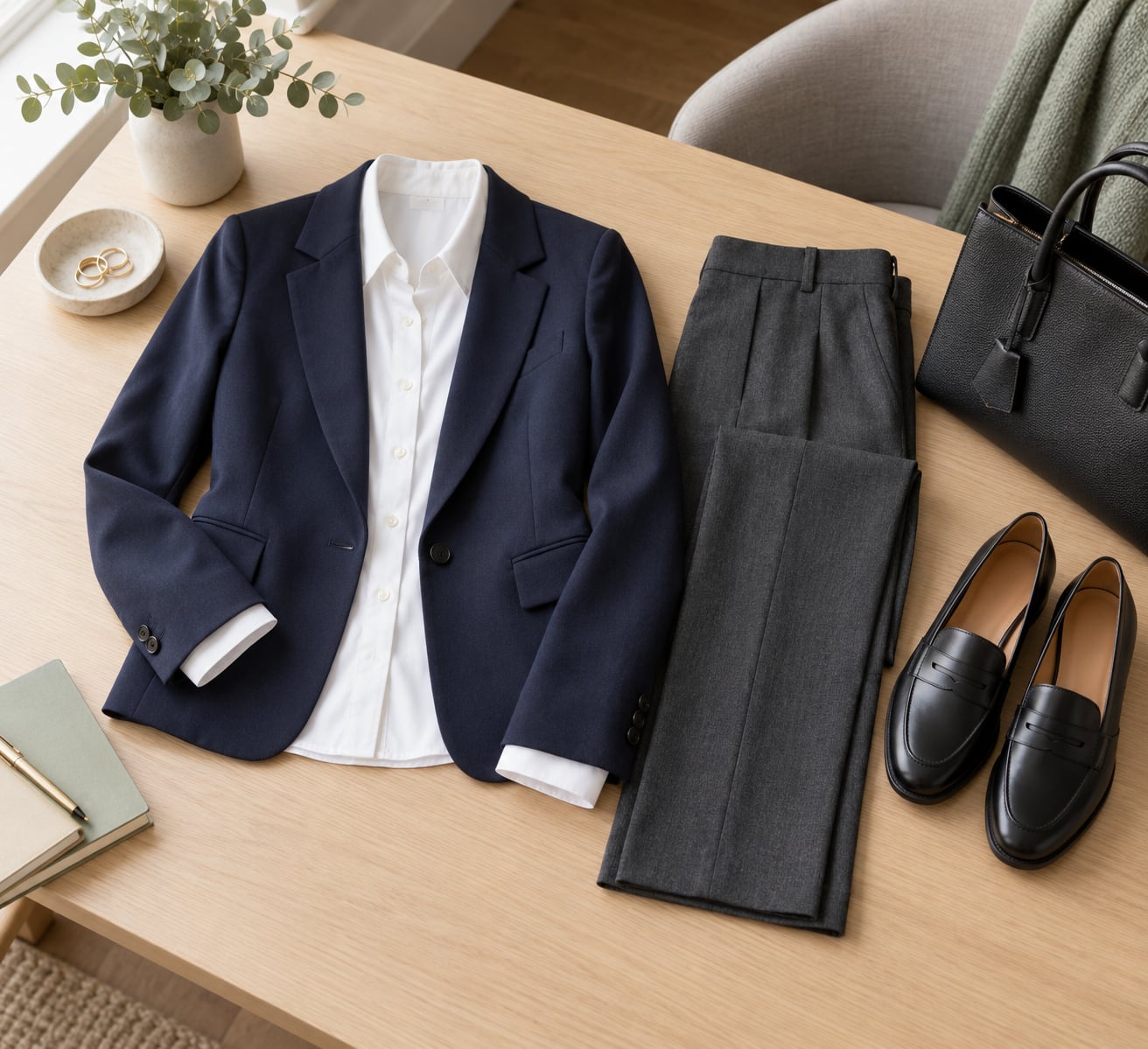
Business professional dress code means wearing tailored, well-fitted, conservative clothing in neutral colors: a suit with a dress shirt, or an equivalent structured outfit such as a blazer with trousers or a knee-length skirt, finished with polished closed-toe leather shoes and understated accessories. What counts as business professional has loosened a lot, and the label now means something slightly different in every office. Here is how to read it in 2026.
That ambiguity is the whole reason people search this phrase. Someone accepted an offer, was told the code was business professional, and immediately asked a forum to decode a term that was supposed to be self-explanatory. It is not. The label is a starting point, not a specification.
Table of Contents
- What Business Professional Dress Code Means Today
- How Workplace Dress Has Changed
- What to Wear for Common Business Settings
- How to Read Your Workplace or Industry
- What Business Professional Does Not Require
- How to Make Your Outfit Feel Polished Without Being Rigid
- Frequently Asked Questions
- Does business professional mean I have to wear a suit?
- Can I wear jeans as business professional attire?
- Is a blazer required for a business professional dress code?
- What should I wear on my first day with a business professional dress code?
- What is not acceptable for a business professional outfit?
- Does a business professional dress code apply on remote and video-call days?
What Business Professional Dress Code Means Today
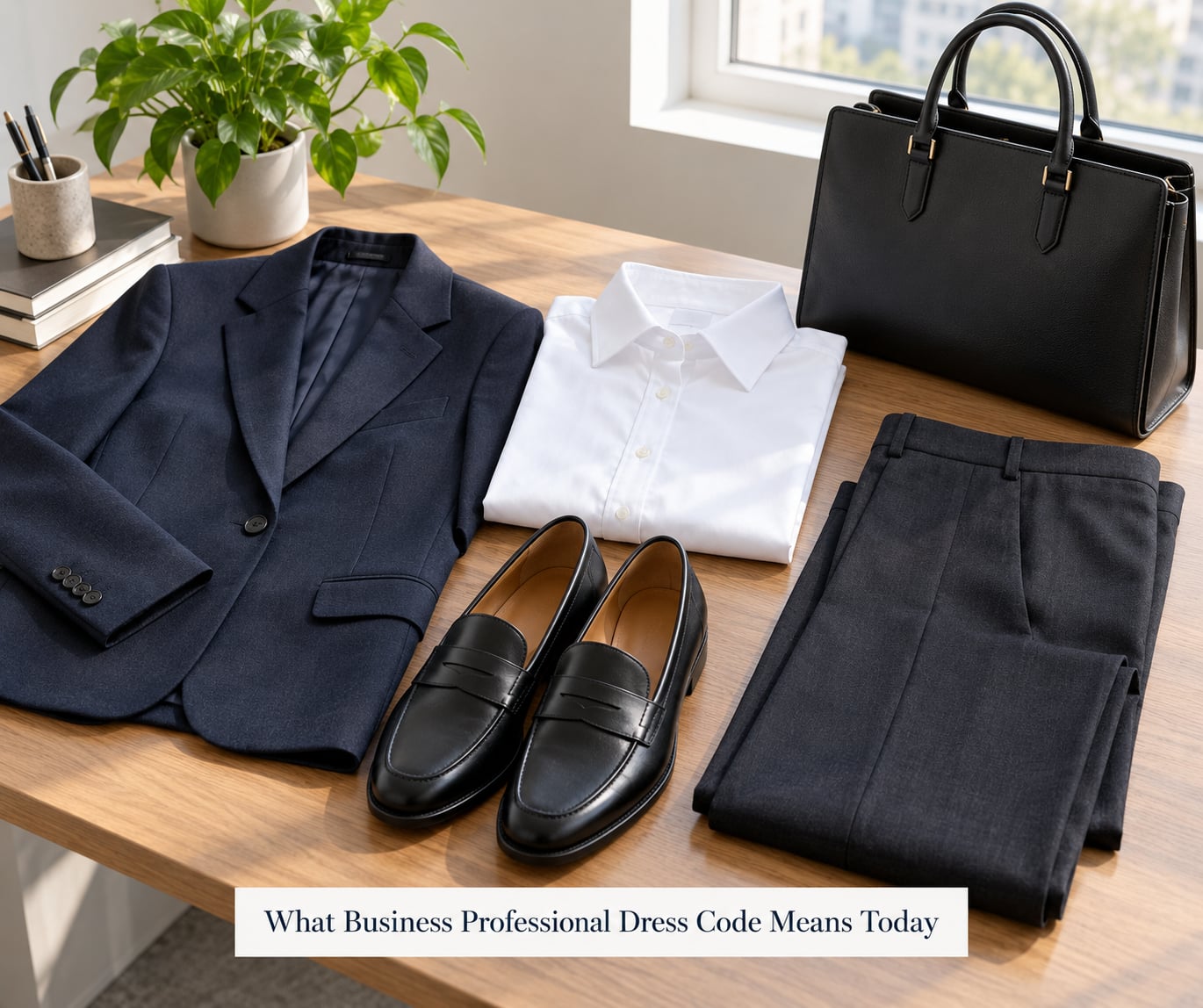
The current meaning is a middle tier: more structured than business casual, less rigid than business formal. The core requirements have barely moved. Garments should be tailored rather than baggy, in a neutral palette, with a clean line and closed-toe leather shoes. Accessories stay quiet. A tie is optional in most environments and required in only a few.
Where the meaning shifts is the level of formality around that core. One company reads business professional as a full suit every day. The next reads it as a blazer and no tie. Both are using the same words honestly, because the term sets a floor and a ceiling and leaves the middle to the employer, the industry, your role and the day you are walking into.
Here is how the five tiers stack up, in descending formality. This is the decoder most readers are missing, because the same phrase gets used for two or three different rows in real life.
| Dress code | Typical garments | Footwear | Where you see it |
|---|---|---|---|
| Business formal | Full matching suit, tie, conservative dress shirt, minimal visible skin | Polished leather oxfords or heels | Courtrooms, weddings, galas, high-profile board events |
| Business professional | Suit or blazer with tailored trousers or a knee-length skirt, button-up shirt, optional tie | Polished leather loafers, oxfords or low heels | Consulting, finance, law, client-facing corporate roles |
| Business casual | Chinos or dark jeans with a polo, sweater or button-up; no tie | Clean leather shoes, clean minimal sneakers | Most technology, healthcare and office-based startups |
| Smart casual | Dark jeans or chinos with a blazer or overshirt, or a simple dress | Clean sneakers or loafers | Networking events, industry conferences, dinners |
| Casual | T-shirts, jeans, unstructured layers, athleisure | Sneakers | Casual Fridays, creative studios, remote days |
Most job postings that use the phrase are describing row two, and most offices you will walk into are living somewhere between rows two and three. The distance between those two rows is where nearly all of the anxiety lives.
How Workplace Dress Has Changed
The shift is not toward less effort. It is toward less uniformity. For decades the professional look was a single corporate uniform, and the only real question was whether you owned the right version of it. That has loosened, and four variables now do most of the work: your employer, your industry, your seniority, and how much of your week is spent in front of clients or the public.
What replaced the old rule is a spectrum. The more external your role, the closer to the formal end people sit, and the more internal or technical your work, the more the jacket and tie become optional. A fund manager presenting to investors and a fund manager on a data project can wear different outfits on the same Tuesday, and nobody in either room reads anything into it.
Hybrid work added a second code that nobody wrote down. Remote days have no visible rule at all, except that video calls reintroduce one narrow expectation: the top half of you is on screen, and it should look like work. That is the entire remote dress standard, and it is much easier to meet than most people fear.
What to Wear for Common Business Settings
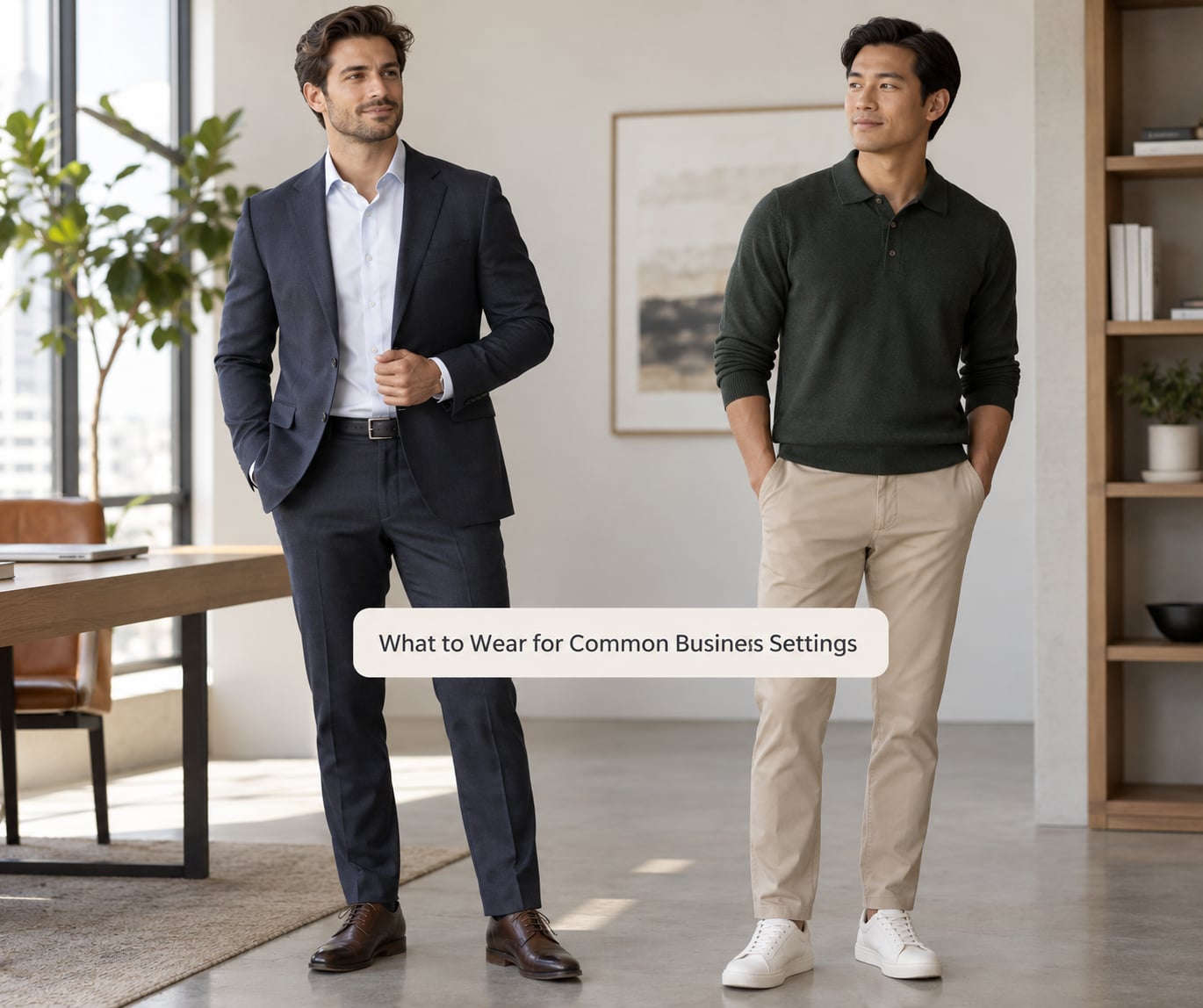
Concrete formulas beat abstract advice here, so these are the combinations that land reliably in each setting.
- Job interview: a tailored suit in navy or charcoal, a white or pale blue shirt, a tie if the role is finance, law or consulting, and polished leather shoes. A coordinated trouser-and-blazer set works almost as well.
- Client meeting: one step up from your everyday office look. Add the blazer, keep the shirt, swap to your most neutral color. The rule is that your client should not notice you dressed up, only that they notice you dressed well.
- Everyday office work: tailored trousers or a knee-length skirt, a button-up or fine knit top, a blazer you can remove indoors, and leather shoes. A tie is optional almost everywhere outside finance and law.
- Presentation or conference speaking: a full suit or a strong jacket-and-trouser combination in a solid color. You will be standing and moving, so check that everything still reads well from the back of a room.
- Networking event: one notch more polished than work, not less. A blazer, dark denim or tailored trousers, and leather shoes. Business casual or smart casual both work if the pieces are sharp.
- Hybrid or remote day: a clean top half for video calls in a neutral color, and comfortable bottoms nobody sees. Wear the blazer only if the calendar holds an external call.
One useful habit from people who do this well: build outfits around a layer you can add. The r/fashionwomens35 crowd described a routine of dressing in the middle of the range and adding a blazer they could take off if the day turned casual. It removes the guesswork without looking like a costume change.
How to Read Your Workplace or Industry
You cannot infer a dress code from a job title, so read it in this order instead. The first two steps settle most cases on their own.
- Read the employee handbook. Search it for dress, attire, appearance or grooming. Many companies publish an image board or a short list of examples, and that page is the closest thing to an authoritative answer you will get.
- Ask the recruiter or HR directly, before you start. One specific question gets a specific answer: what does someone typically wear to an in-office client meeting? Email trails count as a record, which matters later.
- Look at what people around you actually wear. The visible norms of your immediate team beat any written document, because that is what your manager is really comparing you against.
- Weight the client and public exposure. Count how many meetings a week are external. Nearly no client-facing role is served by business casual, however casual the rest of the office is.
- Start one notch higher, then adjust after week one. Overdressing for a few days is a minor oddity. Underdressing on day one is the thing that gets remembered, and it is the mistake new hires regret most.
When the handbook and the room disagree, follow the room, quietly, and fix the paperwork separately. On a Wall Street Oasis thread about a consulting offer billed as business professional every day, the advice that surfaced repeatedly was to watch the team for a few days before settling in. Overdressing is rarely penalized in practice; looking like you skipped the meeting is.
Industry sets the default. Law, finance, insurance and executive offices expect a suit. Consulting expects a suit on client days and less on internal days. Technology and most startups sit at business casual. Creative studios, academia and nonprofit work vary the most, and observation beats any general rule. Healthcare has its own separate professional uniform norms, with scrubs and clinical dress codes that sit outside this whole conversation.
What Business Professional Does Not Require
A business professional dress code does not require a matching suit, designer labels, a particular hairstyle, stilettos, or an outfit that never changes. None of those are part of the definition, though plenty of outdated listicles still imply they are.
The matching suit is the big one. A jacket with tailored trousers in a coordinating color, or a structured blazer with a skirt or chinos, is business professional in most industries. So is a dark, well-cut dress with a cardigan or jacket in cool weather. What makes an outfit read professional is fit, structure and a clean silhouette, not a two-piece match.
Labels are not required either. The quality of the wool, the shoulder line and whether the trousers break correctly at the shoe do the work that a brand name used to do. Plenty of people read as more senior in a well-fitting garment from an unremarkable label than in a badly fitted one from a famous one.
On grooming, there is a real expectation, and it is worth being honest about it. Hair and facial hair should be tidy, nails clean, and visible tattoos and piercings that an employer has restricted should be covered or out of sight. What it does not require is any particular length, color, or makeup level, and it never justified treating a wider accepted color range for women as anything other than an old double standard that people notice and complain about, correctly, on r/NoStupidQuestions and elsewhere.
Two exceptions are worth knowing. Conservative industries, courts and boardrooms still expect genuine formality. And occasional events, an awards dinner, an important client dinner, a funeral at the company, a wedding, are separate dress codes with their own logic. Read the invitation.
How to Make Your Outfit Feel Polished Without Being Rigid
Polish is mostly a handful of small decisions repeated consistently. None of them require money.
- Fit first. Shoulders sit at the shoulder seam, sleeves end at the wrist bone, trousers break once at the shoe. A tailor altering a cheap jacket beats buying an expensive one that does not fit.
- Choose fabric that holds shape. Wool, wool blends, cotton poplin and heavier knits. Wrinkled and shapeless is what casual looks like, not what comfortable looks like.
- Keep color close to neutral. Navy, charcoal, black, grey, cream, navy-adjacent blues, and one quiet accent. A colored shirt or a patterned skirt is an easy way to show personality while staying business professional.
- Shoes get more scrutiny than they earn. Clean, closed-toe, polished, and quiet enough to walk a hallway in. Block heels and loafers read as professional. Athletic shoes do not, unless your industry has genuinely made that the norm.
- Limit accessories to two or three. A watch, a simple ring, small earrings, one bag that holds everything. Remove the bulky necklace before the meeting rather than during it.
- Adapt to the climate. Office air conditioning is colder than the walk to the office. A cardigan or unstructured blazer solves that without changing your whole outfit, and it doubles as your layer on a casual day.
- Buy fewer, better pieces. New hires worry about the cost of a wardrobe they will replace in three years. A small set that works together, in two or three colors, wears far more often than a large varied one.
Comfort is part of professionalism now, not a compromise against it. If you are adjusting your shoulders all day, you are not presenting at your best. A shift dress, a wider trouser cut or a lower block heel solves more problems than any accessory.
Frequently Asked Questions
Does business professional mean I have to wear a suit?
No. A suit is the safest interpretation and the expected one in law, finance and consulting, but the code really describes a level of structure, not a two-piece match. A blazer with tailored trousers or a knee-length skirt in a coordinating color reads as business professional nearly everywhere. If you are unsure, ask what someone wears to a client meeting rather than what the label means in general.
Can I wear jeans as business professional attire?
Dark, clean, well-fitting jeans with no distressing can work in a business professional outfit in many industries, usually paired with a blazer, dress shirt and leather shoes. In conservative fields, wear trousers instead. Light-wash, ripped or frayed denim is the one version almost nobody accepts, because the distress detail is what reads as casual.
Is a blazer required for a business professional dress code?
In practice, yes, a jacket of some kind is the item that most reliably signals business professional rather than business casual. A tailored blazer, suit jacket or structured cardigan covers it, and in most offices you can take it off indoors. In finance and law, a full suit jacket is usually expected, and in creative environments you may not need one at all.
What should I wear on my first day with a business professional dress code?
Dress one notch above what you saw in the job posting, then adjust. A suit, or a coordinated blazer and trousers with a dress shirt, is a safe start. Bring one change of top and a pair of backup shoes. The risk worth avoiding is underdressing on day one; looking slightly formal for a few days costs almost nothing and reads as preparation.
What is not acceptable for a business professional outfit?
Distressed denim, athletic wear, flip-flops, shorts, casual logo-heavy pieces, wrinkled garments, strong cologne, and anything with visible logos or slogans. Torn hems, worn elbows and untidy shoes count too, and so does clothing that fits badly. The common thread across employer lists is neatness and fit rather than any single garment.
Does a business professional dress code apply on remote and video-call days?
Usually not in writing, but video calls create a small practical standard: your visible top half should look like work. Wear a clean, neutral-colored shirt or knit for external calls, and something comfortable below, since nobody sees it. Many employees also keep one blazer nearby purely for the days a morning meeting is added without warning.
Start with the handbook, then watch the room. Whatever business professional dress code means at your workplace, it is narrower than the phrase sounds and easier to satisfy than the anxiety suggests. Build five outfits that share pieces, keep a blazer where you can reach it, and adjust after your first week rather than before it.