Looking expensive is about fit, fabric, neutral colour discipline and grooming, not price tags. Get the fit right, wear matte natural fibres in a tight neutral palette, keep shoes and hems clean, and spend whatever you can spare on alterations. That is the whole game.
It also helps to know what you are not up against. Nobody can see your bank account across a room. They see whether your shoulders sit right, whether your trousers end where they should, whether your clothes are wrinkled, and whether your shoes look cared for. Those are the signals, and every one of them is adjustable on a small budget.
This guide assumes you are not shopping with a large surplus. If you are rebuilding a wardrobe while paying rent, saving for a car, or stretching one income across a lot of ground, everything here still applies. You do not need a new wardrobe to start. You need to look at what you already own.
Table of Contents
- What You Need
- Step-by-Step: How to Look Expensive Without Spending Much
- 1. Audit the fit of your best pieces
- 2. Build a tighter, more neutral color palette
- 3. Choose versatile pieces with a clean silhouette
- 4. Make accessories look intentional
- 5. Use contrast and texture without adding clutter
- 6. Keep hair, makeup, and shoes from undermining the outfit
- 7. Shop for fewer pieces and inspect them carefully
- Common Mistakes
- Fit is wrong in a way you keep ignoring
- Too many visible logos
- Mismatched colours across an outfit
- Over-accessorizing
- Wrinkled clothes
- Worn-out shoes and yellowing whites
- Copying a trend without adapting it
- Frequently Asked Questions
- What makes an outfit look expensive even when it is inexpensive?
- Can I look put together on a very tight budget?
- How can I style cheap clothes so they do not look cheap?
- Should I buy designer pieces to look more polished?
- What clothing items make the biggest difference in my wardrobe?
- Conclusion
What You Need
You need far less than most style advice implies. Almost the entire method runs on your existing clothes plus five things.
- A handheld mirror for checking hems, sleeve length and shoulder alignment without walking to a full-length mirror every time.
- A measuring tape, for comparing a garment against your own measurements rather than against the size on the label.
- A steamer or iron, because a wrinkled garment looks neglected no matter what it cost.
- A lint roller and a fabric shaver for surface fuzz and pills, which are the fastest tell of a fast-fashion piece.
- A few neutral accessories in one metal and one colour family, so everything you already own has something to work with.
Two optional items earn their place if you can spare them: a good wooden or padded hanger, which keeps shoulders from collapsing in storage, and shoe polish or a shoe-cleaning foam for leather. Beyond that, resist. Grooming products, colour-themed sets and gadget organisers all cost money and change how you look very little.
One honest note about tailoring: hemming trousers and taking in a waistband are the two alterations almost every tailor does cheaply, and they deliver more visible change per unit spent than any other purchase. Whatever else you do, start there.
Step-by-Step: How to Look Expensive Without Spending Much
Seven steps, in the order that actually moves the needle. You can see a real difference in a week without buying anything, and a larger one over a season.
1. Audit the fit of your best pieces
Most cheap-looking outfits are not cheap-looking because of the fabric. They are cheap-looking because the garment does not sit correctly on the body. Start by putting on the three pieces you reach for most and checking four things.
- Shoulders. The shoulder seam should end where your shoulder bone ends, not past it or short of it.
- Sleeve length. Cuffs should hit near the wrist bone. This one adjustment alone makes an ordinary shirt look intentional.
- Trouser length. A full break flattens the shoe, a slight break lengthens the leg, a cropped hem shows ankle. Pick one and hem the rest to match.
- Waist. Nothing should pull, strain or gape. Fabric that buttons smoothly without a gap is the cheapest polish there is.
Oversized is fine, but only with structure somewhere. A wide shirt over a slim trouser works. Wide shirt, wide trousers, wide coat, all at once, reads as shapeless. One loose piece plus one fitted piece is the whole trick.
How to check: stand sideways to the mirror with your arms down and look at the back of the garment. Anything pulling diagonally is a fitting problem, not a weight problem.
2. Build a tighter, more neutral color palette
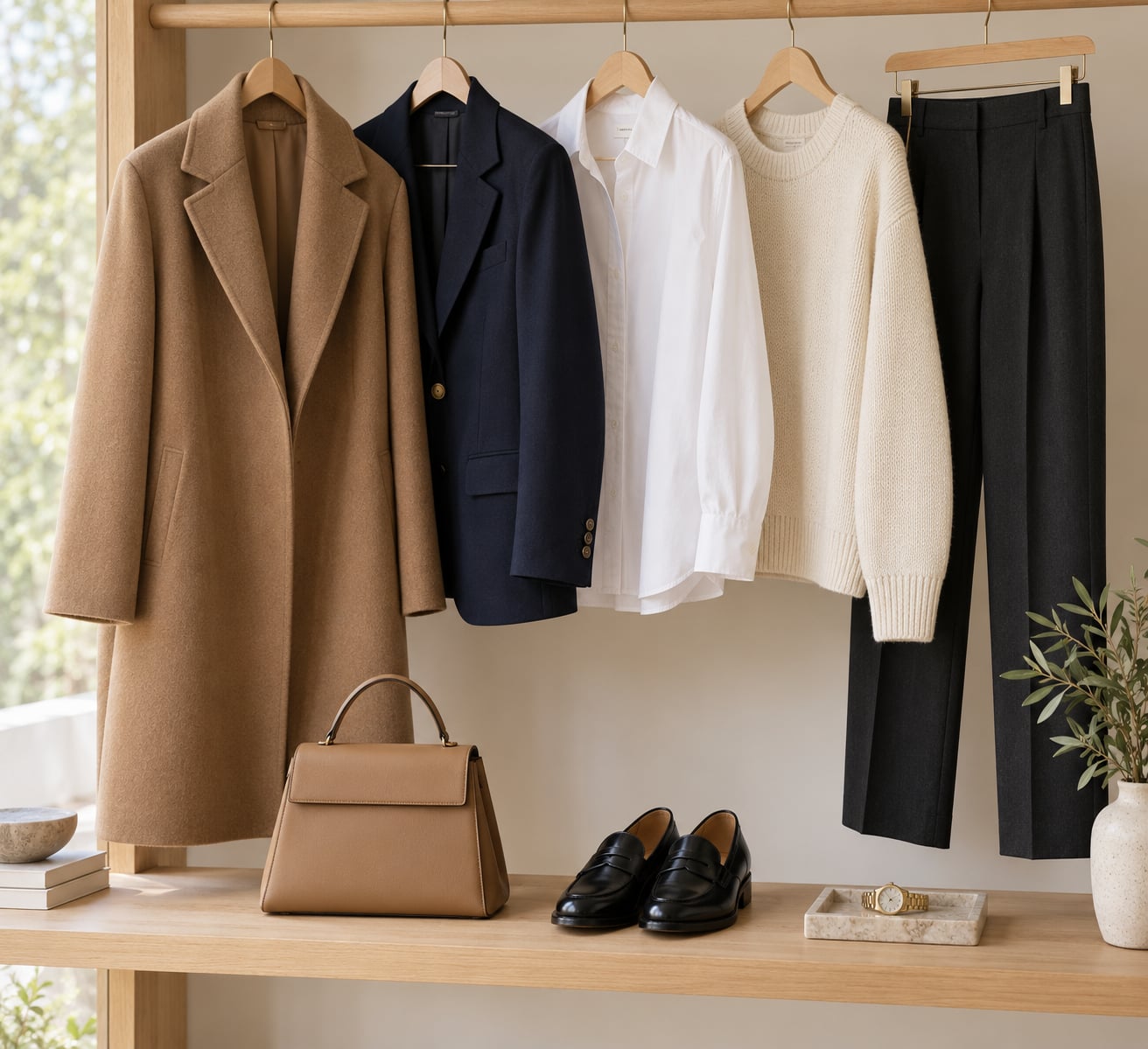
Camel, cream, ivory, black, navy, charcoal grey, crisp white and chocolate brown will cover more of your week than the full spectrum of colours currently in your closet. Neutrals mix with each other by default, which means half the outfits you own will suddenly work together.
Pick your two core neutrals and let the rest sit in the same family. Then add exactly one accent that you deliberately repeat: a red lip, a dark green bag, a rust scarf. One accent makes a neutral outfit look chosen rather than defaulted.
Use texture to keep monochrome from going flat. A cream knit, navy wide trousers and a camel wool coat in one colour family have depth because the surfaces differ. Same palette, three textures, no clash.
How to check: lay out tomorrow’s outfit and squint at it. If your eye goes immediately to a clashing colour rather than a texture or a clean line, something is off.
3. Choose versatile pieces with a clean silhouette
A small set of well-fitting pieces will carry more outfits than a large set of almost-right ones. The categories worth getting right are a coat with structure, tailored trousers or straight-leg jeans, a blazer that buttons without straining, a fine-knit top, a crisp shirt, one streamlined dress if that is your thing, and a pair of polished flat shoes or low boots.
What separates them from the cheap version is rarely the label. It is a lined body, a clean collar roll, a seam that finishes neatly inside, and a hem with real weight to it. Those are the details people mean when they describe something as well made.
Buy those categories in your neutral palette and you will be able to build a work outfit, a weekend outfit and one dinner outfit from the same group.
How to check: count the outfits you can list right now from the seven pieces above. Most wardrobes produce six or fewer. That number is your target.
4. Make accessories look intentional
Three accessories, chosen once, do more for an outfit than a drawer full of options. A structured bag with a defined shape, one watch or bracelet, and earrings or a belt that repeats a metal already in the outfit. Consistency is what reads as taste.
Pick one metal and stick with it within an outfit. Mixing gold and silver across a single look is one of the most common reasons an otherwise good outfit looks thrown together.
Scale matters as much as quantity. A chunky bag with fine jewellery, or a slim bag with one bold piece, both look decided. Five medium-sized items at once just looks busy.
How to check: remove everything, then put back only what earns its place. Anything you hesitated over stays out.
5. Use contrast and texture without adding clutter
The cheapest way to make simple clothes look considered is to give them something to contrast against. Matte against shiny, structured against fluid, smooth against nubby. Three low-cost combinations that work:
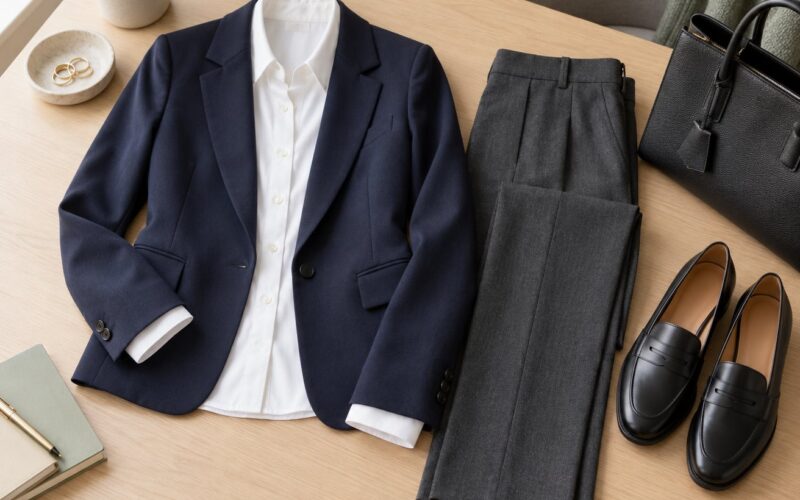
- Office: a crisp white shirt under a well-fitting navy blazer, with straight-leg trousers in charcoal and black loafers. The contrast is the sharp collar against the soft blazer.
- Brunch: a cream fine-knit with straight-leg jeans in a true dark blue, finished with a camel coat and a small leather bag. Same palette, four textures.
- Evening: a black column dress with a cream knit draped over the shoulders and one piece of gold jewellery. The knit breaks the monochrome without adding a colour.
Each one works because the surfaces differ, not because anything expensive is involved.
6. Keep hair, makeup, and shoes from undermining the outfit
An expensive-looking outfit with scuffed shoes and chipped nail polish reads as a costume. Hair, nails and shoes are the last mile, and they cost very little to maintain.
Clean hair in a sleek low bun or loose waves suits a tailored look more than a badly brushed blowout. Brows defined, skin tone even, nails trimmed and filed, cuticles tidy. A signature scent you wear every day does more for how put-together you seem than any single garment.
Shoes: clean leather, resoled before the tread flattens, stored in dust bags rather than on the floor. Wipe soles before you walk out. Scuffed soles are visible to everyone and only to you while you are standing still.
How to check: look at your shoes and your nails before you look at your outfit. Fix those first and the rest of the look falls into place.
7. Shop for fewer pieces and inspect them carefully
Buying less and choosing better is the only free trick left in the system. Before you buy, run five checks. Turn the garment inside out and look at the seams. Count stitches per inch along a side seam. Even, dense stitching is a sign the maker budgeted for construction; sparse, skipping or uneven stitching is not.
Check the lining. A lined jacket or coat will hang properly and sit smoother than an unlined one, and it costs a tailor less to work on later. Then look at hem finishing: is it machine-finished and enclosed, or raw and loose inside?
Pull the fabric gently. Good drape falls back into place. Cheap fabric stays creased. Hold it up to a window; heavy shadow and a visible hand of skin mean it is thin. Finally, weigh the buttons and zips in your hand. Hardware feels obvious when you have handled both kinds.
Online, you cannot do any of that, so substitute: read the fibre composition, look for close-up review photos rather than styled shots, and check the return policy before you commit. A garment that fails three or more of the five checks will not become a good outfit by wishing.
Keep tags on until you have worn a piece a few times. Most returns happen because the fit was wrong, not the colour.
Common Mistakes
Even a good budget wardrobe can be sabotaged by a handful of habits. Each of these gives the game away faster than fabric ever will.
Fit is wrong in a way you keep ignoring
Yes, the top gapes at the waist and the trousers have never been hemmed. Noticing it and not fixing it is the mistake. Have both altered rather than replacing them.
Too many visible logos
One logo can read as a choice. Three read as an advertisement, and on a small budget they advertise a budget. Unbranded basics solve this better than anything else: simple clothes that fit well never date, and nobody reads them as cheap.
Mismatched colours across an outfit
A warm cream next to a cool blue-white will look wrong every time. Warm and cool neutrals both work well, together and separately. Mixing them in one outfit is what reads as a mistake.
Over-accessorizing
Necklace, earrings, bracelet, ring, belt, bag, scarf, sunglasses, brooch. Pick three and remove the rest. The same pieces worn alone look polished in a way the full set never will.
Wrinkled clothes
Hang your outfit the night before and steam it in the morning. A handheld steamer does more for how expensive you look than most of what you could buy, and it lasts years.
Worn-out shoes and yellowing whites
Scuffed soles, creased uppers and grey-white shirts read as neglected. Clean them, treat them, and replace the one pair that is genuinely finished. Shoes are the part of an outfit people notice first.
Copying a trend without adapting it
A trend silhouette designed for one body or one height will look borrowed on everyone else. Take the idea, change the proportion until it fits you. Fashion advice repeating in your feed is mostly written for a sample-size frame; the rest of us have to translate.
A few general tips to close on. Choose quality over quantity in the categories that get seen most, and keep quiet about the rest. Wash carefully, fold knits, hang structured pieces, and give leather and suede a season of use before judging them. Learn the five fabric checks and stop guessing. Above all, wear a smaller number of pieces that fit perfectly rather than a wardrobe of nearly right.
Frequently Asked Questions
What makes an outfit look expensive even when it is inexpensive?
Four signals do most of the work: a garment that fits your shoulders, waist and hem correctly; fabric that looks matte and substantial rather than thin and shiny; a controlled palette of neutrals with one deliberate accent; and clean, maintained shoes and grooming. People judge an outfit in seconds, and these are what they read. None of them depend on a price tag, and all of them can be changed for very little.
Can I look put together on a very tight budget?
Yes, and the honest answer is that your existing wardrobe contains almost everything you need. Start by having your best-fitting trousers hemmed and your best shirt sleeves shortened, because fit is the cheapest and fastest upgrade available to you. Then narrow what you wear to neutrals, care for what you own with a steamer and a fabric shaver, and stop buying pieces that only work as one outfit. Spending less but wearing what you own more often is the entire strategy.
How can I style cheap clothes so they do not look cheap?
Treat inexpensive pieces like tailoring samples. Alter anything that pulls or gapes, press rather than scrunch, de-pill before wearing, and swap a shiny synthetic for a matte cotton, linen or wool-blend version in the same colour. Add one structured accessory to anchor the look, keep accessories to three, and make sure shoes are clean and soles are intact. Cheap fabric becomes invisible once nothing about the garment is sloppy.
Should I buy designer pieces to look more polished?
No, not to start. Construction is a manufacturing decision rather than a creative one, so a designer garment is not automatically built or cut better than a good non-logo one. What you actually notice is fit, surface quality, colour discipline and condition, and none of those are controlled by the label. Spending on alterations, one good coat and one excellent pair of shoes will read as more polished than a logo on an ill-fitting garment.
What clothing items make the biggest difference in my wardrobe?
A well-fitting coat, tailored trousers or straight-leg jeans, a blazer that buttons without straining, a crisp shirt, a fine-knit top and a pair of clean structured shoes. Those six categories generate more outfits than everything else combined, and they are the pieces where fabric and fit actually get noticed. Once they are right in your neutral palette, the rest of your wardrobe gets easier to style.
Conclusion
To look expensive without spending much, change four things in order: the fit of your best pieces, the number of colours you wear, the quality of the handful of categories you actually use, and the condition of your shoes and grooming. Take one outfit you already own, fix the hems and the sleeve length, cut it back to two neutrals and one accessory, and wear it this week. That single exercise will teach you more than another round of shopping.