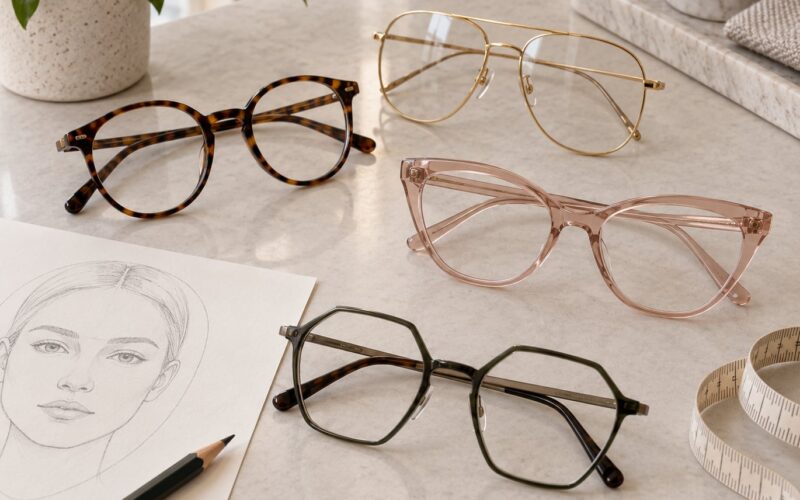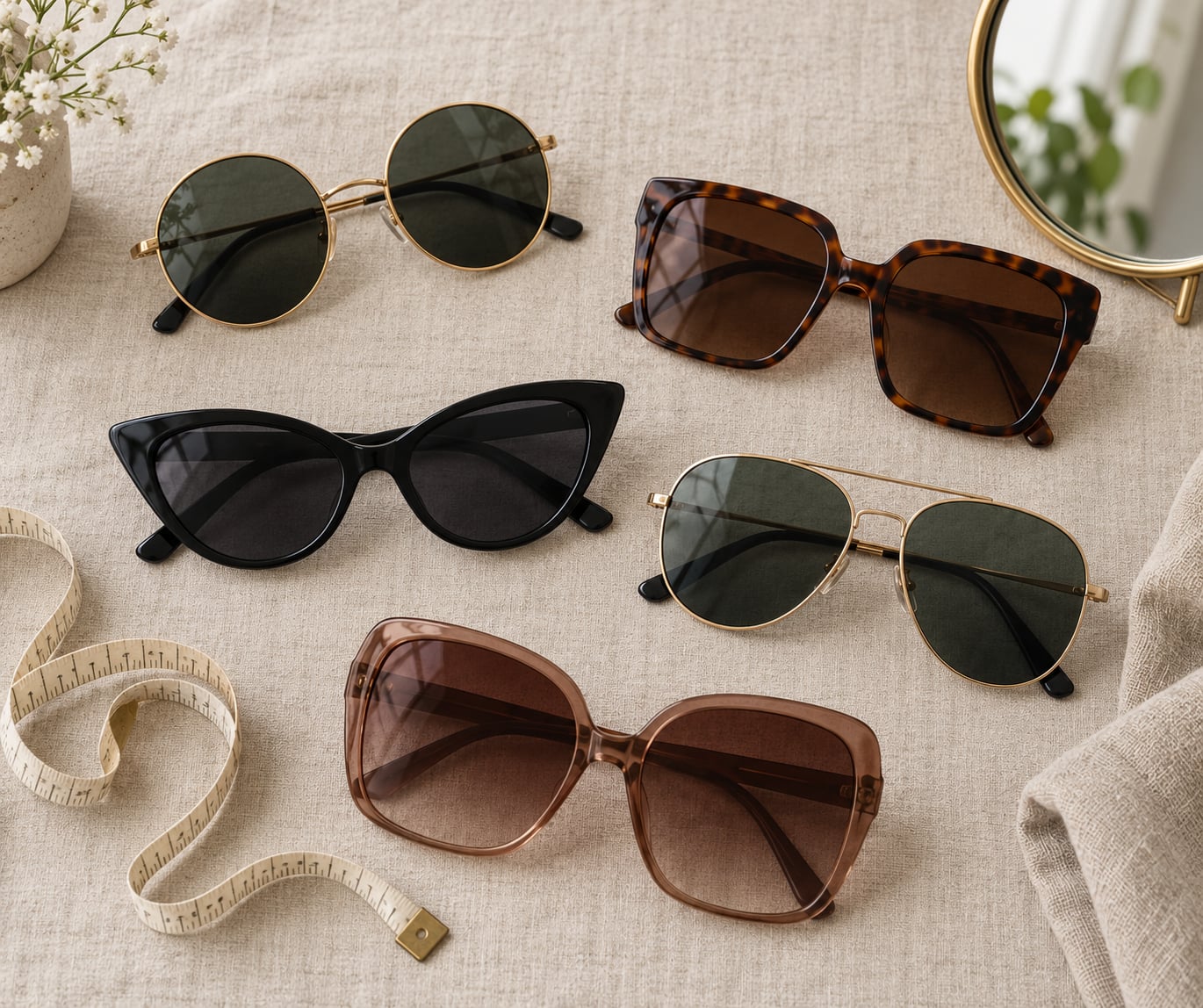
To pick sunglasses that suit you, work out your face shape, then choose a frame that contrasts it and sits at the right width on your face. Face shape tells you which silhouettes flatter you; frame width and lens choice decide whether the pair is actually wearable every day. The whole process takes about twenty minutes in a shop with a mirror.
It usually goes wrong in one of two ways. Either people buy a shape because it looked good on someone else, or they buy on impulse from a product photo and discover the proportions are wrong on their own face. Both are avoidable if you measure first.
Updated for October 2026.
Table of Contents
- What You Need
- Step-by-Step
- How to Match Sunglasses to Your Face Shape
- How to Choose a Color and Lens Tint
- How to Check Fit, Comfort, and Quality
- Common Mistakes
- Frequently Asked Questions
- What are the most flattering sunglasses to wear?
- How do I check my face shape for sunglasses?
- What should I avoid when buying sunglasses?
- What face shape should not wear aviators?
- Should I get 52 or 54 glasses?
- Can AI pick glasses for me?
- Conclusion
What You Need
Nothing exotic. You need a soft tape measure or a ruler, a mirror with enough light, and your phone camera for photos from the front and side.
Before you try a single frame, gather a few facts about yourself:
- Your face shape. Compare the width of your forehead, cheekbones and jaw. More on that below.
- Your colouring. Warm or cool undertone, hair colour, and the two or three colours you wear most.
- Your usual outfits. The frames need to work with clothes you actually own, not an imagined capsule wardrobe.
- Where you wear them. Driving, beach, cycling, running, or mostly fashion.
- Your budget range. A number you are comfortable with, so you stop browsing on impulse.
- A prescription, if you have one. That changes the shortlist more than anything else on this list.
If you wear glasses already, note where they press. Frames that pinch at the nose after an hour will pinch whether or not they are fashionable.
Step-by-Step
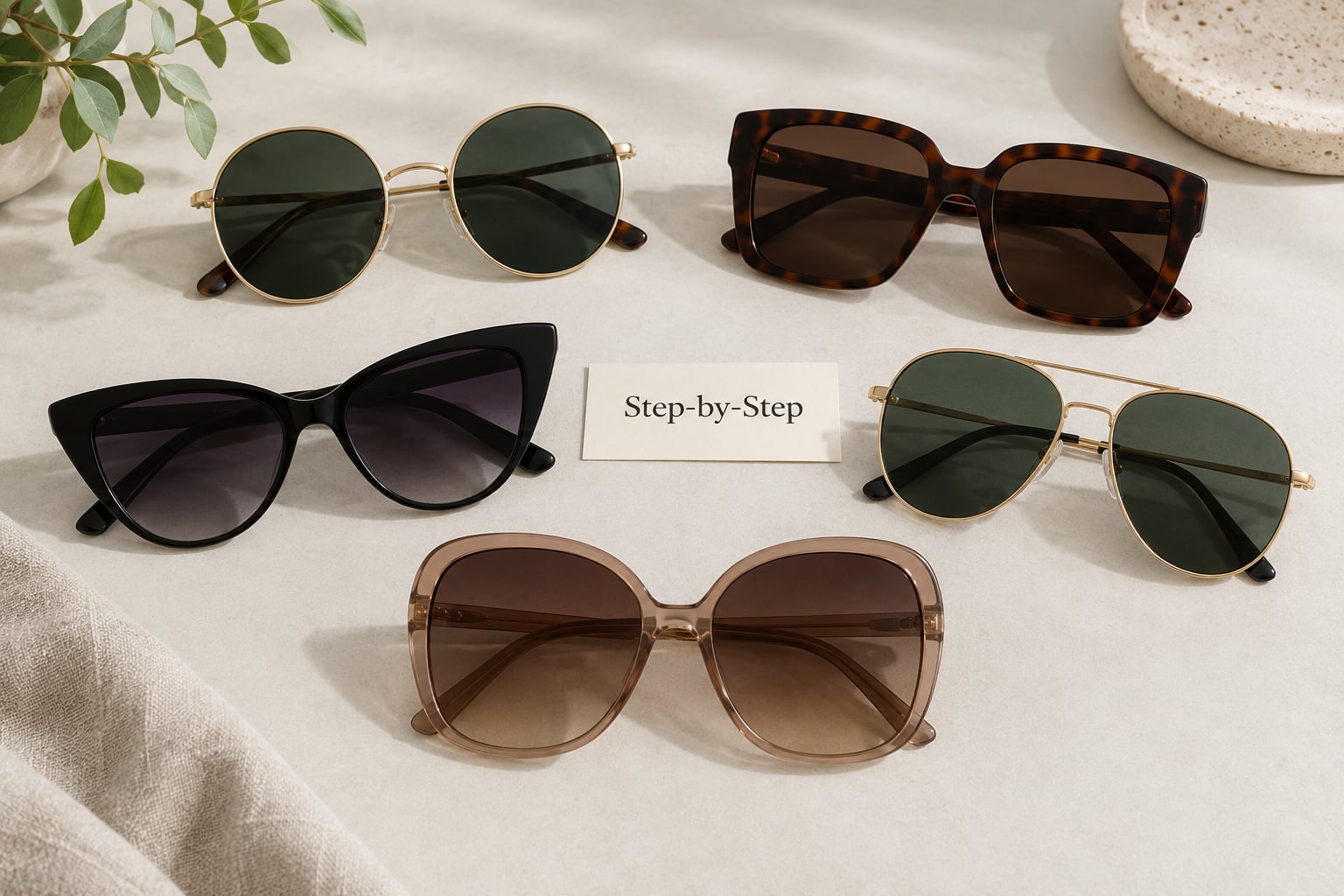
How to Match Sunglasses to Your Face Shape
Face shape is just the relationship between three widths: forehead, cheekbones, jaw. Pull your hair back, look straight into a mirror, and either eyeball it or measure across the widest point of each with a tape measure held level.
Whichever section is widest tells you your shape. If forehead and cheekbones match and both are wider than the jaw, you have a heart or triangle face. If the jaw is the widest point with a defined angle, you have a square face. If cheekbones are clearly the widest, you have a diamond face. Equal widths all round, you have an oval. Cheeks wider than both other sections with a soft jaw, round. Forehead and jaw similar but the whole face noticeably longer than it is wide, oblong.
Now match the frame to that structure. The rule is contrast: a frame that echoes your face shape repeats its angles, and a frame that pulls the other way visually adjusts them.
| Face shape | Frame shapes that work | Frame shapes to try carefully | Why |
|---|---|---|---|
| Oval | Almost anything, from aviators to cat-eye to geometric | Very narrow frames that leave the temples bare | An oval face is already balanced, so proportion matters more than shape |
| Round | Cat-eye, browline, square, geometric, angular rectangle | Small round frames, thin round wire | Straight lines and lifted outer corners make the face read longer and more defined |
| Square | Round, panto, oval, softened cat-eye, rimless | Heavy square acetate with a straight top bar | Curves interrupt the jaw angle and take weight off a strong line |
| Heart | Aviator, navigator, round, wider styles near the jaw | Narrow cat-eye that pinches to a point at the cheek | Visual weight below the cheekbone balances a narrow chin |
| Diamond | Cat-eye, browline, oval, rimless, delicate thin frames | Chunky frames that stop at the widest point of the cheek | Delicate bridges and upturned corners connect forehead to jaw |
| Oblong or long | Wide, deep frames, browline, oversized square | Tall narrow frames that add more length | Width cuts the length of the face |
| Triangle | Cat-eye, round, softened square, anything narrowing to the chin | Broad frames wider than the jaw on a strong jaw | Keeps attention away from the widest lower section |
Treat that table as a starting point, not a rulebook. The recurring comment on style forums is that there are no strict rules and you should play around with shapes. If a frame makes you feel good and fits properly, it works, whatever your face shape.
How to Choose a Color and Lens Tint
Colour works on the same contrast principle. Warm tortoise, amber, camel and gold metal tend to suit warm complexions with red, gold or olive undertones. Cool black, navy, grey, silver and crystal suit cool complexions with pink, blue or neutral skin.
Your hair colour is a decent shortcut. Warm hair pairs easily with tortoise and honey acetate; cool hair with black, navy and grey. When you are unsure, a neutral frame that matches your shoe colour or watch strap rarely clashes.
The lens matters as much as the frame, and this is where most guides go quiet. Tint is the darkness of the lens, and it decides what you can cope with for how many hours.
| Lens type | Best for | Watch out for |
|---|---|---|
| Light tint, category 1 | Indoors, overcast winter days, driving in low light | Offers almost no glare reduction |
| Medium tint, category 2 | Everyday wear, spring and autumn, walking around | Too dark for driving at dusk |
| Dark tint, category 3 | Bright summer sun, driving, beach | Children under three should not wear these |
| Very dark tint, category 4 | Glacier, desert, water sports | Not legal for road driving in many countries |
| Polarised | Driving, water, cycling, glare off roads and water | Can make screens and dashboard displays harder to read |
| Gradient | Everyday, driving, city use | Less protection than a solid dark lens of the same depth |
Polarised lenses cut glare from wet roads and water, which is why they feel so good in a car. The trade-off is that they dim some screens, including a dashboard display and a phone. If you read your navigation a lot, test a pair first.
How to Check Fit, Comfort, and Quality
Shape is the least important thing about fit. Width is the most important, and you can measure it.
Frame measurements are printed on the inside of one temple arm in a format like 52-18-145. The first number is lens width, the second is bridge width, the third is temple length. Ask any shop to show you, and check what they measure if a frame you like carries the 52 or 54 figure people argue about online.
Community measuring guides put face width, temple to temple, into rough bands: narrower faces around 118-128mm, average faces 129-139mm, wider faces 140-150mm total frame width. Use those as a starting point, then confirm in person.
Once a pair is on your face, run four checks:
- Cheekbone line. The bottom edge of the lens should sit at or just below your cheekbone, never cutting across the middle of your cheek.
- No light leak. Tilt your head down slightly. If daylight cuts in above the lens, the frame sits too low or too wide.
- No pinching. Give it ten minutes, not ten seconds. Pressure marks on the sides of your nose mean the bridge is too narrow.
- No slipping. Look down and shake your head gently. If they slide toward your nostrils, the temple arms need adjusting or the frame is too big.
On quality, check four things before you pay. Look for a UV400 marking or an equivalent certification, because a printed sticker on a cheap pair proves nothing. Flex the hinges gently; a good metal hinge pulls straight back and returns. Hold the frame at arm’s length and tilt it to catch light across the lens, looking for distortion. And ask whether the lenses can be replaced, because lenses scratch and frames rarely do.
Face shape is only the first filter. Nose bridge shape and where your ears sit decide whether a flattering frame is wearable, which is why the same 52-18-145 frame can suit two faces and fit only one of them.
Common Mistakes
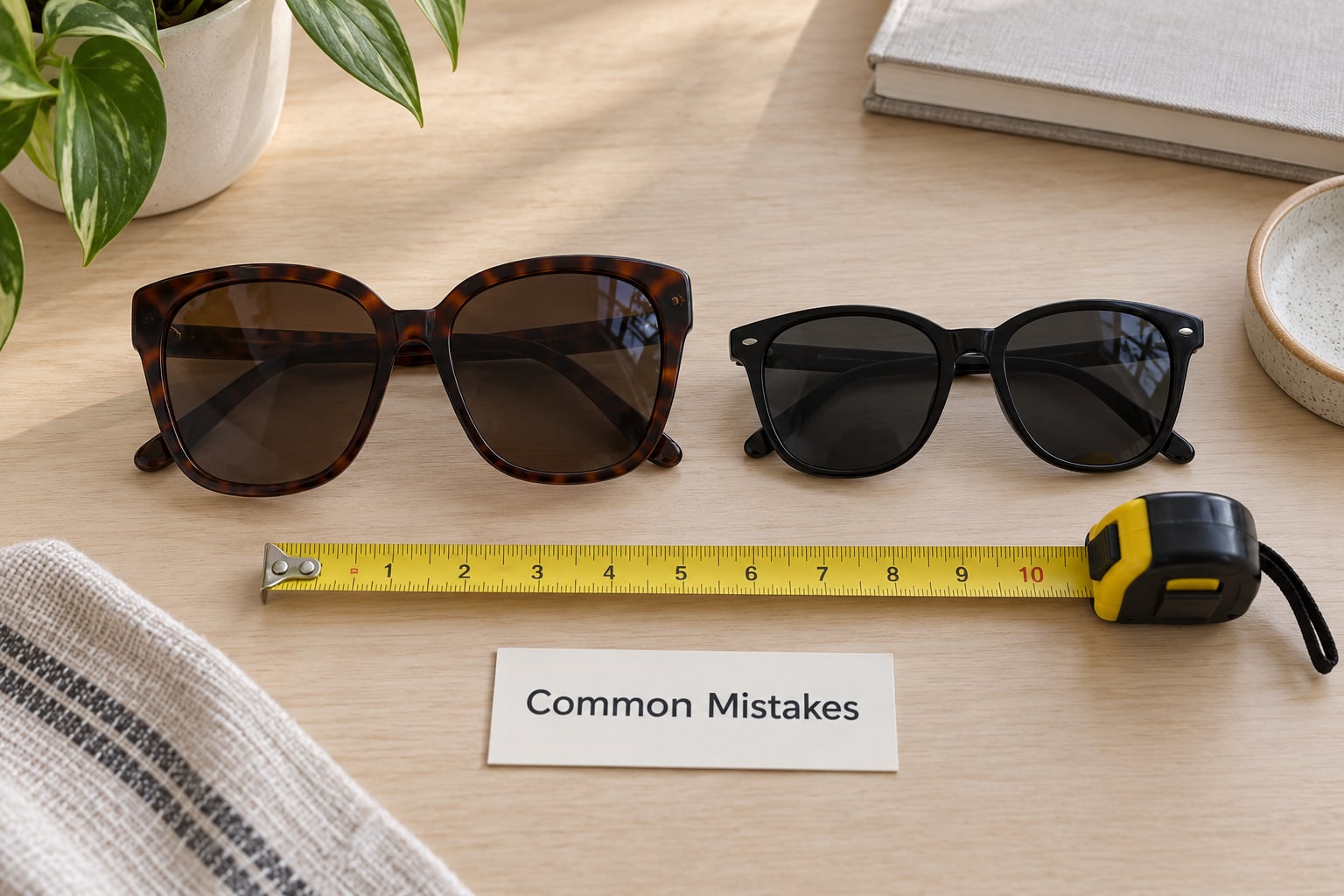
Buying from a product photo. Flat-lay photography flatters almost anything. Fix: photograph yourself in the frame from the front and the side, in daylight, before you commit.
Ignoring the frame width. This is the mistake behind almost every disappointment I have seen described. Fix: check the measurement printed on the temple arm against your face width.
Skipping the lens check. Fit, tint and protection are separate decisions from shape. Fix: verify UV protection, look at the lens under a light for distortion, and confirm the tint suits your conditions.
Ignoring the nose bridge. A narrow bridge on a wide face slides and pinches. Fix: try on two pairs of the same frame in different bridge widths if you can.
Following trend rules too strictly. Nobody looks worse in aviators because of their face shape. Fix: treat matching tables as a starting point and buy what you actually like.
Wearing a pair that hurts. Comfort decides whether sunglasses get used daily. Fix: wear any pair for at least ten minutes before buying it.
Two smaller habits help. Buy a second pair in a shape that handles different light, and store sunglasses in a case rather than loose in a bag, since a single scratch can distort your view and a dropped pair usually bends a hinge for good.
Frequently Asked Questions
What are the most flattering sunglasses to wear?
The most flattering pair is the one whose width matches your face at the temples and whose shape contrasts your structure. Angular frames suit round faces, curved frames soften square jaws, and wide frames shorten a long face. On an oval face almost any well-proportioned shape works, so use style rather than rules as the deciding factor.
How do I check my face shape for sunglasses?
Pull your hair back, face a mirror straight on, and compare the widest point of your forehead, cheekbones and jaw. The widest section names your shape: jaw widest means square, cheekbones widest means diamond, forehead and cheekbones both wider than the jaw means heart or triangle, and near-equal widths with a longer face mean oblong. A tape measure across each section makes it clearer.
What should I avoid when buying sunglasses?
Avoid frames far wider or narrower than your face, frames that pinch at the bridge after ten minutes, and lenses with visible distortion when tilted under light. Treat a printed UV sticker with no certification as meaningless. Skip buying from a product photo alone, and skip very dark lenses if you drive regularly or expect to wear them indoors.
What face shape should not wear aviators?
No face shape is banned from aviators. The silhouette is widest at the top and narrows at the chin, so it suits heart, triangle and oval faces particularly well because it adds width below the cheekbone. On a very round or very wide face the teardrop can read as another curve rather than a contrast, so a squarer frame may suit better. Try both.
Should I get 52 or 54 glasses?
The 52 and 54 figures are lens widths in millimetres, and they say nothing on their own about how a frame will fit you. Judge the total frame width against your face width at the temples, roughly 118-128mm for narrower faces and 129-139mm for average ones. Bridge width and temple length change how the frame sits just as much as lens width.
Can AI pick glasses for me?
Virtual try-on tools are good at one thing: letting you compare several shapes and colours without a shop trip. They cannot judge how a frame sits on your nose bridge, whether it pinches after an hour, or how a lens tint performs at real glare levels. Treat them as a filter for shapes you like, then confirm fit and comfort in person.
Conclusion
Start with proportions. Measure your face width, find a frame whose total width matches it, and confirm the bridge does not pinch after ten minutes. Everything else is refinement: choose a frame shape that contrasts your structure, pick a lens tint for where you actually spend your days, then let personal preference overrule any table.