Knowing how to choose jewelry for your neckline comes down to one rule: either echo the shape of the opening, or deliberately contrast it, but never let the chain land exactly on the fabric edge. That single detail is why a necklace that looked great in the shop reads as slightly wrong in an outfit. Get the shape and length right and the whole upper half of the outfit settles.
The good news is that this is a five-minute decision once you know what to look for. Start by naming your neckline honestly, decide how much visual weight the outfit already carries, and then pick jewelry that either fills an open frame or clears a closed one.
Table of Contents
- What You Need
- Step-by-Step: Match Jewelry to Your Neckline
- 1. Identify the neckline’s shape and openness
- 2. Choose a necklace shape that echoes or contrasts intentionally
- 3. Match the jewelry’s visual weight to the neckline
- 4. Choose the right length for the opening and the outfit
- 5. Coordinate metal, color, and texture
- 6. Style the complete look, not just the neckline
- Common Mistakes
- Frequently Asked Questions
- What jewelry is best for a V-neck?
- Should jewelry match the color of my top?
- Can I mix gold and silver jewelry?
- What necklace length works with a crewneck?
- How do I choose jewelry for a strapless neckline?
- How many statement jewelry pieces can I wear at once?
- Start With the Neckline
What You Need
Before you pick anything, pin down four things. First, the neckline itself, described plainly: is it closed at the base of the throat, open to the collarbone, or plunging to the chest? Second, how much emphasis the rest of the outfit already has, including sleeves, shoulders, prints, and waist detail.
Third, the metals and finishes you actually own. You do not need a large collection to do this well, and matching what you already wear is more useful than any rule. Fourth, anything already planned for the look, including earrings, so the necklace is not competing with a pair of drop earrings you have already chosen.
That is genuinely all. I do it in that order every time, and it stops the decision from turning into a fitting-room spiral.
Step-by-Step: Match Jewelry to Your Neckline
1. Identify the neckline’s shape and openness
Classify your neckline as open, closed, rounded, angular, high, or low. Most are two of those at once, and that pairing is what tells you what shape of jewelry to reach for.
A V-neck is angular and open. A square neck is angular and closed. A scoop is rounded and open. A turtleneck is rounded, closed, and high. A strapless bodice is open all the way down. Once you can say your neckline is “angular and open” without guessing, the rest is straightforward.
If you cannot name it, describe the shape out loud in plain words and start from there. Plenty of people get stuck not because the rule is unclear but because they do not know the vocabulary.
2. Choose a necklace shape that echoes or contrasts intentionally
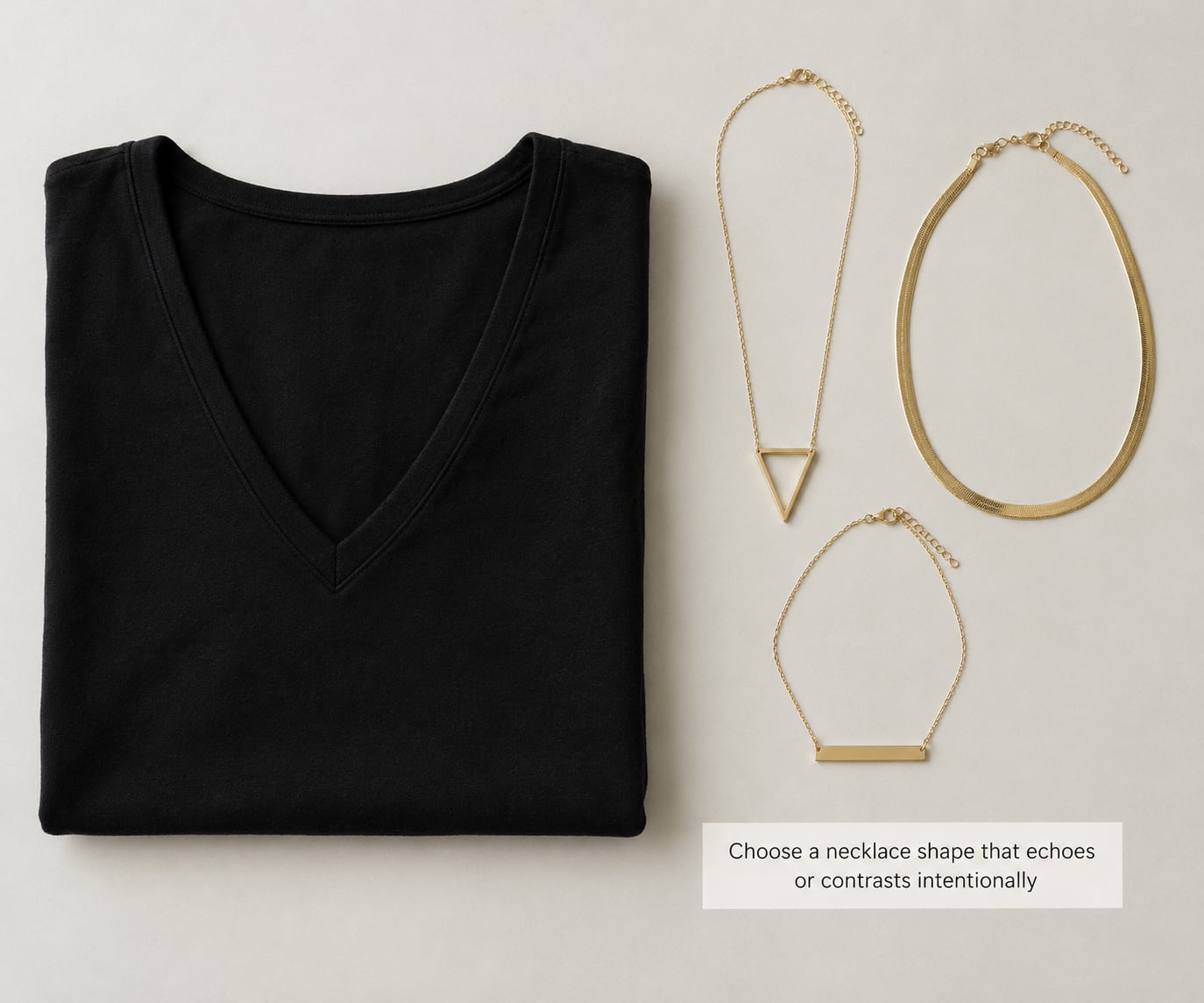
Echo the shape when you want the outfit to read as one clean line. A V-shaped drop or Y-pendant sits inside a V-neck and repeats its angle. A rounded or teardrop pendant follows a scoop or crew. An angular geometric pendant matches a square neckline.
Contrast when the neckline is very plain or very structured and needs a point of interest. A round or curved pendant over a square neckline breaks the geometry in a way that looks intentional. A sharp pendant over a soft cowl neck does the same thing.
What kills a look is a third option: a necklace that neither matches nor opposes, so it just sits there. If you cannot articulate why the shapes relate, change one of them.
3. Match the jewelry’s visual weight to the neckline
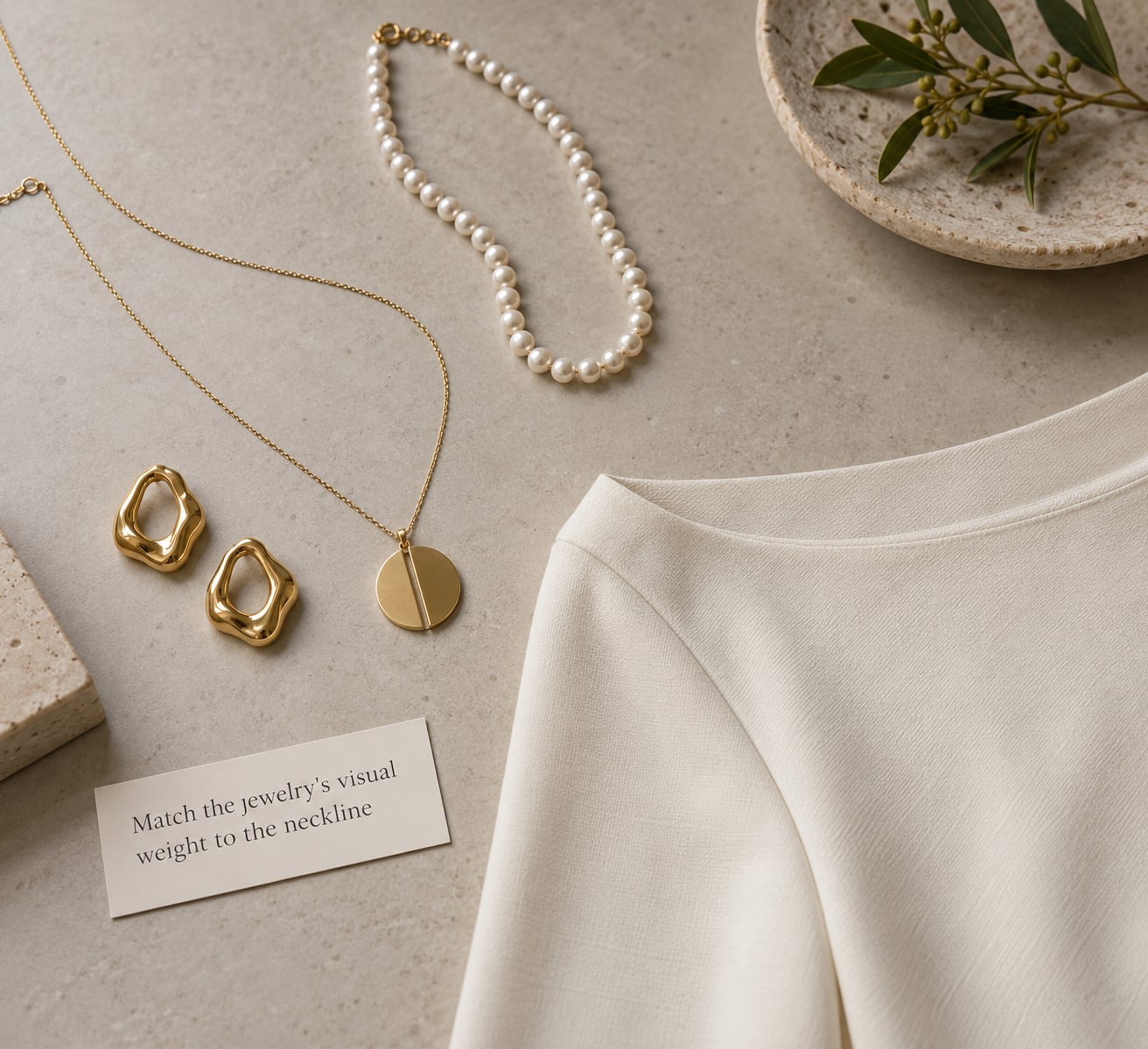
Delicate jewelry suits fine, close-fitting necklines. A crew or boat neck is already a clean, quiet frame, so a fine chain, a small beaded strand, or a tiny pendant sits on it without fighting.
Bold pieces anchor open, structured, or high-contrast necklines. A strapless bodice, a plunging V, and an off-the-shoulder line are all missing something, and a chunky chain, a bib, or a lariat fills that space and keeps the eye centred.
The balance test is simple. If the neckline is the loudest thing in the outfit, keep the jewelry quiet. If the neckline is plain and the fabric is plain, let one piece carry the interest. One statement piece at a time; two competing focal points always look unresolved.
4. Choose the right length for the opening and the outfit
Length is where most outfits go wrong, because people buy by what looks nice in a photo and not by where the chain will land on them. Measure against the neckline itself: a chain that ends right at the fabric line is the single most common complaint I hear about jewelry and necklines, and it is the easiest thing to fix with an adjustable chain.
Rough guides: a V-neck usually wants a pendant that finishes a couple of inches inside the V or below it. A crew neck takes a choker or collar at 12 to 14 inches, or a princess length at 16 to 18 inches sitting cleanly on the fabric. A turtleneck wants either a close collar at 14 to 16 inches or a longer chain at 20 inches and up, so the fabric reads as a backdrop. A scoop neck wants the drop to follow the curve, usually 18 to 20 inches. Square and sweetheart necklines work best with a shorter pendant at 16 to 18 inches so the corners stay visible. A strapless or plunging neckline can take anything from 18 to 30 inches because there is plenty of skin to work with.
To measure a chain you already own, lay it flat on a table, smooth it out, and measure from clasp to end with a soft tape. A sheet of paper and a pen work fine too. That number tells you instantly whether the piece is a choker, a princess, a matinee at 20 to 24 inches, or an opera at 28 to 36 inches.
5. Coordinate metal, color, and texture
Decide the relationship between the jewelry and the clothing rather than matching blindly. A warm gold against cream, camel, olive, and warm red tones looks settled. Silver or white gold against black, navy, white, and cool blue tones does the same. When the clothing has its own metal hardware, such as buttons, a buckle, or a bag clasp, match that metal.
Texture adds a second dimension. A matte or brushed piece beside a smooth jersey fabric looks clean, while a highly polished chain catches light and needs a quieter fabric nearby. Pearls read as soft and work beautifully against knitwear and evening fabrics.
Mixed metals are fine when they are deliberate. Keep one metal clearly dominant and let the second appear as a small accent, ideally in the same area of the body, such as mixed earrings with a single-metal necklace.
6. Style the complete look, not just the neckline
A necklace is one element of an outfit, not the whole of it. Earrings set the tone: drops or statement shapes suit open necklines where there is room beside the jaw, while studs or small hoops suit high and closed necklines that already carry detail. Hair matters too, since an updo exposes the neckline and gives a choker room to breathe.
Rings, bracelets, and belts can either pick up the necklace metal or deliberately stay in a different register. Keep the repetition intentional. If three pieces share one metal and one piece does not, that mismatch needs a reason, and usually the simplest reason is that you meant to make it.
Finish with one practical check. Look at the outfit in a mirror at conversation distance, not inches away. If your eye snags on one spot, that is the spot to fix, whether it is a chain on a collar edge or two competing pendants.
Common Mistakes
Choosing jewelry by trend alone. The piece was popular, but it does not relate to your neckline. Fix: apply the shape test from step 2 before you buy, and skip anything you cannot justify against the outfit’s geometry.
Ignoring garment proportions. A very fine chain on a wide-shouldered, heavily detailed top disappears. Fix: scale the jewelry to the frame. Broad shoulders can carry a bolder chain; narrow shoulders usually suit finer lines and shorter drops.
Wearing several competing statement pieces. A large necklace, big drop earrings, a chunky bracelet, and a wide cuff all at once. Fix: pick one focal point and keep the rest supporting.
Placing a necklace over a high neckline. A chain that sits exactly on the collar edge is the most repeated styling complaint in reader discussions, and it is the reason so many high-neck outfits get abandoned. Fix: either tuck the chain fully under the fabric for a clean mock neck effect, or push it clearly to one side and layer it above the collar at 14 to 16 inches.
Picking a length that interrupts the face. A busy pendant at chin height cuts the neck in half. Fix: use the mirror check and let the chain end at the collarbone or below it.
Adding a necklace when the neckline needs none. Halter necks, high ruffled collars, and detailed cowls often look better bare at the throat. Fix: skip the necklace, wear the earrings, and let the fabric texture do the work. No necklace is a legitimate styling choice.
Frequently Asked Questions
What jewelry is best for a V-neck?
A pendant that repeats the V, or a chain that finishes inside or below the point of the opening. A Y-pendant or angular drop echoes the angle without crowding it, and a curved or round pendant contrasts with it if the neckline is very plain. The practical rule is to leave a couple of inches of space between the bottom of the V and your pendant so the chain never lands on the fabric edge.
Should jewelry match the color of my top?
Match the metal to the color family rather than to the exact shade. Warm metals suit cream, camel, olive, rust, and burgundy; cool metals suit black, white, navy, and grey. When you are unsure, match the jewelry hardware already in the outfit, such as buttons or a bag clasp. A deliberate mismatch also works when one piece clearly dominates.
Can I mix gold and silver jewelry?
Yes, as long as the mix looks intentional. Keep one metal clearly dominant and use the second as an accent rather than an equal partner, and keep them in the same area of the body so the eye reads it as one choice. Two-tone pieces are the easiest way to bridge both. Avoid mixing when the outfit already carries warm and cool metal details of its own.
What necklace length works with a crewneck?
Two good options, depending on the fabric. For a close-fitting jersey or knit crew, a choker or collar at 12 to 14 inches sits cleanly above the neckline. Over a heavier sweatshirt or chunky sweater, a longer chain at 20 inches or more lets the garment read as texture and avoids the chain resting on the collar edge. An adjustable chain makes both easy.
How do I choose jewelry for a strapless neckline?
Treat the empty décolletage as an invitation. A statement necklace, a lariat, a bib, or a chunky chain fills the space and keeps the eye centred, and almost any length from 18 to 30 inches works because there is plenty of skin showing. Add drop earrings only if the necklace is not already the focal point. A delicate chain here tends to look like an afterthought.
How many statement jewelry pieces can I wear at once?
One. A statement necklace and statement earrings at the same time pulls the eye in two directions and the outfit loses its centre. A simple way to keep a look balanced is the 2:1:1 ratio: one statement piece, one moderate piece, one delicate piece. If you want two bold pieces, separate them across the body and keep the metal identical.
Start With the Neckline
Knowing how to choose jewelry for your neckline gets easy once the order is right. Name the neckline’s shape, decide whether it is open or closed, and only then pick jewelry. Echo the shape when the neckline already looks polished; fill an open frame or float the chain clearly above a closed one.
Then check one thing before you leave the mirror: does any part of the chain land exactly on a fabric edge? If it does, change the length. That one adjustment fixes more outfits than anything else on this list.