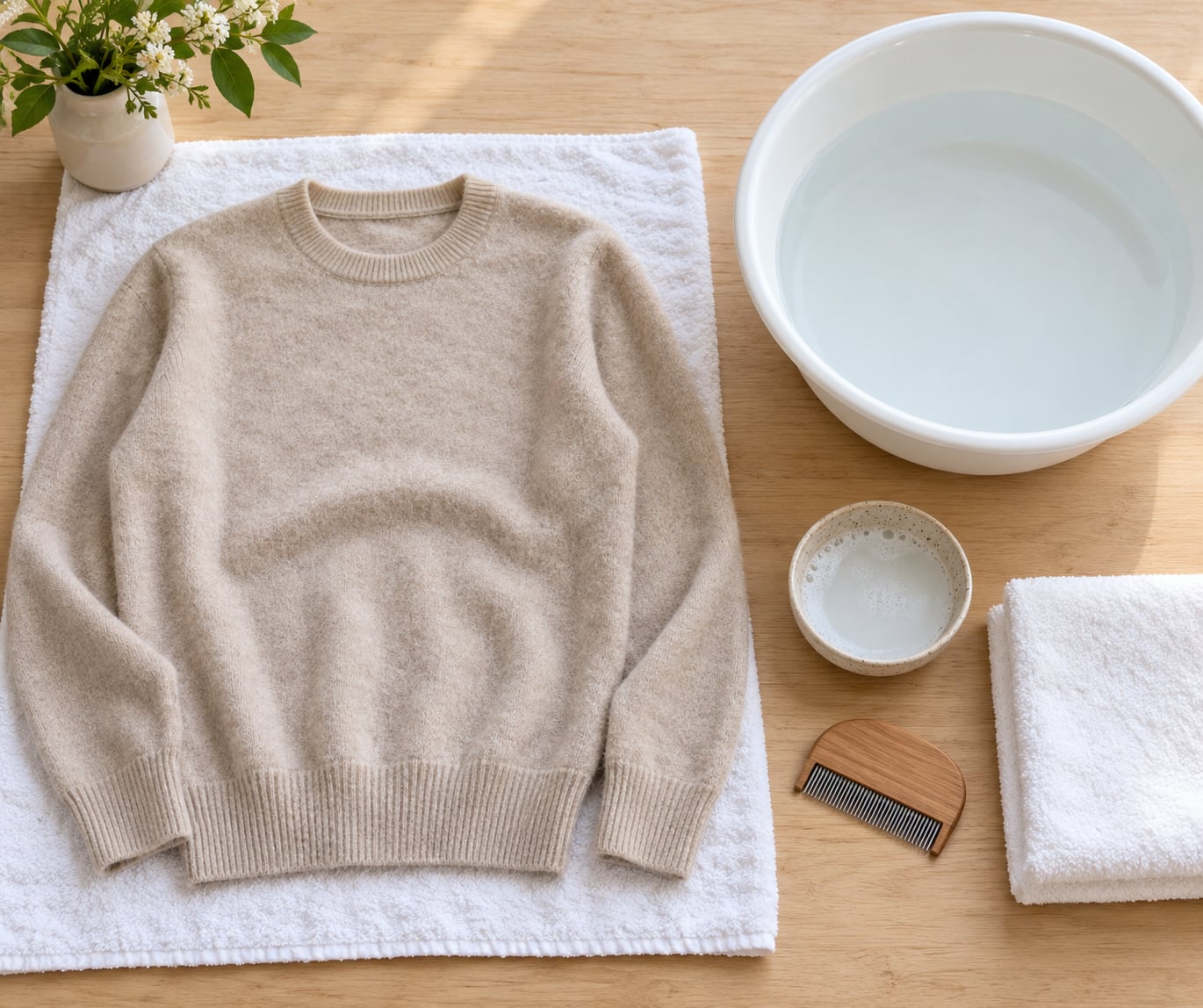
Cashmere handles a careful home wash better than most people expect. Learning how to care for cashmere at home comes down to four moves: wash it by hand in cool water with a small amount of wool wash, press the water out instead of wringing, reshape it to its original measurements, and dry it flat away from heat.
That takes about twenty minutes of active work and a full day of drying. Cashmere feels risky because three specific habits ruin it: hot water, wringing, and hanging it while wet. Skip those and the fibre cooperates.
What follows is the routine I use on a sweater, scarf or hat that lives in a normal closet rather than a professional laundry. Last checked for October 2026.
Table of Contents
- What You Need
- Which Detergents Are Safe
- Can You Machine Wash Cashmere?
- How to Read a Dry Clean Only Label
- Scarves, Hats, Gloves and Blankets
- Step-by-Step: How to Care for Cashmere at Home
- How to care for cashmere at home when washing a sweater
- How to dry cashmere so it does not shrink
- How to brush, de-pill, and store cashmere
- How Often to Wash Cashmere
- Removing Common Stains
- Cashmere vs Wool and Merino — Does Care Differ?
- Common Mistakes That Ruin Cashmere
- Myths Worth Dropping
- A Simple At-Home Maintenance Checklist
- Frequently Asked Questions
- Can I machine wash cashmere at home?
- How often should I wash a cashmere sweater?
- How do I remove pills from cashmere?
- Can I use baby shampoo to wash cashmere?
- What should I do if my cashmere sweater shrinks?
- How do I remove an oil or makeup stain from cashmere?
- Where to Start Tonight
What You Need
The care label wins every time. Turn it inside out and read it before anything else, because it tells you whether the garment can take a machine wash at all. Cashmere labels fall into three groups: hand wash only, dry clean only, and a gentler machine-washable wording that some modern knits use.
A dry clean only label is worth arguing with, but not ignoring. Cashmere is elastic and self-lubricating, so a short, cool, low-agitation soak does not destroy it the way the label implies. What does destroy it is heat and friction. That said, an unlined vintage coat or a piece with heavy embellishment is a different risk tier than a plain sweater, and the label exists for a reason.
Most cashmere also sheds a little in its first few wears, and pills are friction rather than a quality signal. Both get treated below.
For an ordinary knit, here is what to gather before you start:
- A clean basin, sink or bathtub, cool or lukewarm water, never warmer than body temperature (about 30°C / 86°F is the ceiling).
- A wool wash, cashmere shampoo, or no-rinse delicate wash. One tablespoon in a basin is plenty.
- Two or three clean, dry towels you do not mind sacrificing to dye transfer.
- A flat drying surface: a drying rack laid flat, a towel on a bed, or a clean table.
- A cashmere comb or knit comb. A fabric shaver works too, held just above the fabric.
- A mesh washing bag if the label allows machine washing.
- A stain remover formulated for wool, if the sweater has marks on it.
Before filling the basin, decide whether the garment needs a full wash at all. Cashmere holds no body odour the way synthetics do, so a small mark on a worn sweater usually comes out with a damp cloth and a drop of wool wash. That one minute of spot cleaning saves a full soak, and full soaks are what wear knitwear out over time.
One more preparation step people skip: check colourfastness. Rub a damp white cloth on an inside seam. If the cloth picks up colour, test a longer hidden area first. Bleeding dye in a warm basin is harder to undo than a colour test.
Which Detergents Are Safe
Detergent choice matters more than most people expect, because the wrong one leaves a film that makes cashmere scratchy instead of soft.
| Option | Verdict | Why |
|---|---|---|
| Wool wash or no-rinse delicate wash | Use this | pH-neutral and gentle on fibre scales |
| Cashmere shampoo or handknit wash | Fine | Mild, meant for skin-adjacent fibres |
| Unscented baby shampoo | In a pinch | Works, but rinse thoroughly |
| Dish soap | Skip it | Strong surfactants, leaves residue, dulls colour |
| Fabric softener | Never | Coats the fibre and kills loft over time |
| Bleach | Never | Damages keratin fibres permanently |
Never use hot water, even if the wool wash bottle allows it. Warmth is what triggers felting, and felting is not reversible.
Dish soap comes up often because people assume it is gentler than laundry detergent. It is not. Surfactant strength is what makes it cut grease, and the same strength strips the fibre and leaves a film you will feel as scratchiness after the sweater dries.
Can You Machine Wash Cashmere?
Sometimes, yes. A top-loading machine with an agitator is a no. A front-loader on a cool or 30°C delicate cycle with wool wash and the lowest spin setting can handle a modern, machine-washable cashmere knit without a problem.
The mesh bag is not optional. It stops the garment moving around, which is where most of the abrasion happens, and it keeps a loose button or a snag from working its way through the knit.
| Method | Time | Shrink risk | Best for |
|---|---|---|---|
| Hand wash | 15 min active, about 10 | Lowest | Plain sweaters, vintage knits, anything expensive |
| Machine, delicate | Under 10 min | Low with a mesh bag and no spin | Modern machine-washable cashmere |
| Dry cleaning | Drop-off and collection | Low from heat, high from solvents and pressing | Coats, structured or embellished pieces |
Solvent-based dry cleaning dissolves grease fast, which is exactly why coats and heavily stained structured pieces go that way. The trade-off is that the pressing and finishing process at the back can stretch a knit permanently, which is something a basin at home never does.
How to Read a Dry Clean Only Label
For a plain unlined sweater, treat the label as guidance rather than a prohibition. The fibre itself tolerates a gentle soak; what kills it is heat and agitation, and neither has to be in the wash.
The label earns real obedience in three cases: a lined or structured coat where the interlining can distort, a piece with beading or embellishment that snag, and a vintage or heirloom knit whose value you would rather not gamble on. For everything else, the basin method is the lowest-risk option available.
Scarves, Hats, Gloves and Blankets
Accessories follow the same rules and are easier to wash than sweaters, because they are smaller and flatter. A scarf goes in the basin whole. A hat soaks and presses like a sweater, but keep the brim flat while it dries so it does not curl. Gloves need nothing more than a cool soak and a flat towel.
Blankets and throws are the exception. They need a bathtub or large basin, more detergent, and a longer soak, plus more room to dry. Never put a cashmere throw in the dryer, even on air-only, unless you have a very large machine and space to hang the whole thing flat afterwards.
Step-by-Step: How to Care for Cashmere at Home
Eight steps, in order. Each one tells you how to tell it worked, because cashmere problems are easier to fix at the stage they happen than a week later.
How to care for cashmere at home when washing a sweater
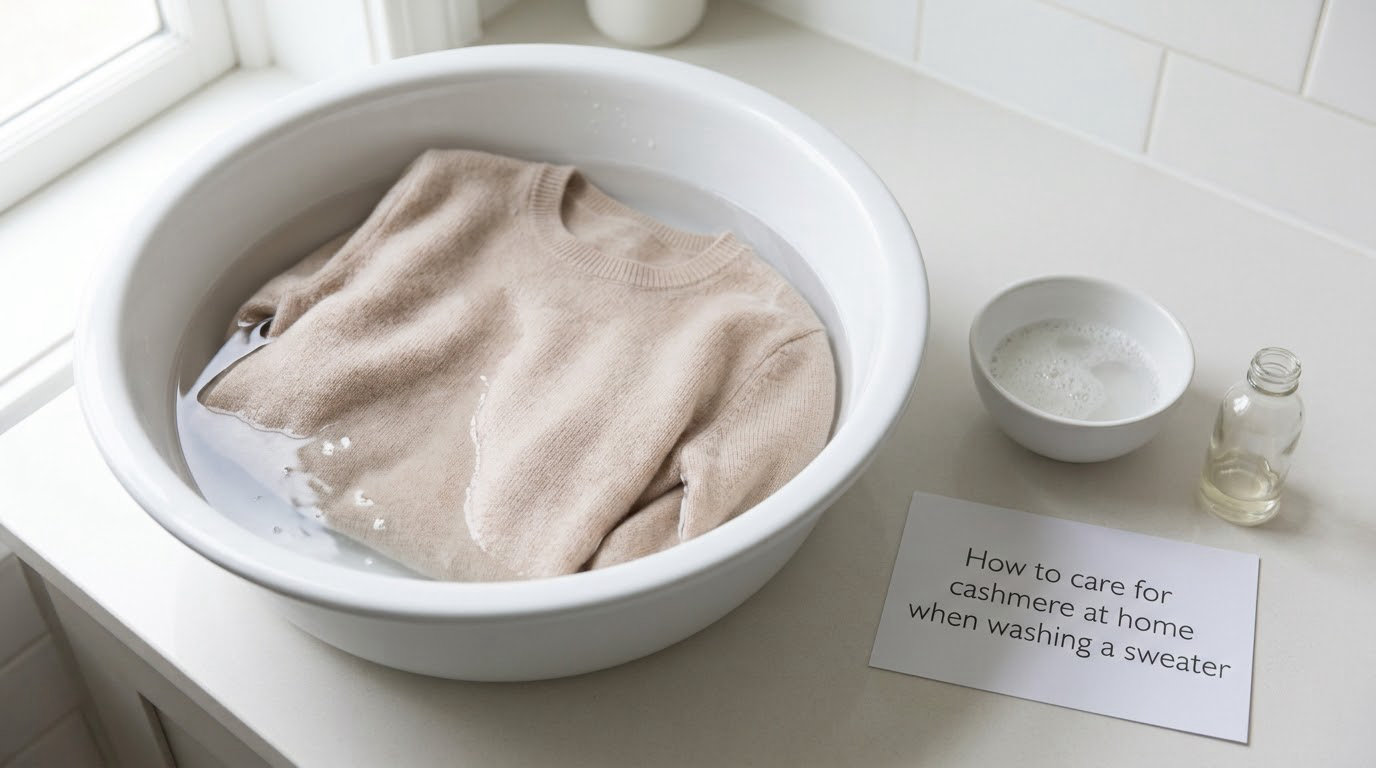
The safest method is also the simplest, so start here even if you own a washing machine.
- Take the sweater off and check it over. Empty the pockets, note any stains, and look for pulls in the knit. Count the pills while you are there, because knowing the starting number makes the result obvious later.
- De-pill before it goes in the water. Run a cashmere comb with light, even strokes in the direction of the fibres, working section by section. Pills that stay on through a wash tighten up and are much harder to remove afterwards.
- Fill the basin with cool water and add the detergent. About one tablespoon of wool wash, swirled in until it disappears. Let the water sit a minute so the detergent is evenly dispersed.
- Submerge the sweater and soak for 10 to 15 minutes. Push it down gently with one hand and let it sit. Do not scrub, rub, or work the knit against itself. You will know it worked when the water looks faintly cloudy and the sweater feels heavy and soft rather than stiff.
- Press the water out. Do not wring. Lift the sweater out by supporting its full weight with both hands, never by one shoulder or by the cuffs, and let the excess drain back into the basin. This is the single step that causes most home-ruined cashmere. Twisting the fabric to squeeze it is what breaks fibres and pulls the knit out of shape.
- Rinse by pressing, not running. Drain the basin, refill with the same cool water, and press the sweater down and up a few times. Repeat until the water runs clear and no soap smell remains. Squeezing is fine here; twisting is still not.
- Roll it in a towel. Lay a dry towel flat, set the sweater on top, roll both together, and press the roll down with your palms. The towel soaks up the water the sweater is still holding.
- Reshape and dry flat. See the next section.
Do not skip the soak for a quick rinse. The ten quiet minutes are where the wool wash lifts body oils out of the fibre. Agitation and soaking are opposites, and the soak is the part that works.
How to dry cashmere so it does not shrink
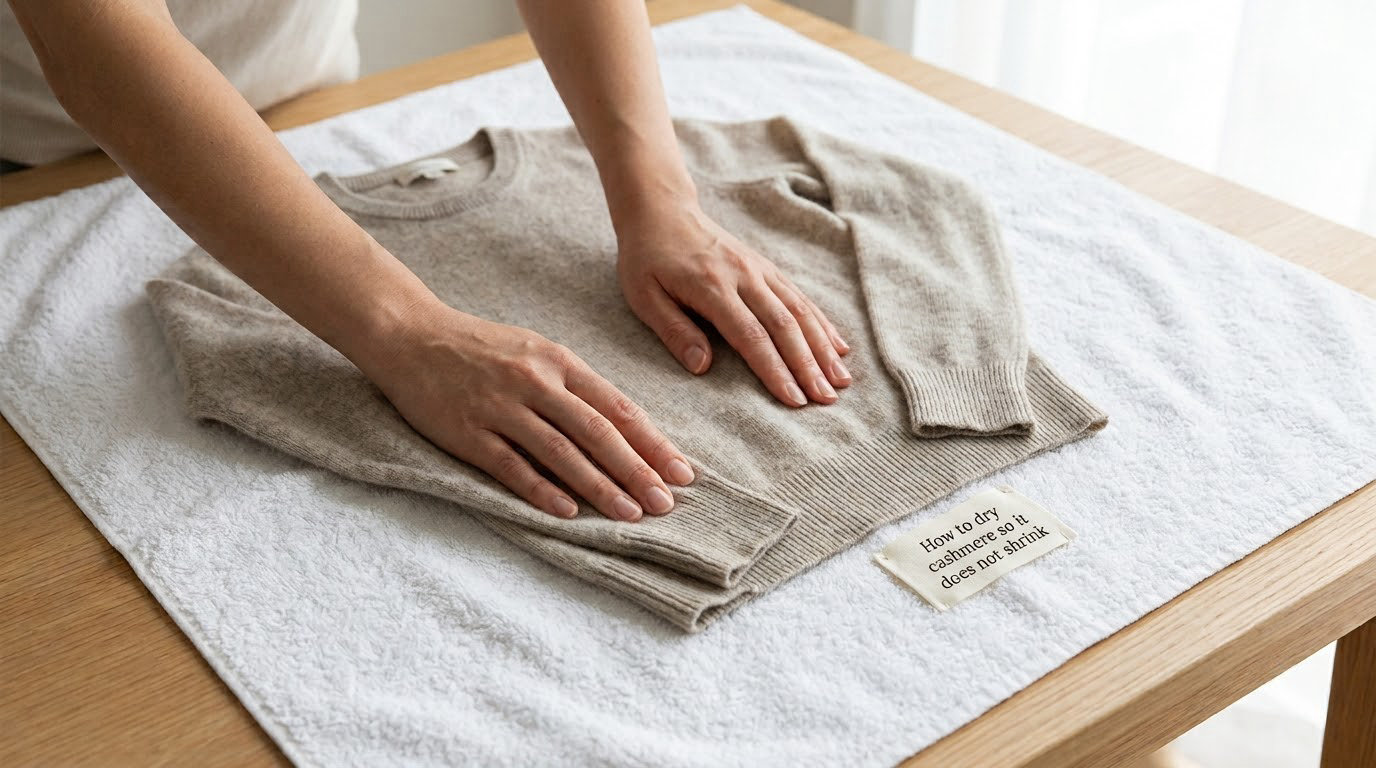
Drying is where most of the damage gets done, because a wet cashmere sweater is heavier than it looks and a wet knit stretches under its own weight.
- Lay the sweater flat on a dry towel, right side up. Smooth the sleeves out straight rather than folded across the body, and align the hem.
- Reshape it to its original dimensions. Tug each edge gently back to where it sat before washing, using a tape measure if you want to be precise. Knits remember. This is called blocking, and it is the fix for a sweater that looks a size smaller after washing.
- Leave it flat in a ventilated room. Air movement finishes the drying. Turn the sweater over once, after several hours, so both sides dry evenly.
- Wait until it is completely dry before putting it away. Damp cashmere stored folded grows a musty smell and gives moths an easy target.
A dryer is the worst option. Tumble heat shrinks the fibre and agitation felts it, and even an air-only cycle dries wool unevenly and can leave it stiff. Do not hang the sweater wet either, even on a wide padded hanger; wet cashmere stretches under its own weight and the shoulders never recover.
Direct sunlight and radiators are out for the same reason, just slower. Shade plus moving air is the whole setup.
If you need to speed things up, a garment steamer held a few inches away will release wrinkles and dampen the fabric for a second flat-drying pass. Never steam a piece with embellishment, or one that is labelled dry clean only.
How to brush, de-pill, and store cashmere
Pilling is friction, not a defect. Short fibres work loose at the spots that rub: under the arms, across the front where a bag strap sits, at the cuff. Longer fibres stay put, which is one reason higher-grade cashmere pills less.
De-pill after every few wears, not at the end of the season. Hold the sweater stretched over your thigh, work the cashmere comb in the direction of the nap with light strokes, and stop when the comb starts dragging. A fabric shaver is a second option: hover it just above the surface and let the rotating head do the work without pressing down, which can thin the knit.
For stubborn pills, put the sweater in a cotton pillowcase, tie it shut, and run it through the dryer on an air-only or no-heat tumble for ten minutes. The tumbling loosens pills so they come off the comb in one pass. If you prefer cold, a sealed bag in the freezer overnight followed by gentle combing works the same way.
Store folded. Cashmere knits stretch under their own weight on a hanger, especially at the shoulders and cuffs. Fold each piece along its natural seams, wrap it in acid-free tissue paper, and put it in a breathable cotton garment bag rather than a plastic one. Plastic traps moisture, which invites mildew and moths.
Moth prevention is straightforward. Clean garments attract moths far more than dirty ones, so wash before storing at the end of the season. Cedar blocks and lavender sachets help in a closed closet, and laundering the closet itself once helps if you already have holes. Avoid mothballs indoors; the vapour is unpleasant and the odour is hard to remove from wool.
Some shedding in the first few wears of a new cashmere piece is normal, especially with shorter fibres and darker colours. It settles down as the loose fibres work free. A lint roller on a dark top catches most of what comes off, and persistent fuzz after a dozen wears points to shorter fibre length rather than a faulty garment.
How Often to Wash Cashmere
Twenty to thirty wears is a reasonable ceiling for a sweater you only reach for in cold weather. Airing it overnight on a hanger near an open window handles nearly every ordinary smell, because cashmere fibres are good at releasing what they hold.
Wash it sooner when there is a mark, when it has been worn against bare skin several times in a row, or when a moths’ hole appears. Otherwise a seasonal schedule beats a habit schedule. A small airing session after each wear also keeps the fibre less compressed, which means pills form more slowly.
Removing Common Stains
Treat any spot while it is fresh, and work from the outside of the mark toward the centre so you do not push the stain outward into clean fibre. Dab rather than scrub. A wool-safe stain remover or a little liquid wool wash diluted in cool water handles most fresh marks.
Wine and coffee both respond to a cold soak before treatment, blotted from the edge in. Oil needs a degreasing agent rather than more soap, since ordinary detergent does not dissolve grease well. Makeup comes off fastest with a small amount of wool wash worked in gently and left for five minutes before rinsing.
One trap catches people every spring. A white wine spill on a pale cashmere sweater may look harmless and clean immediately, then oxidise into a dull yellow patch over the summer. That is why the correct response is to treat it now, not to trust it.
Cashmere vs Wool and Merino — Does Care Differ?
Carefully, but not much. Cashmere is the fine undercoat combed from cashmere goats, and merino is a sheep’s wool; both are protein fibres that behave the same way in heat and agitation. Merino tolerates a machine wash on a wool cycle a little more readily because its fibres are longer and springier. Cashmere is fussier mainly because it is finer, so it felts and pills at lower thresholds.
Lambswool is the opposite case. It is coarser, it is prone to growing much larger when washed, and it wants cool water and flat drying for exactly the same reasons. If a garment is a blend, follow the most delicate fibre in it.
Common Mistakes That Ruin Cashmere
Almost every damaged cashmere sweater I have seen traces back to one of these, and every one of them has a simple correction.
- Hot water. Heat plus agitation felts wool fibres together into a stiff mat. Correction: cool or lukewarm, 30°C / 86°F at most, and no heat at any later stage.
- Wringing or twisting the sweater. This is what pulls a knit out of shape and breaks fibres. Correction: press water out with both hands, or roll the garment in a towel and press.
- Machine drying. Heat plus tumbling shrinks and mats. Correction: lay flat and let moving air finish the job, overnight if needed.
- Hanging a wet sweater. Wet cashmere is heavier than it looks and stretches. Correction: fold or roll damp, reshape flat, dry flat.
- Standard laundry detergent or dish soap. Strong surfactants strip the fibre and leave a scratchy residue. Correction: wool wash or no-rinse delicate wash, one tablespoon.
- Fabric softener. It coats the fibre, dulls colour, and reduces loft over time. Correction: none, ever. If a softener bottle is a habit, rinse the machine tub after using it.
- Washing too often. Every soak abrades fibre, even a careful one. Correction: 20 to 30 wears between washes for a seasonal sweater, and air the piece between wears.
- Ignoring pills until laundry day. Set pills tighten and then snag. Correction: a quick comb pass every few wears.
- Brushing too hard. Vigorous brushing cuts surface fibres and thins the knit. Correction: light strokes in one direction only.
- Hanging instead of folding in the closet. Gravity stretches shoulders and cuffs permanently. Correction: fold with tissue paper between layers.
Two smaller habits pay off more than any special product. Skip the shoulder-bag strap over a fine cashmere sweater, and keep necklaces from resting against the neckline; both are the highest-friction spots on the garment and both are the first places pills appear.
Myths Worth Dropping
Four pieces of folk advice come up in almost every cashmere conversation, and all four cost you something.
The first says dry cleaning is the safest option for cashmere. It is the most expensive option, and the solvents and finishing presses can stretch a knit in ways a basin at home never will. It earns its place on structured coats, not on a sweater.
The second says a little dish soap is a fine substitute for wool wash. Surfactant strength is what makes it cut grease, and that same strength strips the fibre.
The third says fabric softener makes cashmere softer. It does, for about one wash, then leaves a coating that dulls colour and flattens the loft. The sweater feels worse over a year of use, not better.
The fourth says you should wash cashmere after every wear. Cashmere is self-cleaning to a degree and holds no odour the way polyester does. Washing on a schedule instead of a reaction is what keeps a sweater in circulation for a decade instead of three.
A Simple At-Home Maintenance Checklist
Once a season, walk the closet and handle everything:
- Comb each sweater once and remove any pills, working from the hem upward.
- Aire anything worn recently overnight on a hanger near an open window.
- Wash pieces that have reached 20 to 30 wears before folding them away.
- Check storage boxes for holes, webbing, or larvae and launder the box liner if you find any.
- Replace cedar blocks or lavender sachets if the scent has faded to nothing.
If a sweater has already been through a bad wash, most of it is recoverable. Soak it in cool water with a little conditioner or baby shampoo for 20 minutes, then stretch it gently back to its original measurements, lay it flat, and dry it flat. Slight shrinkage usually relaxes out this way. Fully felted patches do not recover, but they are rarer than people fear, because felting needs heat and agitation together.
Frequently Asked Questions
Can I machine wash cashmere at home?
Yes, if the label allows it. Put the garment inside a mesh washing bag, use wool wash rather than standard detergent, and choose a cool or 30°C delicate cycle with little or no spin. Skip the dryer completely and reshape the piece flat while it dries. If your sweater is expensive, vintage, or labelled dry clean only, hand washing in a basin is the safer route.
How often should I wash a cashmere sweater?
For a sweater worn only in cold weather, 20 to 30 wears between washes is reasonable. Cashmere resists odour better than synthetic knitwear, so airing it overnight on a hanger handles most smells. Wash sooner if there is a mark, if it has been worn against bare skin repeatedly, or before storing it at the end of the season, since clean fibre is far less attractive to moths.
How do I remove pills from cashmere?
Work a cashmere comb over the fabric in the direction of the fibres using light, even strokes, with the sweater stretched over your thigh. A fabric shaver also works if you hover it just above the surface instead of pressing down. For stubborn pills, tumble the sweater inside a cotton pillowcase on an air-only cycle for ten minutes, then comb again. Comb before washing too, not only after.
Can I use baby shampoo to wash cashmere?
Yes, in a pinch, and it is much safer than dish soap or standard laundry detergent. Use about half a tablespoon in a basin of cool water, soak for 10 to 15 minutes, then rinse by pressing the sweater in several changes of cool water until no scent remains. Unscented is the better choice, since heavy fragrance can linger in wool. A wool wash is the better option whenever you can get one.
What should I do if my cashmere sweater shrinks?
Soak the sweater in cool water with a small amount of conditioner or baby shampoo for about 20 minutes. Drain it, press the water out without twisting, then lay it flat and gently tug each edge back toward its original measurements. Dry it flat and leave it stretched for a day. Most shrinkage from a cool, gentle wash relaxes out this way. Felted, hardened patches are the one thing that does not recover.
How do I remove an oil or makeup stain from cashmere?
Treat it before it sets. Lift excess with a dry white cloth, then work a wool-safe stain remover or a small amount of liquid wool wash into the spot from the outer edge inward. Dab, do not rub hard, since rubbing pushes oil deeper into the fibre. Rinse with cool water and press dry, then finish with the flat-drying method. A makeup mark treated the same evening is far easier than one you find after storage.
Where to Start Tonight
Pick the sweater you wear most, check its label, and comb it before anything else. That takes two minutes and tells you how much pilling you are actually dealing with.
Then learn the habit that matters: cool water, one tablespoon of wool wash, a fifteen-minute soak, and pressing instead of wringing. Get that right and the rest of cashmere care is maintenance. Skip it and no amount of money saved on dry cleaning matters, because the garment will never look the same again.