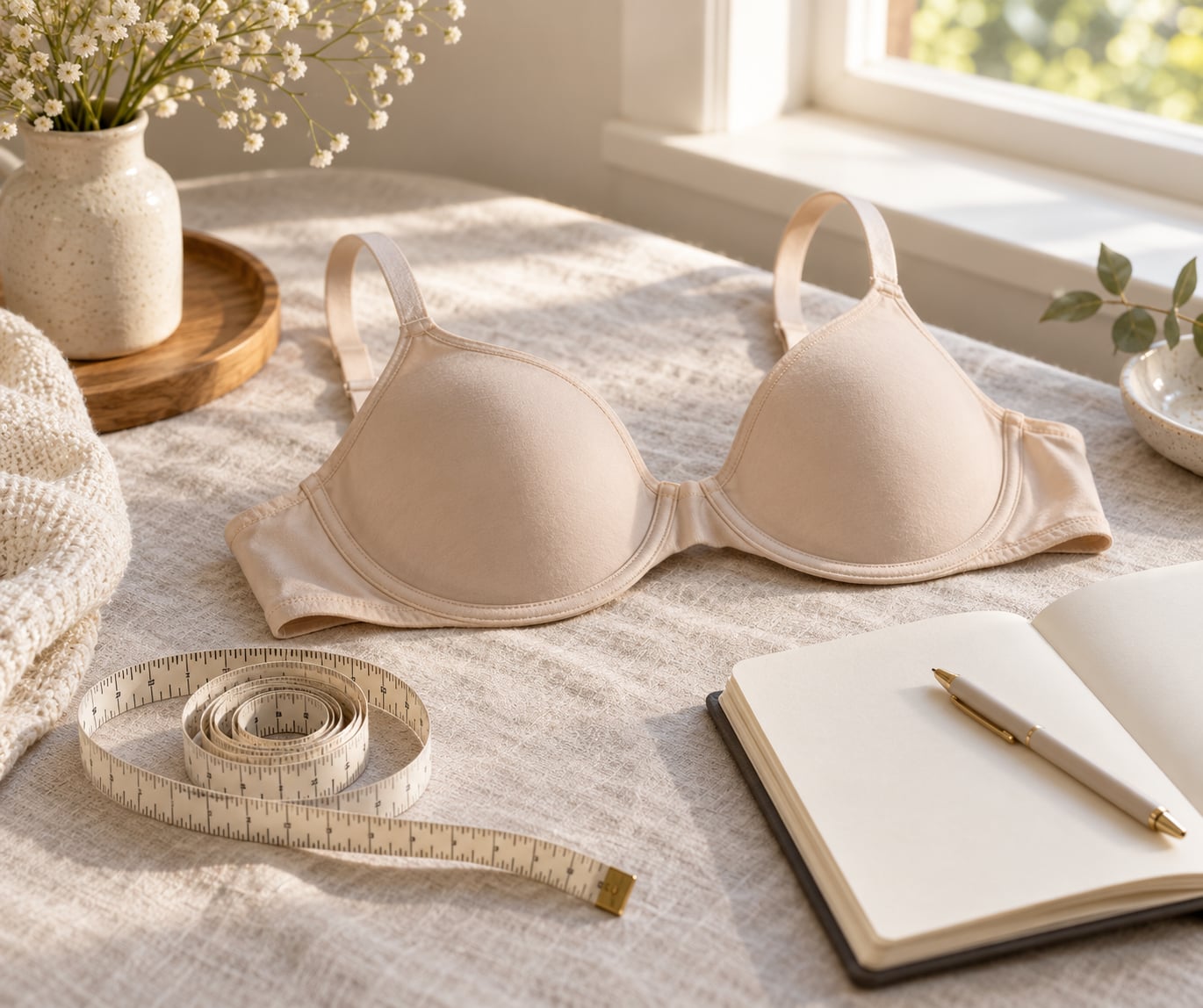
To find your correct bra size at home you need two tape measurements taken over the same bra: your underbust, which gives the band number, and your bust, which gives the cup number once you subtract the band. Five minutes with a soft measuring tape is enough, and checking the result against a bra you already own tells you within seconds whether it worked.
Most people guess their size from a label they have worn for a decade. That label is a starting point, not a measurement, and the two numbers on it mean something different than most people assume. Here is the whole method, including the arithmetic, so you can re-derive any answer instead of trusting it.
Table of Contents
- What You Need
- How to Find Your Correct Bra Size at Home: Step by Step
- Step 1: Measure Your Band Size
- Step 2: Measure Your Bust for Cup Size
- Step 3: Convert the Cup Difference Into a Letter
- Keep your sister size in your pocket
- Step 4: Test the Size for Fit
- Common Mistakes When You Find Your Correct Bra Size at Home
- Frequently Asked Questions
- Can I measure my bra size without a partner?
- How often should I remeasure my bra size?
- Why does the same bra size fit differently from another brand?
- What should I do if I am between two bra sizes?
- Does my breast shape affect my cup size?
- Conclusion
What You Need
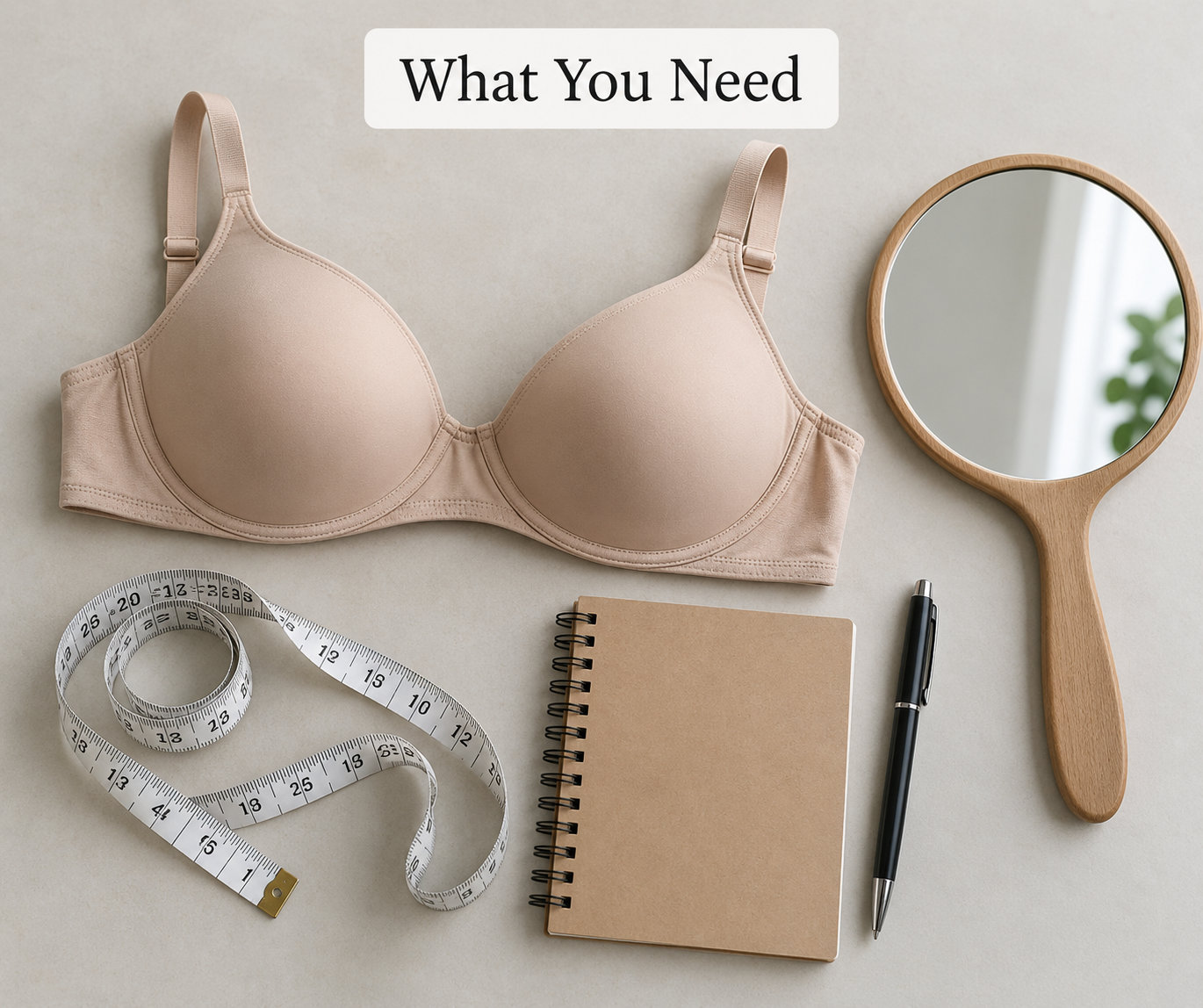
You need four things, and three of them are free.
- A soft measuring tape. The tailor’s kind that slides rather than the stiff plastic kind. It should still have visible inches, or you will need a ruler to read it.
- A well-fitting bra that is not padded. An everyday unlined bra or a sports bra works. You measure over what you wear under clothes, and padding adds an inch or two you do not have.
- A mirror. A full-length one is better than a bathroom one, because you need to see the tape at your back and check that it is level.
- Something to write on. A phone note is fine, as long as you write both numbers down before you start calculating.
No tape? A soft cotton string or a length of ribbon does the job. Wrap it where the tape would go, pinch or mark where it overlaps, lay it flat against a ruler, and read the length. It is less precise, within about a quarter inch, which is close enough to pick the right band.
Measure in the morning or late at night, not straight out of the shower, because skin holds water and changes the reading slightly. And stand up for the band measurement. Sitting down adds a few inches around the ribcage and is the single most common way people end up a size too loose.
How to Find Your Correct Bra Size at Home: Step by Step
Two measurements, one subtraction, two lookups. Take the band first, because if the band number is wrong, the cup number is wrong with it.
Step 1: Measure Your Band Size
Wrap the tape around your ribcage directly under the bust, where the underwire of your bra would sit. Keep it snug, not tight. You should be able to slide two fingers underneath it, and no more.
Three details matter more than anything else here. First, the tape must be level all the way round, which is where the mirror earns its place. Second, exhale normally rather than holding your breath or puffing out. Third, do not measure over a shirt.
You now have a number in inches. In US sizing your band size is that number rounded to the nearest even number, because bands are made in even sizes only.
| Underbust measurement (inches) | US band size | UK band size | EU band size |
|---|---|---|---|
| 26 | 26 | 26 | 70 |
| 27 | 28 | 28 | 70 |
| 28 | 28 | 28 | 75 |
| 29 | 28 | 28 | 75 |
| 30 | 30 | 30 | 80 |
| 31 | 30 | 30 | 80 |
| 32 | 32 | 32 | 80 |
| 33 | 32 | 32 | 85 |
| 34 | 34 | 34 | 85 |
| 35 | 34 | 34 | 85 |
| 36 | 36 | 36 | 90 |
| 37 | 36 | 36 | 90 |
| 38 | 38 | 38 | 95 |
| 39 | 38 | 38 | 95 |
| 40 | 40 | 40 | 100 |
| 41 | 40 | 40 | 100 |
| 42 | 42 | 42 | 105 |
| 43 | 42 | 42 | 105 |
| 44 | 44 | 44 | 110 |
| 45 | 44 | 44 | 110 |
| 46 | 46 | 46 | 115 |
One warning, because it derails more people than anything else on this page: do not add four inches to your underbust number. The old plus-four method came from measuring around the fullest part of the bust and mentally adding slack for the band, and it is still printed in a lot of guides. Modern bands stretch, so if you add four you will order a band four inches too loose and end up tightening the shoulder straps to hold it up, which is exactly what causes the digging and the riding up people complain about.
Band numbers in the US and UK are the same. EU sizes use centimetres, which is why a US 32 band is an EU 80 and a US 36 is an EU 90.
Step 2: Measure Your Bust for Cup Size
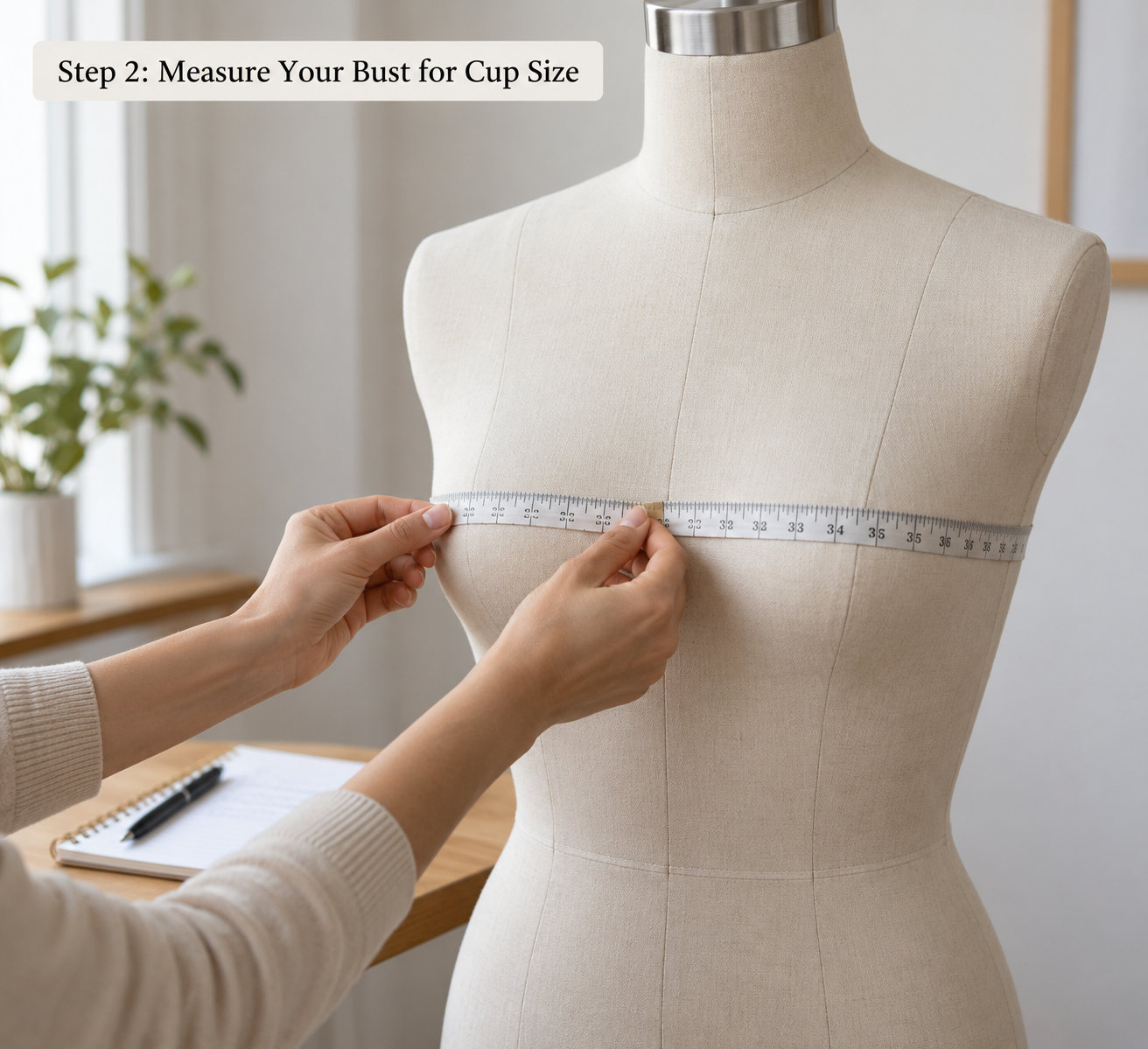
Keep the same bra on. Bring the tape up to the fullest point of your bust, which is usually across the nipple line, and wrap it around your body. Arms down at your sides, tape horizontal, sitting comfortably rather than pulled tight.
If your bust is fuller on the bottom than the top, the fullest point is often higher and slightly to the side. Move the tape around in small steps until you find the widest circumference, and use that number. Do not measure diagonally across the chest.
There is also an overbust measurement, taken around the top of the breasts with the tape angled up slightly, that some fuller-bust fitting guides use instead. It gives a smaller cup letter than the standard method. Pick one method and stick with it, because mixing them is where most of the contradictory guides online come from.
Write down the bust number next to the band number. The next step is subtraction, and it is the whole trick.
Step 3: Convert the Cup Difference Into a Letter
Subtract your band measurement from your bust measurement. The result, in inches, is your cup size.
| Bust minus underbust (inches) | US cup letter | UK cup letter | EU cup letter |
|---|---|---|---|
| 1 | A | A | A |
| 2 | B | B | B |
| 3 | C | C | C |
| 4 | D | D | C |
| 5 | DD | DD | D |
| 6 | DDD | E | E |
| 7 | G (sometimes DDDD) | F | F |
So here is a real example. Underbust 32 inches, bust 37 inches. The band is 32. The difference is 5 inches, which is a DD. Your size is 32DD.
| Step | Measurement or calculation | Result |
|---|---|---|
| 1 | Underbust, snug under the bust, doubled and rounded to the nearest even number | 32 inches, so band 32 |
| 2 | Fullest point of the bust, arms relaxed | 37 inches |
| 3 | 37 minus 32 | 5 inch difference |
| 4 | 5 inch difference on the cup table | DD |
| 5 | Band plus cup letter | 32DD |
Two things follow from that example, and both trip people up.
First, a cup letter is not a fixed volume. A 34C holds noticeably less than a 36C, because the band is doing more of the holding. So 36C is bigger than 34C, and 34C is not a size you can carry between brands without checking.
Second, letters drift between countries. A US 36DDD, a UK 36E and an EU 90E are the same bra. If a brand’s guide says DDD and another says E for what looks like the same fit, both are right, which is why the table above carries all three columns.
Keep your sister size in your pocket
Sister sizing means moving up a band and down a cup for roughly the same volume. It is the fastest fix when a cup is slightly wrong but the shape is right, and it is a useful second option when your size is sold out and you are ordering online.
| Your size | Sister size | Approximate equivalent |
|---|---|---|
| 32C | 34B | About the same cup volume |
| 34C | 36B | About the same cup volume |
| 34D | 36C | About the same cup volume |
| 36D | 38C | About the same cup volume |
| 34DD | 36C | About the same cup volume |
Treat it as a fallback rather than a permanent substitute for your measured size, and be careful with strapless and plunge styles. Those designs have no shoulder straps to share the load, so a slightly smaller band in the same family usually fits them better.
Step 4: Test the Size for Fit
Numbers are a starting point, not a verdict. Put the size you calculated on and run this check. Everything should pass at once, because the band, cups and straps are one system.
- The band sits level. It runs straight and parallel to the floor and does not climb toward your shoulder blades. If it rides up, the band is too loose, whatever the label says.
- Two fingers fit under the band. On the loosest hook first, since a new bra has not stretched yet.
- All of the bust is contained. No quad-boob along the top of the cup, and nothing sitting under your arm.
- The cups are filled. No gaping fabric at the top edge, no empty space you could put a fist into. Gaping points to a cup too large or a shape mismatch; overflow points to a cup too small.
- The straps are not the load-bearing part. If you can lift the shoulder an inch and the whole bra goes with it, the band is too loose and the straps are compensating.
- The centre gore lies flat. A raised tent between the cups usually means the band is too tight or the cup is too small, pushing the breast tissue forward.
Most bands that ride up are one size too large, not a shape problem. And a 1 to 2 cup difference between your breasts is completely normal, which means one cup will rarely look perfectly filled. Fit the fuller breast and let the strap adjustment handle the other.
Common Mistakes When You Find Your Correct Bra Size at Home
Measuring too loosely. A slack tape reads two to four inches bigger than reality. You should feel gentle pressure, not a squeeze, and the tape should not be able to slide around your torso.
Measuring over a shirt or a padded bra. Fabric adds a layer you will not wear under the bra you are sizing. Measure skin to skin, or over the thinnest layer you own.
Confusing the loose underbust with the snug band. Measuring in a straight drop-down line under the breast gives a different number than measuring around the ribcage. The band is a circle around your body, snug, level, and under the fullest part.
Adding four inches. Already covered above, and still the most common error in print. Skip it.
Buying the cup letter without the band. “I wear a D” tells a fitter nothing. The letter only means something next to its band number.
Expecting one size to fit across styles and brands. A molded full-coverage cup, a push-up, a balconette and a bralette are cut from different patterns. The label is a starting point within a brand’s range, and a 36DD in one brand can fit very differently from a 36DD in another.
Using a stretched-out bra as your reference. Do not measure an old favourite and copy its label. Bands lose elasticity over roughly a year to a year and a half of regular wear, which is exactly why the band rides up on bras that fit fine when new.
Frequently Asked Questions
Can I measure my bra size without a partner?
Yes. Both measurements are body circumferences, so nobody else is needed. Stand in front of a full-length mirror, wrap the tape under your bust for the band, then around the fullest point for the bust, and check in the mirror that the tape is level. Read the numbers straight off the tape, or use a soft string and a ruler if you have no tape at all. Everything here is a self-measurement, so a helper adds nothing.
How often should I remeasure my bra size?
Every year for most people, and straight away after anything that changes your measurements: weight loss or gain of a few pounds, pregnancy, weaning, or a switch to a different bra style. By then the threads in your band have stretched, so the label on your current bra is a poor guide. Readers on bra fit forums tend to remeasure every few months rather than waiting a full year, which is easy enough to do and catches drift early.
Why does the same bra size fit differently from another brand?
Because the label describes a rough volume, not a pattern. Brands grade differently, and cup shape, wire width, strap placement and fabric stretch all change how a size sits. A molded cup fits very differently from a lace cup of the same letter, and a plunge style is cut to push tissue upward rather than contain it. Treat your measured size as the entry point, then compare fit rather than expect identical results.
What should I do if I am between two bra sizes?
Buy the larger band and the smaller cup, then adjust from there. Bands stretch, so the larger one settles into place, and a slightly full cup is far more comfortable than a tight one. If the band is fine but the cup is not, use the sister size instead: go up a band and down a cup. If the band is loose but the cup is right, go down a band and up a cup. Either way, run the fit check before you keep it.
Does my breast shape affect my cup size?
The measurement gives you a starting number, but shape decides how that number feels. Tissue spread across a wide chest often needs a wider-set frame and a fuller cup, while a narrow base can run a cup larger than the math suggests. Shape also decides which style suits you: a balconette flatters higher-set breasts, a plunge suits fuller ones, and a full-coverage cup suits shallow or wide-set shapes.
Conclusion
Measure your band snug around the ribcage and level, measure your bust at the fullest point, subtract, and look the difference up in the cup table. A 32 inch underbust with a 37 inch bust is a 32DD, and you can check that answer against a bra you already own in about a minute.
Then trust what you see in the mirror over the label on the packet. The band should be level, the cups filled, the straps relaxed, and the gore flat. If one of those fails, adjust the band and cup independently rather than moving both at once, and let comfort have the final say.