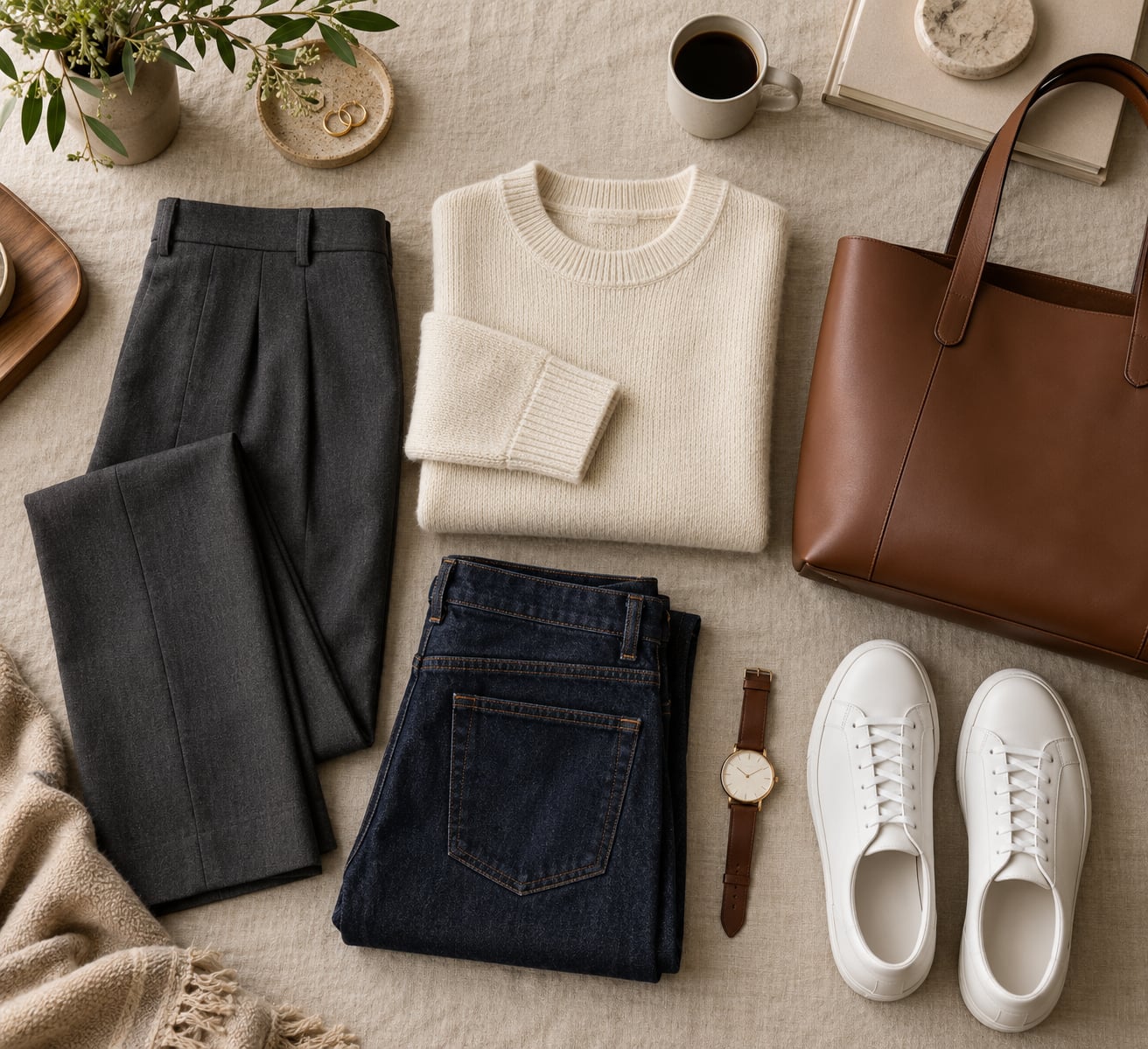
There is no creative office uniform, but there is a standard: clothes that fit, shoes that are clean, and enough intention that nobody wonders whether you took the day seriously. The short version of what to wear to a creative industry office is dark, non-distressed denim or trousers, a top that fits properly, an optional unstructured blazer, clean shoes, and one detail that is unmistakably yours.
Creative-industry workwear is a relaxed-but-intentional dress code. Dark non-distressed denim or trousers, a fitted top, an optional unstructured blazer, clean shoes, and personal style welcomed as long as fit, grooming and context are respected. Most creative companies publish no dress code at all, so the norm is set socially rather than in a handbook.
Last updated October 2026.
Table of Contents
- What You Need
- Step-by-Step
- 1. Identify the office’s creative-industry dress code
- 2. Choose a reliable base outfit
- 3. Add one intentional personal-style detail
- 4. Dress for the day’s work
- 5. Check the outfit from every angle
- Common Mistakes
- Frequently Asked Questions
- Can I wear sneakers to a creative industry office?
- How do I dress for a creative-industry interview?
- What counts as too casual for an agency or media office?
- How can I show personal style without looking underdressed?
- What should I wear for a client presentation in a creative office?
- Can I wear the same outfit on video calls and in-person meetings?
- Conclusion
What You Need
Before you shop anything, name the dress code. Not the one in your head, and not the one your last office used. The label below is how people actually describe office expectations, and each one asks something different of you.
| Dress code label | What it looks like day to day | Watch out for |
|---|---|---|
| Business casual | Trousers or a midi skirt, a button-up or knit, closed shoes | Overdressing reads as stiff in a studio, not impressive |
| Smart casual | Dark denim, fitted top, loafers or clean sneakers | No visible wear-through, pilling or frayed hems |
| Creative casual | Trousers or denim plus one expressive piece, layering optional | Without one deliberate detail it just looks rumpled |
| Dress-code-free | Whatever people wear to a gallery opening at the weekend | “No code” is not a licence; someone still sets the tone |
Then work through five variables. Workplace culture is the biggest one: a twelve-person studio and a two-hundred-person agency behave nothing alike. Industry norm matters next, because fashion, media, publishing and tech each read the same outfit differently. The day ahead decides the formality, whether that is a client meeting, a shoot, or eight hours at a desk. Weather and building decides the layers, and air-conditioned floors in a warm city are a real consideration. Personal comfort is the one most people overrule and regret later, because an outfit you cannot sit in for six hours is not an outfit, it is a photo.
Nothing on that list requires a single purchase to complete.
Step-by-Step
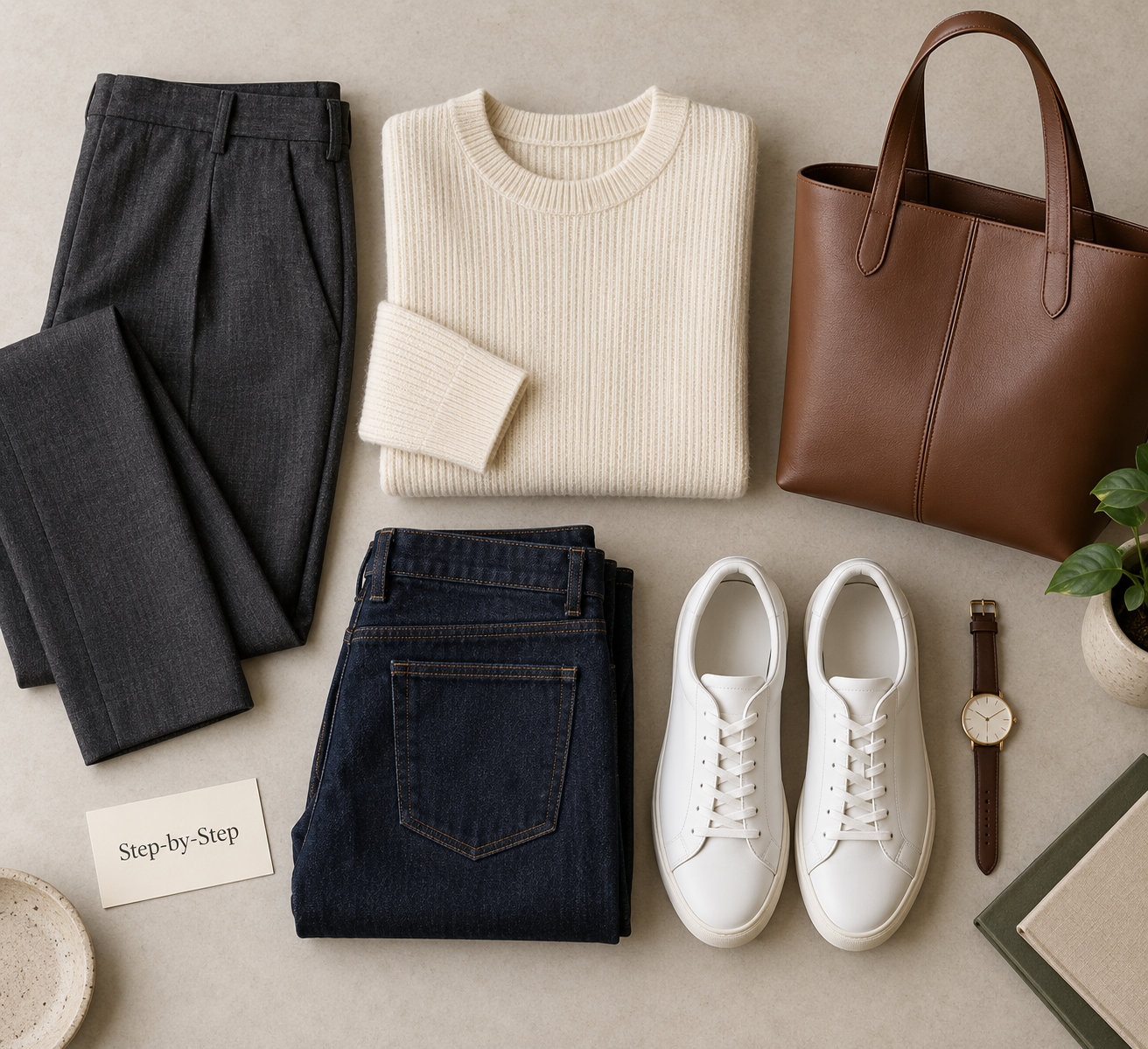
Five steps, and most of the actual work happens in the first two.
1. Identify the office’s creative-industry dress code
You cannot guess this from a job posting, so read the room instead. During your first week, look at what people wear to arrive, what they change into for a client call, and who dresses up when leadership walks the floor. The useful signal is not the average, it is the most dressed-up person in your immediate team: match them and you will never be the odd one out.
If you have not started yet, ask. “What do people usually wear in on a pitch day?” is a normal, well-received question and it tells you more than any article. You have worked it out when you can describe the norm in one sentence without hedging.
2. Choose a reliable base outfit
Build the foundation in neutrals and let one piece carry the personality. A cream silk shell with wide-leg black trousers, a fine merino knit with straight-leg dark denim, a plain white tee under an unlined blazer with a midi A-line skirt. The base has to work on its own, because on some days that is all you will wear.
Fit does more work here than price. Trousers that break once at the shoe, a sleeve that ends at the wrist bone, a shoulder that sits on the point, a knit that has not pilled at the cuff. Fabric weight matters too: linen and Tencel read crisp and a little dressy, organic cotton and merino read relaxed, and a silk blend quietly raises the register of everything under it.
3. Add one intentional personal-style detail
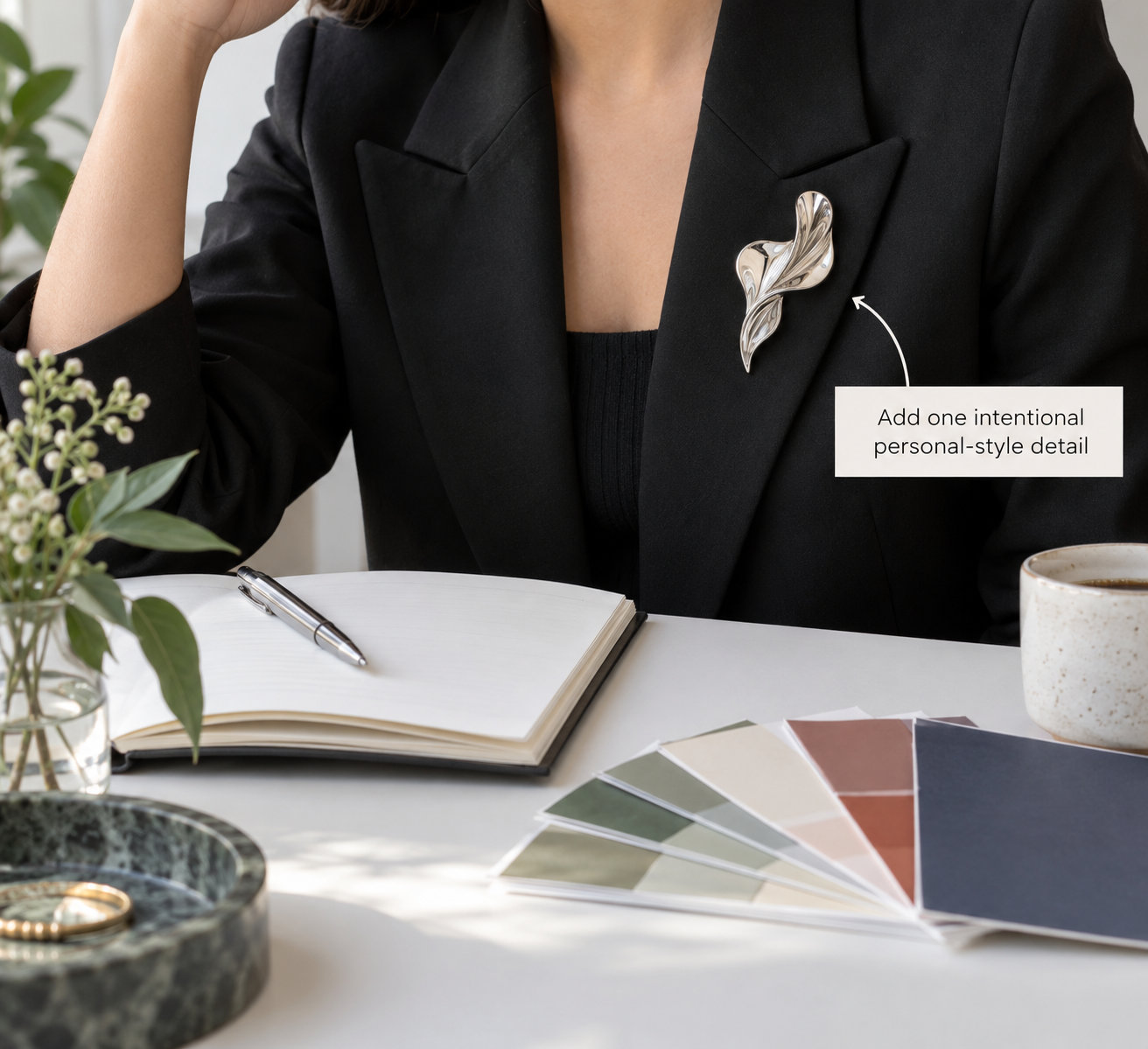
One focal point, not three. A silk neck scarf at the throat, a single sculptural earring, a sculptural brooch on an otherwise plain blazer, a colour that does not appear anywhere else in the outfit. One detail reads as a decision. Three read as a costume, and that is the line most people cross.
A fast way to test an outfit is the 3-3-3 rule: three body-defining pieces, three colours, three accessories. It was built for people who get dressed in five minutes, and it works well here because it forces restraint. If your outfit already has a statement earring and a patterned trouser, the third accessory should be a watch.
4. Dress for the day’s work
Most days are a studio day, and the base outfit is right for it. A client meeting needs one more layer and a closed shoe, plus a bag that sits on the table rather than on the floor. A presentation or portfolio review is where tailoring earns its keep: an unstructured blazer over the top, colour muted, nothing that catches the light on a projector.
Video-call days have their own rules. Skip busy checks and thin straps, keep the neckline framed so it does not crop badly when you lean in, and wear something you can move in, because you will be gesturing for an hour.
The hardest day is the one that ends at an opening. Start with the pitch outfit, then swap the closed shoe for something sharper, remove the layer if the room is warm, and add one piece of jewellery. No second outfit, no changing in a stairwell.
5. Check the outfit from every angle
Ninety seconds, standing up, in good light. Sit down and check that nothing pulls at the waist or gapes at the back. Look for the small failures that read as carelessness rather than style: a crease across the back of a jacket, a mark at the elbow, a collar that has lost its shape, a heel scuffed past saving.
Then walk to the lift. Shoes that survive ten minutes of standing are the real test, and if you will be on camera, check the framing first. You have got it right when you cannot find the one thing someone would comment on negatively.
Common Mistakes
- Wearing the corporate outfit you would wear anywhere else. A full navy suit to a Tuesday studio day reads as someone on their first day, forever. Fix: swap the suit trousers for denim or a softer knit and keep the top.
- Confusing a relaxed dress code with no effort. A relaxed office still has a person who looks put together, and that person gets remembered. Fix: perfect fit, clean shoes, groomed hair. Those three do more than any designer piece.
- An outfit with no focal point. Six neutral pieces in a row is not minimalism, it is nothing to look at. Fix: add one detail, and only one.
- Wearing more than your colleagues have on. When your team is in tees and you arrive in a midi column dress, the gap is read as try-hard, not as effort. Fix: calibrate upward, never downward, and only on client days.
- Ignoring what the office actually is. A fashion brand, a charity, a defence contractor and a skateboard brand have wildly different norms. Fix: observe in week one, ask before you start, and assume the most senior person sets the ceiling.
- Letting the outfit age past its best. Pilled knits, worn-through elbows and faded denim are the fastest way to look casual when you did not mean to be. Fix: a laundry and repair routine beats buying anything new.
A few things worth knowing. On colour, build around neutrals and earth tones, then add one muted bright rather than a full head-to-toe statement. On budget, thrifted denim, knitwear and bags do the job fine; spend more on shoes and outerwear, because those are the pieces people actually see. Cost per wear is the honest measure, and a blazer worn 200 times beats a cheaper one worn four. On layers, studios run cold in summer, so keep a cardigan or unlined blazer within reach rather than freezing in a fitted dress all afternoon.
Frequently Asked Questions
Can I wear sneakers to a creative industry office?
Yes, if they are clean, structured and in good repair. White leather sneakers work better than running shoes because there is nothing on them competing with the outfit. Keep the rest of the look slightly sharper when sneakers are on, since a relaxed shoe plus a relaxed top reads as no decision at all. Worn soles and visible scuffs are the only real disqualifier.
How do I dress for a creative-industry interview?
Dress one notch above what you saw on the team, not ten. Look at the company’s own visual language first, because a design studio or fashion house usually tells you its aesthetic on the homepage. Skip graphic tees, slogans and anything with a visible brand logo. Bring a second option if you can, so a splash of something on the walk in is not a problem.
What counts as too casual for an agency or media office?
Gym clothes, slides, sweat-worn loungewear, slogan tees, heavily distressed denim and shirts worn open with no layer underneath. Even very relaxed offices draw a line, and the line is usually about whether the clothes were chosen for the day or just grabbed. Colleagues in a relaxed creative office tend to wear jeans and tees, but good ones, with proper shoes.
How can I show personal style without looking underdressed?
Put all your personality in one place and keep everything else quiet. A neutral base, a garment that fits properly, clean shoes, and one accessory that is clearly yours. Fit and grooming carry the professionalism; the single detail carries the personality. That balance is what separates a creative office look from someone who simply did not try very hard.
What should I wear for a client presentation in a creative office?
Add a layer and a closed shoe, and mute the colour. An unstructured blazer over your usual base outfit is the highest-return move there is. Keep bags structured and on the table so you look like you brought work, not like you wandered in. If a senior client will be in the room, go one step more formal than the rest of your team normally does.
Can I wear the same outfit on video calls and in-person meetings?
Mostly, but check the camera before the day starts. Avoid busy checks, thin straps and high-contrast necklines that crop strangely when you lean forward, and keep the colour of your top away from your background. Fabric matters more than usual, since a scratchy knit or a rustling jacket plays badly on a microphone. Otherwise your standard meeting outfit will do.
Conclusion
Start by studying the culture. Watch what people wear in the first week, ask one direct question if you can, and match the most put-together person in your team. Then build a small base wardrobe that fits properly in neutrals, and add one detail that is entirely your own. That is the whole answer to what to wear to a creative industry office: nothing borrowed from a corporate manual, nothing random, and nothing that stops you doing your job.