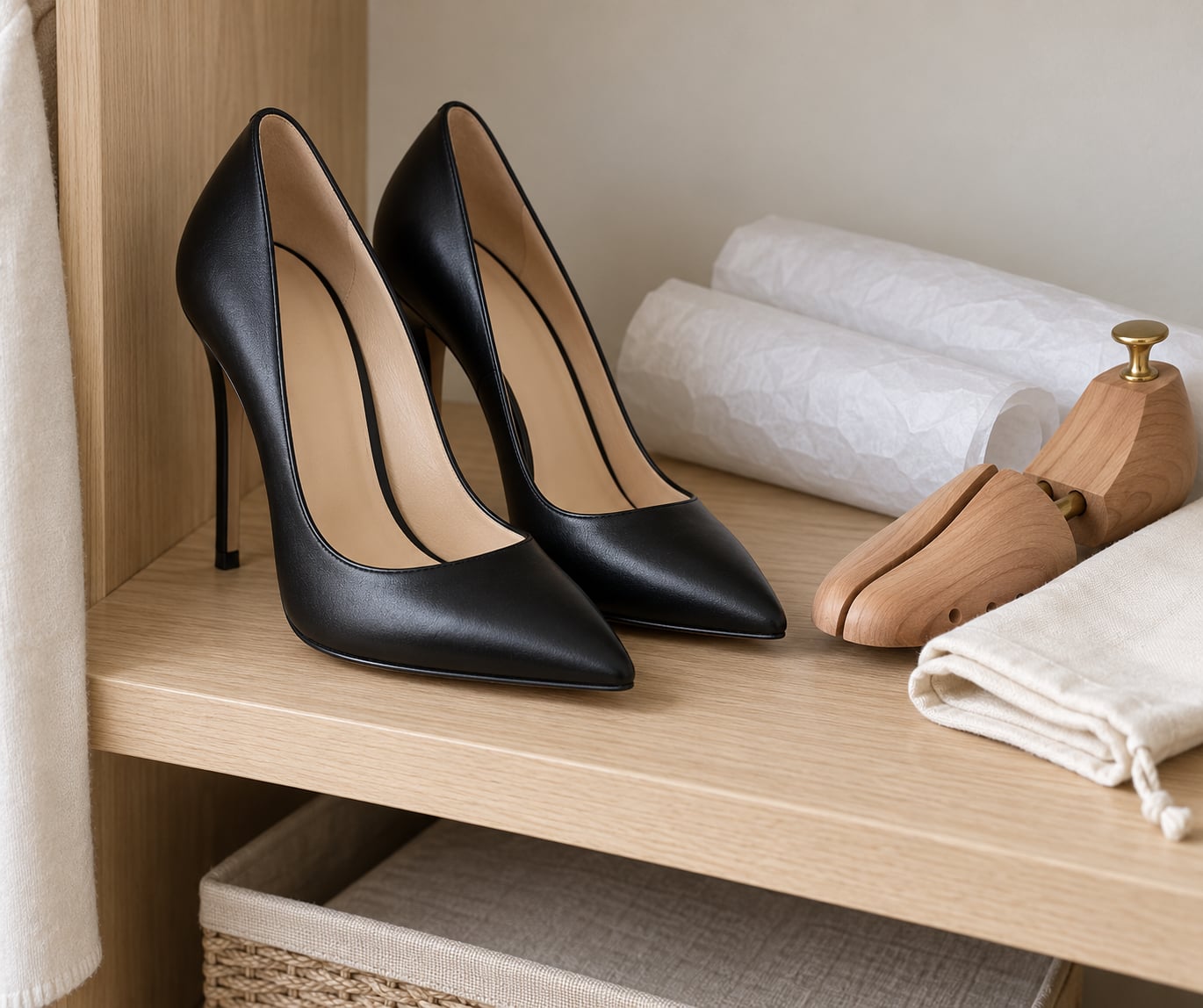
To store heels so they keep their shape, stand every pair upright with nothing resting on top of it, put a firm insert inside the toe box so it cannot fold, and cover each shoe in something breathable before it goes on the shelf. Add clean, dry shoes only, keep them out of sunlight and damp rooms, and skip the flat shoe tree — it is built for a different shape.
That last point catches a lot of people out. You buy the tree, you push it in, and the vamp bulges because the insert was made for a flat. High heels are built to carry weight down through a narrow shank under the arch, and their forward pitch pulls the toe box down every time they sit. Storage is mostly the art of cancelling that pull.
The whole routine takes about a minute per pair once you have the right supplies. Last reviewed in 2026 for pumps, stilettos, platforms and heeled sandals.
Table of Contents
- What You Need
- How to Store Heels So They Keep Their Shape: Step by Step
- 1. Clean and Dry the Heels Before Storing
- 2. Support the Toe Box and Heel Area
- 3. Protect Delicate Materials and Finishes
- 4. Choose the Right Box or Dust Bag
- 5. Store Heels in a Stable, Climate-Controlled Place
- Common Mistakes
- Quick Storage Tips
- Frequently Asked Questions
- Can I use newspaper to store heels and keep their shape?
- What is the best way to store high heels long term?
- Do shoe trees work for pumps, sandals, and boots?
- Should I store heels in a plastic container or breathable bag?
- How can I fix heels that have already become misshapen?
- How should I store tall boots so they do not fold or crease?
- Conclusion
What You Need
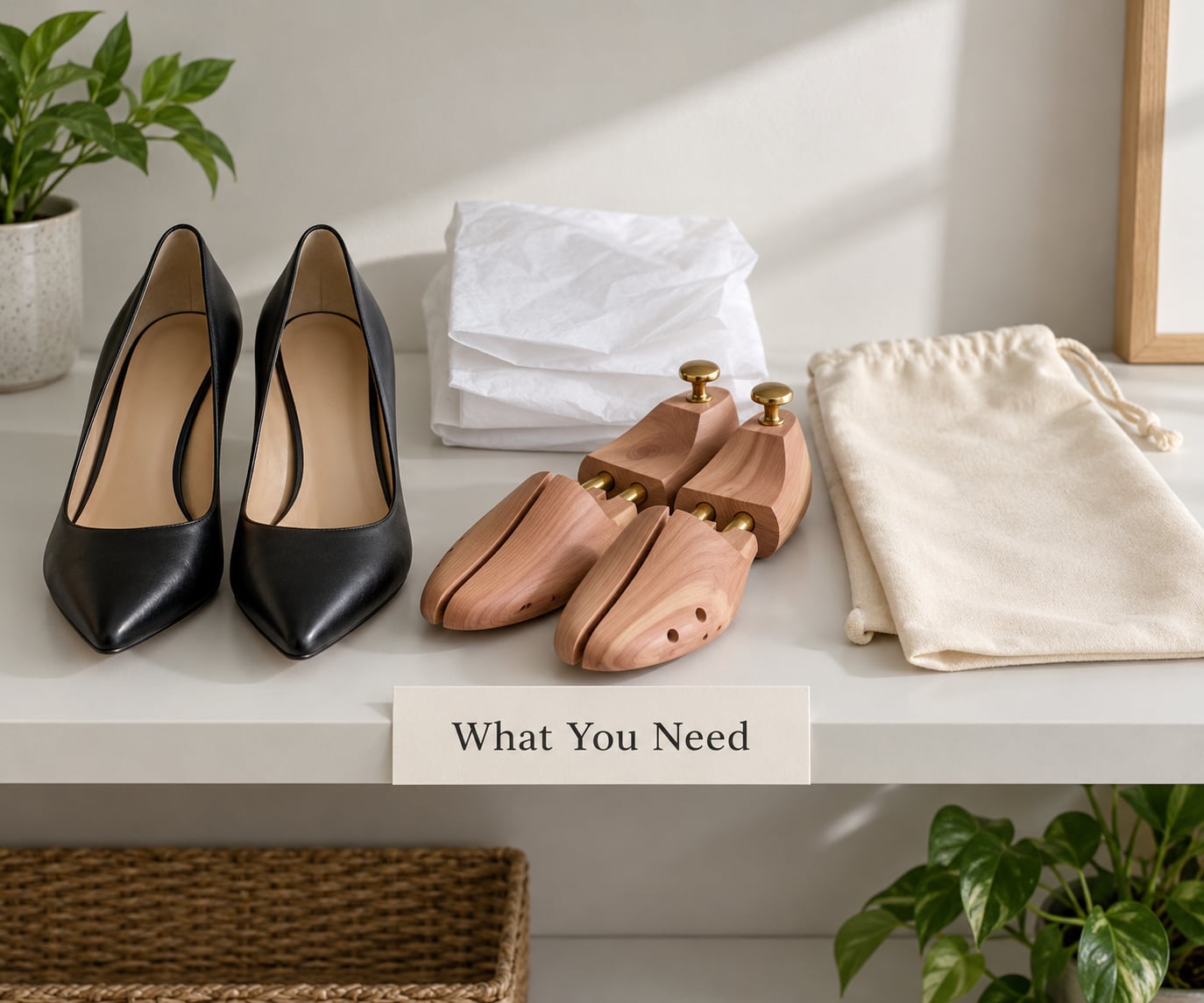
None of this is specialist equipment, and most of it you can improvise:
- Acid-free tissue paper. Plain buffered tissue from an archival supplier, or the tissue sheet that came in the original box. Regular newsprint and acidic tissue will yellow leather over time.
- A heel-specific shaper, or a tight roll of tissue or a magazine to improvise one. A standard flat shoe tree will not do.
- Breathable dust bags. Soft cotton or flannel sleeves, one per shoe.
- A rigid shoe box for pairs you will stack or move around.
- A cool, dry spot with a flat surface that will not tip over.
If you own boots, add boot shapers or rolled pool noodles cut to the shaft height. Satin, patent and embellished pairs need an extra layer between them and everything else.
How to Store Heels So They Keep Their Shape: Step by Step
Work through this in order, once per pair, every time you put shoes away.
1. Clean and Dry the Heels Before Storing
Wipe the soles and the inside of the shoe with a dry cloth first. Street grit works into the shank area and then grinds against the upper every time the shoe moves.
Never put a damp shoe into a closed box or a sealed bag. Moisture gets trapped, adhesive under the upper starts to let go, and in warm weather you can get a musty smell that takes months to shift. If you have just walked through rain, leave the pair out of the box overnight.
2. Support the Toe Box and Heel Area
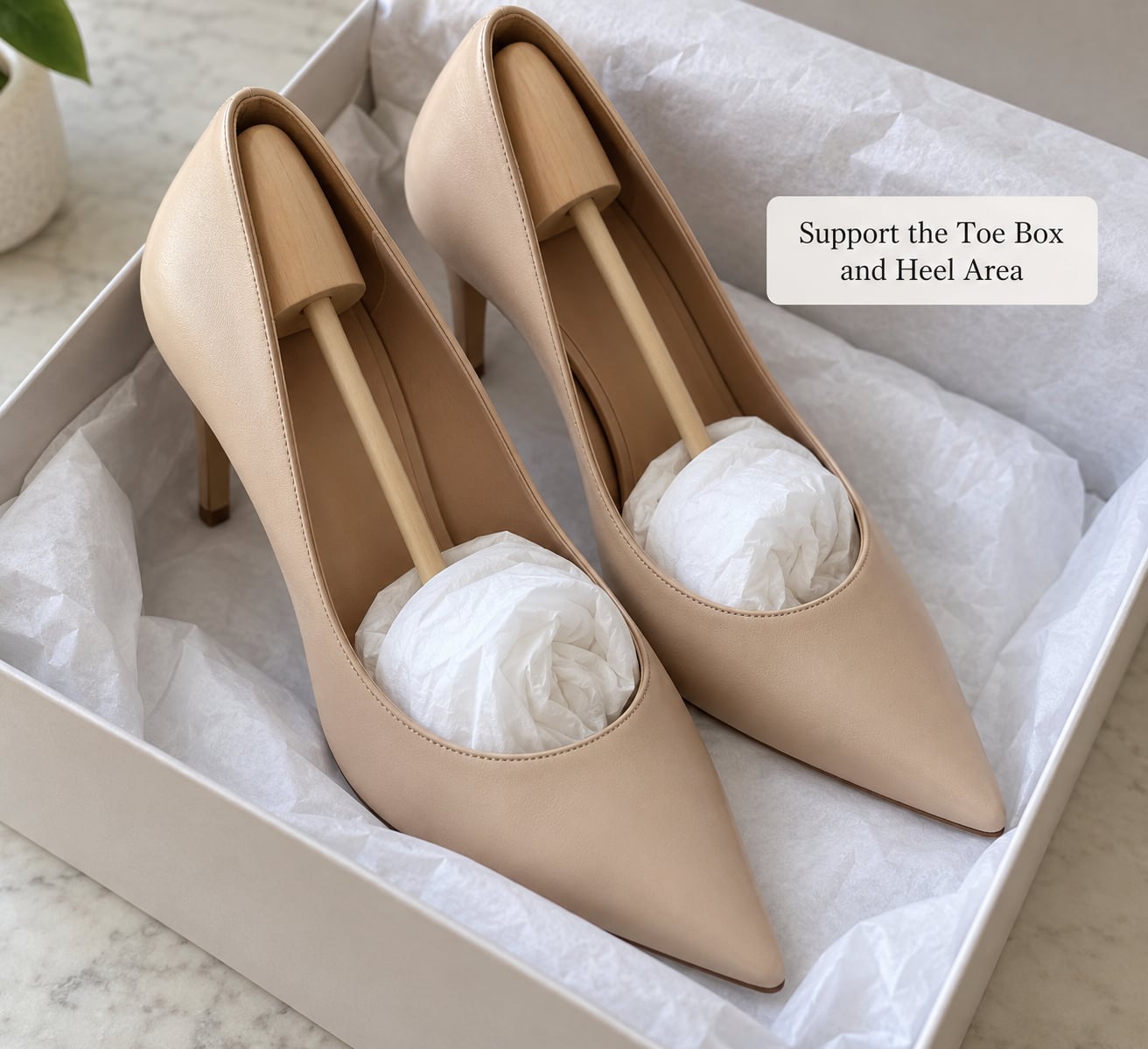
This is the step that actually decides whether a pair looks new next spring. A shoe tree is a shaped insert — often wood, cedar or moulded foam — that fills the inside of a shoe so the toe box and heel counter hold their original curve instead of going flat.
The trick is fit, not force. A standard shoe tree is built for a flat, so pushing one into a pump over-fills the vamp and pushes stress into the shank, which is the part you least want under strain. A heel-specific shaper, or a loosely rolled core of tissue or a magazine, fills the space without straining anything.
As a general rule, heels under about 10 cm can get by with light tissue in the toe box. Taller stilettos need a proper body fill, because the longer the shank, the more weight is pulling the toe down. For sandals, wedge a slim roll between the footbed and the arch so the footbed keeps its curve. For boots, fill the shaft with shapers or a rolled pool noodle; a folded noodle keeps a soft shaft standing without creasing at the ankle.
You will know it worked when the shoe stands on its own sole, the toe box looks rounded, and the back of the shoe holds the heel shape rather than gaping.
3. Protect Delicate Materials and Finishes
Different finishes fail in different ways, so the covering matters as much as the support.
Satin and velvet have a raised pile that abrades when it rubs against another shoe. Give each one its own bag and never place a satin pair directly beside a leather one. Embellished, beaded or rhinestone heels snag easily, so keep them in a rigid box with tissue holding the decoration in place rather than loose in a bag where a zip can catch a bead.
Patent leather creases permanently and shows every scuff, so it needs support rather than space — an insert holding the vamp smooth is worth more to it than an empty box. Light-coloured and white pairs pick up colour transfer from dark leather, so separate them. Suede and nubuck should be brushed and stored away from anything that sheds.
A light-coloured cotton bag does the job for all of them. Plastic is the one material to avoid.
4. Choose the Right Box or Dust Bag
Breathable versus airtight is the whole decision. Cotton, flannel and acid-free tissue let moisture escape. Sealed plastic holds a little dampness in permanently, and over months that trapped moisture is what yellows adhesives and grows mildew on the footbed.
Use individual bags when the pair is sitting on an open shelf. Add a rigid box when you are stacking, when the shoes move between rooms, or when the material is satin or embellished. The original box is fine for a single special pair, but most of them are thin cardboard — fine as a cover, weak as a structural support for anything stacked on top.
A breathable cardboard box also absorbs moisture from the air and attracts pests, so a very long-term collection is better off in a rigid box with tissue inside.
5. Store Heels in a Stable, Climate-Controlled Place
Upright, unsupported, and off the floor. That is the rule, and it is the part people get wrong most often when they ask how to store heels so they keep their shape. Anything sitting on top of a heel puts weight on the shank, and that is exactly what bends it.
Keep boxes away from direct sunlight, which fades colour and dries out leather, and away from radiators, vents and hot attic spaces. Skip damp basements and unheated garages; humidity is what turns a folded toe box into a mouldy one. Sunlight through a bedroom window is the quiet one — pairs on a top shelf facing glass fade unevenly on one side.
The floor is fine for a box you never move, but not for a shelf that sags under a stack of heavier footwear. Put your heaviest pairs on the bottom and your heels above them, on their own.
Common Mistakes
Almost every heel that loses its shape was damaged by one of these.
- Stacking heels under other shoes. The weight compresses the toe box and bends the shank permanently. Fix: give every pair its own level, or put heavier shoes on the bottom.
- Using a flat shoe tree in a heel. It over-fills the vamp and stresses the shank. Fix: a heel shaper or a loosely rolled core of tissue.
- Sealing heels in plastic for months. Trapped moisture yellows adhesive and invites mildew. Fix: cotton or flannel, opened occasionally.
- Storing damp shoes in a closed box. You are wrapping a wet shoe in a bag. Fix: air them out first.
- Folding tall boots at the ankle. The crease at the fold is hard to undo. Fix: boot shapers, a rolled pool noodle, or hanging the boot by its loop.
- Overstuffing the shoe. Packing it tight with newspaper or tissue over time flattens the footbed. Fix: fill loosely, so the shoe still holds its rounded shape when you lift it out.
- Putting delicate pairs shoulder to shoulder. Satin abrades, embellishments snag. Fix: individual bags and a rigid box for the fragile ones.
- Leaving the lid off the box in a closed cupboard. Dust gets into the toe box and rubs with every movement. Fix: cover the pair, even on a shelf.
Quick Storage Tips
Rotate the pairs you actually wear. Shoes kept in a box for two years come out looking stored, not worn.
Check a box when you pull a pair out. A loose heel cap, a lifted sole edge or a scraped shank is cheaper to repair before it is stored than after you need the shoes. Older pairs in a worn condition are usually accepted back into circulation when they still hold close to their original shape.
Refresh your stuffing every few months, and replace paper inserts that have gone limp. Label each box with the pair inside, and photograph the shoe before it goes away.
Frequently Asked Questions
Can I use newspaper to store heels and keep their shape?
It works in a pinch, but it is a short-term fix. Newsprint is acidic and unbuffered, so over time it can dull colour and yellow the inside of the shoe, and ink can transfer to a pale lining. Roll it loosely and swap it out every few weeks, or use acid-free tissue paper instead and keep the newspaper for the parts of the shoe nobody sees.
What is the best way to store high heels long term?
Keep each pair upright in a rigid box lined with acid-free tissue, with a heel shaper or a loosely rolled insert filling the toe box and body. Store the box somewhere cool, dry and out of direct sunlight, never under other footwear. Check it every few months and replace any insert that has flattened. Breathable materials and a stable temperature matter more than the container you choose.
Do shoe trees work for pumps, sandals, and boots?
For pumps, use a heel-specific shaper or a loosely rolled core of tissue, because a standard flat shoe tree over-fills the vamp and stresses the shank. For heeled sandals, a slim roll under the arch keeps the footbed from curling. For boots, boot shapers or a rolled pool noodle cut to shaft height hold the shaft upright and stop it folding at the ankle.
Should I store heels in a plastic container or breathable bag?
Breathable wins for almost every pair. Cotton or flannel dust bags and acid-free tissue let moisture escape, while sealed plastic traps dampness that can yellow adhesives and grow mildew on the footbed over months. Use a rigid plastic container only if it is vented and the shoes inside are completely dry, and leave the lid cracked if you are storing for a season.
How can I fix heels that have already become misshapen?
Dampen a cloth, lay it over the creased area, and warm it gently with a hair dryer held at a distance. Once the leather or satin is pliable, stuff the toe box tightly with tissue and leave the shoe under a flat weight for 24 to 48 hours. Deep cracks in leather and permanently flattened toe boxes are hard to recover, so a cobbler is the realistic option for anything badly bent.
How should I store tall boots so they do not fold or crease?
Keep the shaft standing with boot shapers, rolled pool noodles cut to the shaft height, or acid-free tissue stuffed loosely from the toe up. Never fold the shaft at the ankle, because that crease is the hardest one to undo. Hanging by the boot loop works for smooth shafts but can stretch the calf of a soft suede boot, so an upright fill is safer for those.
Conclusion
Start with the pair in front of you: clean it, let it dry fully, then fill the toe box so it stays rounded. Stand it upright, cover it in cotton rather than plastic, and keep it somewhere cool and out of the sun.
That is the whole method, and it adapts easily. Pumps need a heel shaper, sandals need a small roll under the arch, boots need a filled shaft, and satin or embellished pairs need their own box. Match the support and the covering to the shoe, and the shape will still be there when you pull the lid off.