Reading a skincare ingredient label takes about two minutes: turn the bottle over, find the INCI list, and read it from the top down. Ingredients are listed in descending order of weight, so the first few names tell you what the formula is mostly made of, and the position of an active tells you whether the brand dosed it seriously. That is the whole method. Everything else is detail.
This guide walks through a seven-step process for how to read a skincare ingredient label, from matching the product format to your goal, through translating Latin botanical names, to scanning for fragrance and other sensitivity triggers and cross-checking the formula against the directions and warnings. It is general information about cosmetic labelling, not medical advice. If your skin reacts, worsens or flakes, a board-certified dermatologist can tell you more than any label can.
One thing worth saying up front: no cosmetic is approved by the FDA before it reaches you. Cosmetics are regulated after they hit the market, while over-the-counter drug products, including sunscreen and acne treatments with active ingredients, go through an approval process. That distinction changes what the label is required to tell you, and it comes up again in step 6.
Table of Contents
- What You Need
- Step-by-Step
- 1. Start with the product type, purpose, and claims
- 2. How to read a skincare ingredient label from top to bottom
- 3. Identify the active ingredients and what they do
- 4. Estimate how much of an active is present
- 5. Check ingredients that may irritate sensitive skin
- 6. Compare the formula with the instructions and warnings
- 7. Make a final no-jargon decision
- Common Mistakes
- Frequently Asked Questions
- Which ingredient should be listed first on a skincare label?
- Do skincare labels have to list the exact percentage of every ingredient?
- What is the most common skincare ingredient name that is hard to recognize?
- Are natural or organic skincare ingredients always better for sensitive skin?
- How do I choose between two moisturizers by reading their labels?
- Conclusion
What You Need
You need the product itself, in the packaging it came in. The ingredient list on a boxed product can differ from the refill pouch inside it, and a product’s website version is sometimes reformatted or abbreviated.
You also need a sense of what you want the product to do. Write it down in one sentence before you read anything: hydration, breakouts, uneven tone, texture, fine lines, barrier repair. A formula cannot be good or bad in isolation, only good or bad for a goal.
Third, note anything you already avoid. People with contact dermatitis or scent sensitivity usually arrive with a short list: parfum or fragrance, essential oils such as lavender or tea tree, a drying alcohol they reacted to. Keeping that list in front of you turns a wall of Latin into a quick scan.
Last, have a second product nearby when you are comparing. Side-by-side labels are the fastest way to see why two moisturizers behave so differently.
Step-by-Step
1. Start with the product type, purpose, and claims
Decide what kind of product you are holding before you look at the ingredient names. A cleanser, a moisturizer, a sunscreen, a serum and an acne treatment are built completely differently, and each has its own set of expected ingredients.
- Cleanser: water, surfactants such as sodium lauryl sulfate, cocamidopropyl betaine or sodium cocoyl glycinate, a thickener, a preservative, and usually fragrance.
- Moisturizer: water plus humectants that pull water in, emollients that soften, and occlusives that seal. Glycerin, ceramides, squalane, fatty acids and dimethicone are the usual supporting cast.
- Sunscreen: a filter such as zinc oxide, titanium dioxide, avobenzone or octinoxate, with a base to spread it. In the US this is a drug label, so the filters appear in an Active Ingredient panel with their concentrations.
- Serum: a thinner vehicle, usually water or oil based, where a single active is dosed at the top of the list.
- Treatment: a drug-level active like benzoyl peroxide or hydroquinone, at a stated percentage.
Then read the front claims. “Brightening,” “detoxifying,” “renewing” and “anti-ageing” are not regulated terms. What you want to do is convert each claim into an ingredient that would plausibly produce it. Brightening usually means niacinamide, vitamin C, azelaic acid or tranexamic acid. Hydrating means glycerin, hyaluronic acid or panthenol. “Detoxifying” means almost nothing on a cosmetic label, because the skin does not detoxify in the way that phrase implies.
2. How to read a skincare ingredient label from top to bottom
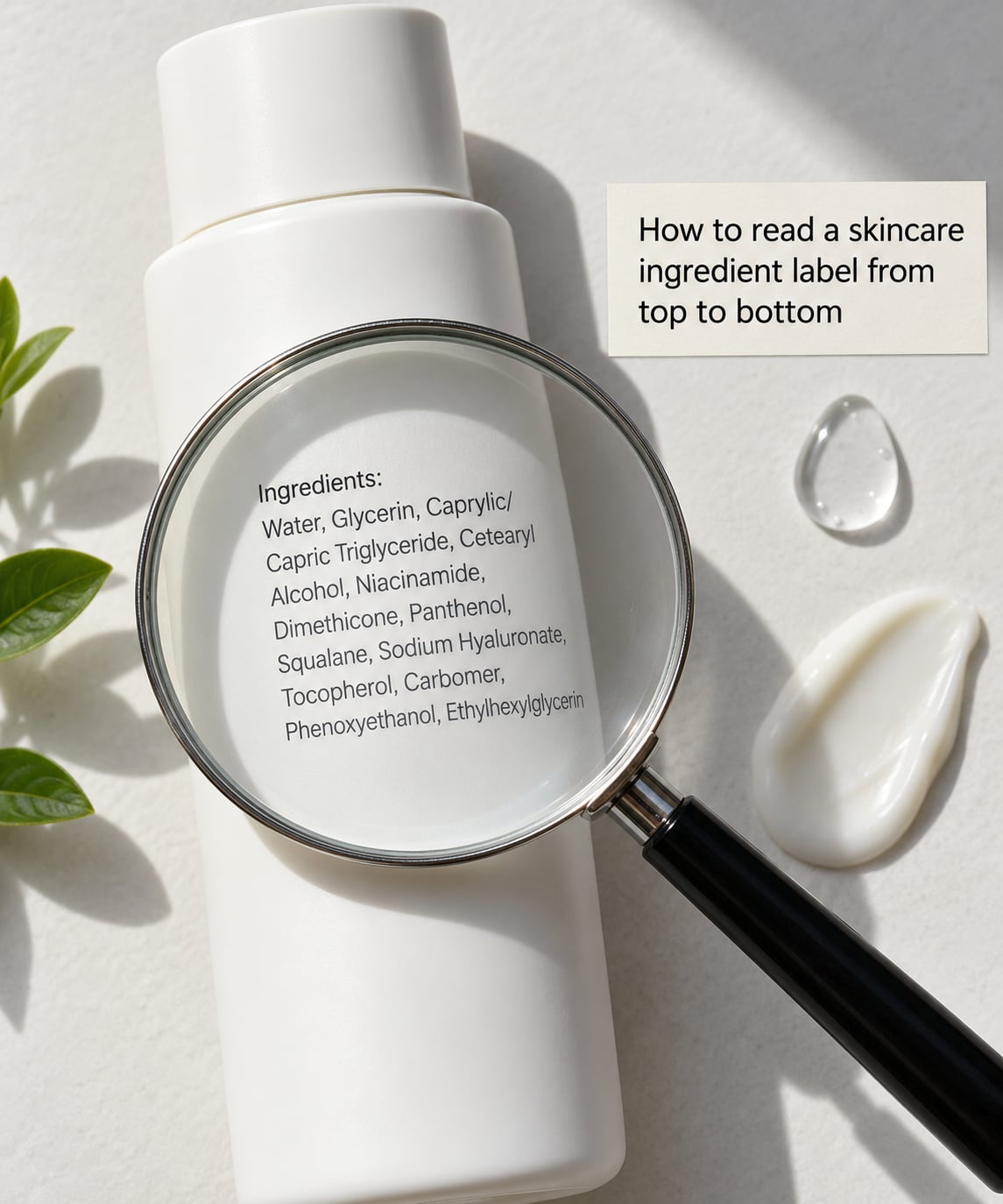
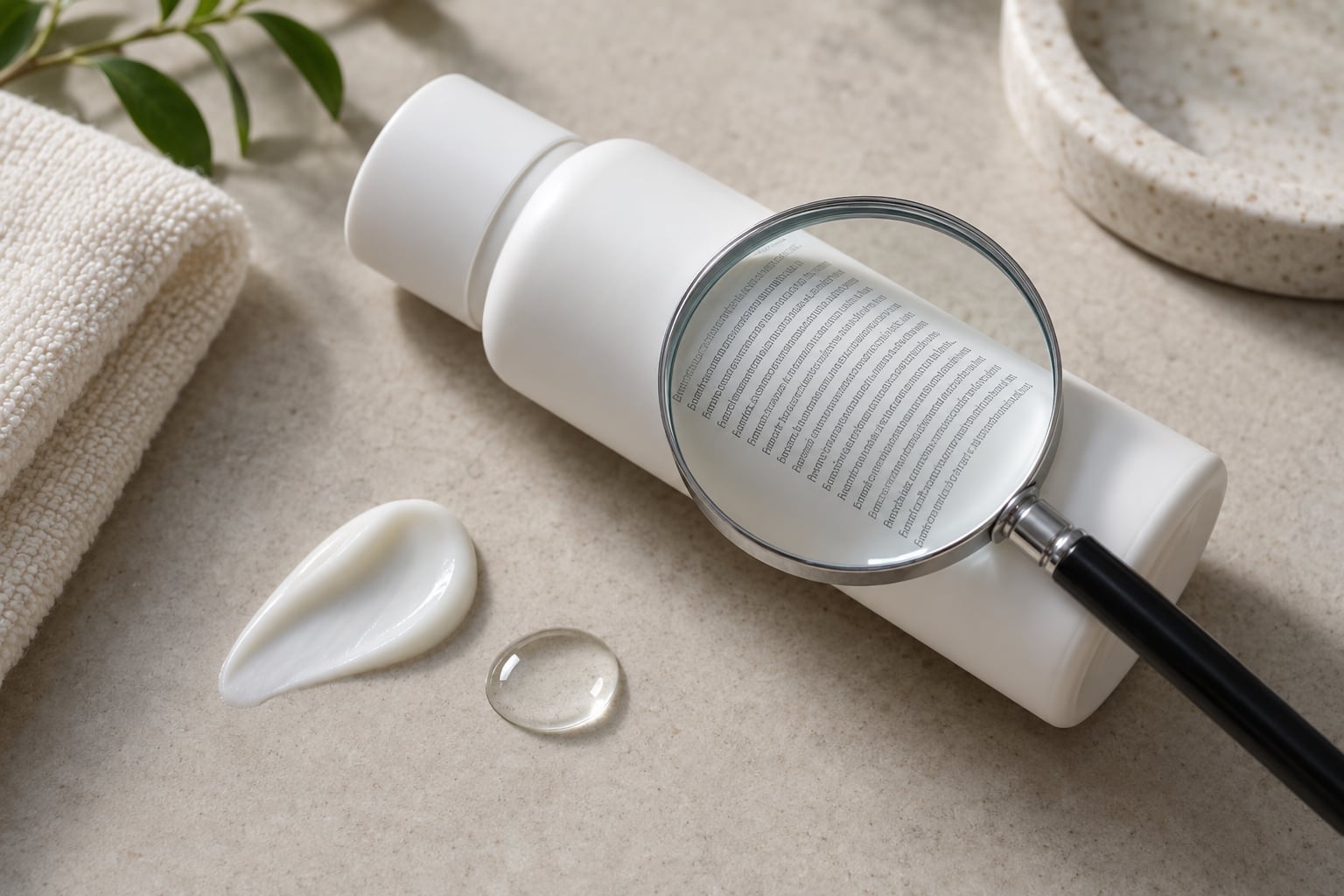
INCI stands for International Nomenclature of Cosmetic Ingredients. It is the shared naming system that lets a label in one country mean the same thing as a label in another, and it is why the list looks the way it does. US and EU rules require cosmetic ingredients to appear in descending order of weight, from most to least.
Water, listed as aqua, water or eau, is usually first. That tells you almost nothing about quality; it just means the product is mostly water, which is true of most moisturizers and cleansers and entirely normal.
The first five ingredients generally make up the bulk of the formula, often 80 percent or more between them. That makes them the most informative line on the label, and it is also the part you can judge fastest. If the first three are water, glycerin and mineral oil, you are looking at a simple, unfussy formula regardless of what the front of the bottle says.
Two verification points. A water-based product such as a gel or lotion should open with water or aqua. An oil-based product such as a cleansing balm or facial oil should open with the oil, whether that is squalane, jojoba oil or a triglyceride blend. If the order does not match the texture in your hand, that is a reason to be skeptical about the rest of the claim.
Korean and Japanese products often follow a similar format but can order by total content rather than exact concentration, and some use grouped headings. If a K-beauty label lists botanical extracts at the very top, it does not automatically mean they dominate the formula.
3. Identify the active ingredients and what they do
Sort the list into categories. Once you know which category an ingredient belongs to, you know whether it is the reason you are buying the product or just keeping it stable.
- Exfoliating acids: glycolic acid, lactic acid, mandelic acid (AHA family), salicylic acid (BHA), and polyhydroxy acids such as gluconolactone.
- Antioxidants: ascorbic acid (vitamin C), tocopherol (vitamin E), ferulic acid, resveratrol, green tea extract.
- Retinoids: retinol, retinaldehyde, tretinoin, adapalene.
- Hydrators and barrier support: glycerin, hyaluronic acid, ceramides, panthenol, squalane, cholesterol and fatty acids.
- Soothing agents: allantoin, bisabolol, centella asiatica, colloidal oatmeal.
- Sunscreen filters: zinc oxide, titanium dioxide, avobenzone, octinoxate, octisalate.
- Structure and preservation: dimethicone and other silicones, thickeners, emulsifiers, and preservatives such as phenoxyethanol, parabens or benzoic acid.
Most of the last category is doing quiet structural work, and its presence is not a warning sign. Silicones, for example, sit on the surface to reduce water loss and smooth texture; they do not absorb into skin.
The translation problem is mostly botanical names. INCI requires the Latin binomial for plant ingredients, which tells you the species but not the part used or how much.
| INCI name on the label | What it actually is |
|---|---|
| Butyrospermum parkii | Shea butter |
| Simmondsia chinensis (seed) oil | Jojoba oil |
| Argania spinosa (kernel) oil | Argan oil |
| Olea europaea (fruit) oil | Olive oil |
| Ascorbic acid | Vitamin C |
| Tocopherol | Vitamin E |
| Niacinamide | Vitamin B3 |
| Panthenol | Pro-vitamin B5 |
| Centella asiatica extract | Cica / gotu kola |
| Aloe barbadensis leaf juice | Aloe vera |
| Helianthus annuus seed oil | Sunflower oil |
| Cocos nucifera oil | Coconut oil |
| Aqua | Water |
| Parfum / Fragrance | A blend of scent compounds, undisclosed |
When a name defeats you, search the exact INCI term plus the plain-language version, or use one of the ingredient decoders built for this. Read their verdicts skeptically: they rank irritation likelihood, not your personal response, and a low score on a decoder does not cancel a contact allergy you already have.
4. Estimate how much of an active is present
Here is the honest answer: a standard cosmetic label does not disclose every exact percentage. What it does is reveal ranking, with one important exception, the 1% rule.
Under EU cosmetics rules, ingredients present at 1 percent or more must be listed in true descending order. Everything at or below 1 percent can then appear in any order the brand likes. So if your hero ingredient sits at position 25, you know it is at or under 1 percent and no more. If it sits at position 3, you know it is meaningfully above 1 percent, though not exactly how much.
That is the entire scope of the 1% rule. It is a real regulatory threshold and a genuinely useful tool, and it is also frequently oversold as a precise dosing calculator. It tells you a ranking, not a number.
Many brands now publish the concentration of their hero active on the front of the pack or on the product page. When they do, treat it as a signal of confidence: a company willing to state “retinol 0.3%” is a company that has nothing to hide from the comparison. Community skincare forums treat percentage disclosure as one of the strongest trust signals there is, alongside specific consumer reviews.
Ranges that show up often enough to be worth holding in your head, based on published concentrations across the category:
| Active | Range commonly seen in products that work |
|---|---|
| Niacinamide | 2 to 5 percent |
| L-ascorbic acid (vitamin C) | 10 to 20 percent |
| Lactic acid | 10 to 20 percent |
| Glycolic acid | 5 to 8 percent |
| Salicylic acid | 0.5 to 2 percent |
| Azelaic acid | 10 to 20 percent |
| Retinol | 0.1 to 1 percent |
| Hyaluronic acid | 0.1 to 2 percent, in weight-average form |
A small amount can still be obvious. A few drops of lavender oil will scent a whole cream, and a trace of pigment can tint a formula, so texture and colour tell you something but not dosage.
5. Check ingredients that may irritate sensitive skin
This is where reading pays off most for reactive skin. What follows is a list of common triggers, not a blacklist of poisons.
- Fragrance: listed as parfum or fragrance, right after water in most formulas. It is one line on the label but a mixture of dozens of compounds, and fragrance allergens are a leading cause of allergic contact dermatitis on the face.
- Essential oils: lavender, tea tree, eucalyptus, peppermint, lemon and rosehip. Natural origin says nothing about gentleness, and oxidation makes some of them more irritating over time.
- Drying alcohols: ethanol, denatured alcohol, isopropyl alcohol, listed high up in a formula. Not the same thing as cetyl or cetearyl alcohol, which are fatty alcohols that thicken and feel smooth rather than sting.
- Strong exfoliants: high-strength AHAs and BHAs, especially in leave-on formulas. Not a sensitivity problem in the allergy sense, but a frequent cause of irritation, dryness and barrier damage when overused.
- Botanical extracts: witch hazel, oakmoss, some citrus-derived ingredients. Plant-derived and fragrance-containing ingredients overlap heavily.
The fragrance-free question deserves clarity, because the words get used loosely.
| Label wording | What it actually means |
|---|---|
| Fragrance-free | No fragrance added. The strongest of the three claims, though it still does not mean allergen-free. |
| Unscented | No scent added on purpose, but masking agents or fragrance components may still be present. It is not a reliable signal. |
| Naturally derived fragrance | Scent from plant or natural sources, chemically identical molecules to synthetic fragrance. Naturally derived is not gentler. |
| Hypoallergenic | Not a regulated term for cosmetics. No standard is enforced behind it. |
Scent-sensitive and eczema-prone readers on skincare forums report reactions from products labelled unscented, which is exactly why the distinction matters. Check the full list for parfum, not just the front of the bottle.
Patch test anything new. Apply a small amount to the inside of the forearm or behind the ear, leave it, and watch for redness, itching or swelling over 24 to 48 hours before it goes on your face.
6. Compare the formula with the instructions and warnings
The ingredient list is one panel. The rest of the back label tells you how the brand expects the formula to be used, and inconsistencies between the two are informative.
- Directions and frequency: does “use nightly” match an active that can irritate, or is the brand telling you to build up slowly?
- Order of application: does the routine described match the texture you are holding?
- Sun-protection language: a retinol or acid formula that warns about sun sensitivity is telling you it is doing real work. Sunscreens carry a Drug Facts panel and a required statement about reapplication.
- Warnings: “avoid contact with eyes”, “for external use only”, “discontinue use if irritation occurs”, and warnings about concurrent products tell you exactly which combinations the brand expects to be a problem.
- Period after opening, the open jar symbol: a small jar with a number such as 12M means use within 12 months of opening. A number without a jar, such as 24M, refers to shelf life after the seal or the date of manufacture.
- Batch or lot code: a stamped or ink-jetted code on the bottle or box. Many brands have a lookup page where entering the code gives the production date and expiry.
- Net contents: a US cosmetic states net weight or net volume in both units, for example 50 mL or 1.7 fl oz with grams alongside. Fill volume is the liquid amount; net weight is what the whole package weighs.
- Country of origin and distributor address: a US distributor address means someone here is the importer of record and point of contact, which matters for a complaint or a safety recall.
If there is no printed expiration date, that is normal for cosmetics. The open jar symbol plus the batch code usually cover it, and a change in smell, colour or texture is its own warning that a product has degraded.
7. Make a final no-jargon decision
Run the label through seven questions in order:
- Does the product type match my goal?
- Do the first five ingredients make sense for that product and its texture?
- Is the active I care about present, and near the top if it is the whole point of the formula?
- Does it contain anything I already know triggers me, especially parfum?
- Do the directions, frequency and warnings match my skin’s tolerance?
- Is it worth the money for my skin, or am I paying for a claim I cannot verify on the label?
- Have I patch tested it?
Two moisturizers make this concrete. Product A opens with water, glycerin, squalane, ceramides and panthenol, then a long tail, and lists no parfum. Product B opens with water, followed by parfum at number two, then a plant oil, with ceramides buried near the end. If your skin is reactive and your goal is barrier repair, A fits the brief and B does not, no matter how the packaging reads.
For an acne treatment with benzoyl peroxide or a sunscreen, look for the Active Ingredient panel instead, where the concentration is stated by law. For anything that is causing persistent redness, burning, itching or swelling, stop reading and book a dermatologist. Label reading gets you a good guess; it does not diagnose anything.
Common Mistakes
Most label-reading errors come from a handful of habits that sound reasonable and are not.
- Assuming the first ingredient is the active one. The first ingredient is usually water. Correction: find your active in the list, then read its position, not the top of the label.
- Expecting exact percentages. Cosmetic labels give ranking, not quantities. Correction: look for published percentages on the pack or product page, and treat the 1% threshold as the only boundary the law draws.
- Treating ingredient order as proof of effectiveness. An active at position 40 may still work, and a hero ingredient at position 2 in a poorly designed formula will not. Correction: combine position with texture, price, directions and published percentages.
- Counting ingredients as a quality score. A 30-ingredient formula built on well-chosen surfactants and a good preservative system can beat an 8-ingredient formula that is mostly water and fragrance. Correction: judge the first five ingredients and the purpose of the rest.
- Believing natural means gentle. Essential oils, citrus extracts and lavender are plant-derived and among the most common facial allergens. Correction: check the function and the concentration, not the source.
- Buying the claim instead of the formula. “Clean”, “non-toxic”, “chemical-free” and “dermatologist-tested” are unregulated for cosmetics. Certification marks such as USDA Organic, Ecocert or Soil Association are third-party and mean something more concrete. Correction: ignore the front when the back answers the question.
- Skipping the patch test. A label tells you what is in the bottle, not how your skin will answer it. Correction: 24 to 48 hours on the inner forearm, then your face.
If you only remember one thing from this guide, make it the 60-second version: find the product type, read the first five ingredients, locate your active and check its position, scan for parfum and known triggers, check the open jar symbol and batch code, then patch test before your face sees it.
Frequently Asked Questions
Which ingredient should be listed first on a skincare label?
Whatever is present in the largest amount by weight. In water-based formulas that is almost always aqua or water, and in oil-based formulas such as a cleansing balm or facial oil it is usually the oil itself. The first position tells you the formula’s base, not its star active, so it is most useful for confirming that a product’s texture matches its claims.
Do skincare labels have to list the exact percentage of every ingredient?
No. Cosmetic labels list ingredients in descending order of weight without disclosing exact quantities. The one useful exception is that, under EU rules, anything at 1 percent or more must appear in true descending order, so ingredients below that threshold can be listed in any order. Brands that publish percentages on the pack are voluntarily being more transparent than the law requires.
What is the most common skincare ingredient name that is hard to recognize?
Butyrospermum parkii, which is shea butter, and Simmondsia chinensis, which is jojoba oil. INCI requires the Latin binomial for plant ingredients, so names like these hide familiar oils and butters behind botanical Latin. Alpha tocopherol is vitamin E, ascorbic acid is vitamin C, and parfum is a fragrance blend listed as a single line.
Are natural or organic skincare ingredients always better for sensitive skin?
No. Origin does not predict how your skin responds. Essential oils such as lavender, tea tree and citrus extracts are plant-derived and are among the most common triggers of allergic contact dermatitis on the face. What matters more is the ingredient’s function and dose, whether the formula lists parfum, and how you respond to it, which is why patch testing beats guessing at natural status.
How do I choose between two moisturizers by reading their labels?
Compare them on five points: what the first five ingredients are, where your target ingredients sit in the order, whether parfum appears at all, whether the active has a published percentage, and whether the directions and warnings match your skin’s tolerance. For reactive skin, the absence of fragrance usually decides it faster than any other factor.
Conclusion
Start tonight with whatever is on your bathroom shelf. Turn the bottle over, name the goal in one sentence, read the first five ingredients, find your active and note its position, scan for parfum and anything on your own trigger list, check the open jar symbol and batch code, then patch test for a day or two before it touches your face. That is how to read a skincare ingredient label without needing a chemistry degree. If your skin is reacting to something already in your routine, a dermatologist can take the guesswork out of it.