
Most people asking about the morning vs evening skincare routine order are not looking for a ten-step ritual twice a day. They want to know which steps change, which stay identical, and what goes on top. The short version: the morning routine works from thinnest to thickest and ends with broad-spectrum sunscreen, while the evening routine starts by removing that sunscreen and makeup, then layers treatment products before a richer moisturizer. Everything else is largely the same.
I have pared my own routine down to four steps morning and night and been happier for it. The order matters more than the number of products, and the texture of what you apply in the morning matters more than most people expect, because sunscreen and makeup sit on top of all of it.
Table of Contents
- Morning vs Evening Skincare Routine Order at a Glance
- Morning vs Evening Skincare Routine Order: Key Differences
- How to Build Each Routine
- Morning Routine: Order, Products, and Reasoning
- Morning vs Evening Skincare Routine Order, Step by Step
- Evening Routine: Order, Products, and Reasoning
- How to Choose Products for Each Time of Day
- Common Skincare Routine Mistakes
- Which Should You Choose?
- Frequently Asked Questions
- Should I use the same skincare products in the morning and evening?
- What is the correct order for morning skincare?
- What is the correct order for evening skincare?
- Do I need sunscreen if I use skincare products at night?
- Can I use retinol or exfoliating acids in the morning instead?
- How many skincare steps do I really need each day?
- Bottom Line
Morning vs Evening Skincare Routine Order at a Glance
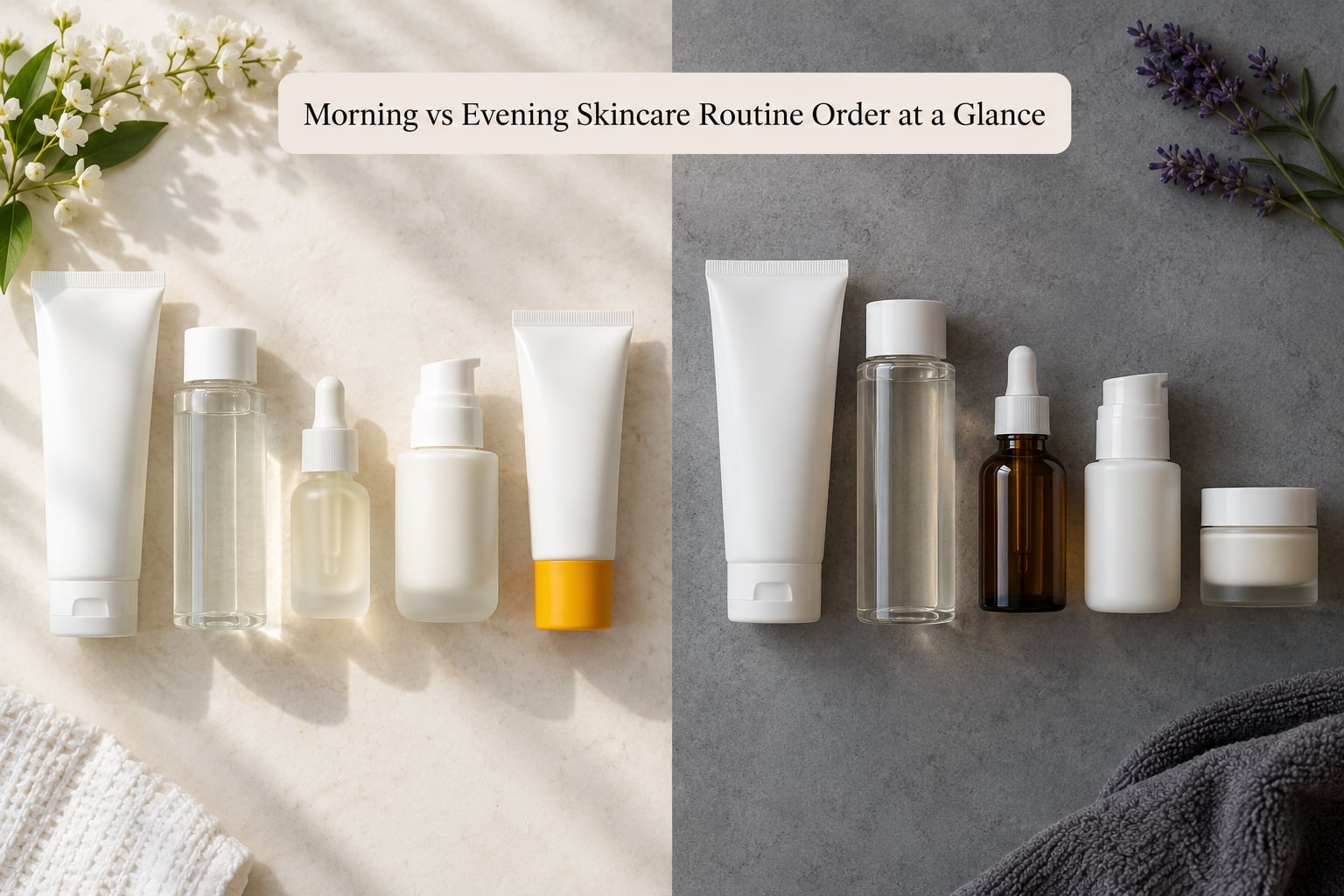
| Criteria | Morning routine | Evening routine |
|---|---|---|
| Main purpose | Protect and prepare | Remove the day and support repair |
| First step | Rinse or gentle cleanse | Remove sunscreen and makeup, then cleanse |
| Treatment products | Antioxidant serum such as vitamin C | Retinoids, exfoliating acids, targeted serums |
| Texture | Light gel or lotion that absorbs fast | Cream, balm or oil that seals moisture in |
| Final step | Broad-spectrum SPF 30 or higher | Moisturizer, optional face oil on top |
| Wait time between layers | About 1 minute for most layers, 15 minutes before sunscreen if using vitamin C | About 1 minute between layers, 10 to 20 minutes before retinoids if skin is sensitive |
| Under makeup | Designed to be layered under makeup without pilling | Not a factor |
| Best fit | Minimal, fast, non-negotiable sunscreen step | Where exfoliation, retinoids and spot treatments belong |
One column of that table is doing most of the work. If you remember nothing else, remember that sunscreen closes the morning and removal of sunscreen opens the evening.
Morning vs Evening Skincare Routine Order: Key Differences
The difference is emphasis rather than an entirely separate set of products. Very few people need a distinct morning and evening shelf. Most need one cleanser, one treatment serum they use at a specific time, a day moisturizer, a night moisturizer, and sunscreen.
What changes in the morning is the finish. Daytime skin meets UV radiation, pollution, free radicals and indoor heating, so products are chosen to sit well under makeup and to not run. What changes in the evening is the starting point, because sunscreen film, makeup and the day’s oil production all have to come off before anything else works properly.
There is a popular slogan in skincare marketing that says night is when skin repairs itself. The nuance is worth knowing: skin does follow a circadian rhythm, and repair activity, cell turnover and hydration recovery do rise during sleep. But that is not a reason to save every active for night. A retinoid in the morning gets wiped off with sunscreen in a few hours and leaves skin more photosensitive, so there is nothing to gain. Products that work by supporting hydration and barrier function, such as ceramides or hyaluronic acid, do just as well in either slot.
The rule I actually use is simpler. Put the products that need hours of contact time or that increase sun sensitivity in the evening. Put protection in the morning. Everything else is a matter of preference and skin feel.
Order matters for one mechanical reason: thin layers have to go on before thick ones, or the thick layer sits on top and the thin one never absorbs. That is also the whole logic behind the thinnest-to-thickest rule, which is the same idea as wetting a sponge before painting it.
How to Build Each Routine
Start with what you already own. Most beginners need a cleanser, a moisturizer and a sunscreen, and they can add one treatment serum once that habit holds for a few weeks. Adding three new actives in the same month is the fastest way to end up with irritated skin and no idea which product did it.
Omit freely. Toners, essences and eye creams are not load-bearing steps. If your skin feels comfortable without them, skip them. The four categories that matter are cleanser, treatment, moisturizer and, in the morning, sunscreen.
Wait a short time between layers. Let water-based serums settle for roughly a minute, and let treatment products dry for 10 to 20 minutes before a retinoid goes over them if your skin is reactive. Moisturizer goes on slightly damp skin, and sunscreen goes on skin that is already fully dry, since applying it over damp skin dilutes the film.
Texture is the reason daytime products feel different. A rich night cream under sunscreen is a recipe for pilling and a milky cast. If you only want one moisturizer, a lotion that suits your skin works in both routines, with a thicker cream or a few drops of face oil added at night.
Morning Routine: Order, Products, and Reasoning
The morning is the shorter of the two. Cleanse or rinse, treat, moisturize, protect. Four steps usually take under five minutes.
- Rinse or cleanse. If you washed your face last night and did not sweat much, plain water is fine. If you used a heavy night cream or worked out, a gentle cleanser clears it without stripping.
- Treatment serum. Vitamin C is the classic morning choice because it works against daytime oxidative stress. Apply it to slightly damp skin and give it about 15 minutes before sunscreen so it settles.
- Moisturizer. A light lotion or gel-cream. This step is not optional for most skin, but you can skip it if your skin is comfortably oily and your sunscreen is moisturizing on its own.
- Eye product, if you like one. Lightly tapped on with your ring finger, either before or after the face serum.
- Broad-spectrum SPF 30 or higher. Last, always. Two finger lengths for the face and neck, reapply every two hours outdoors.
For oily skin, swap the cream for a gel-cream and skip the moisturizer entirely on days your sunscreen already contains it. For dry skin, the morning is where a hydrating serum or a few drops of facial oil under sunscreen helps more than most people expect. For combination skin, treat the oily T-zone and the dry cheeks differently rather than picking one compromise product.
Morning vs Evening Skincare Routine Order, Step by Step
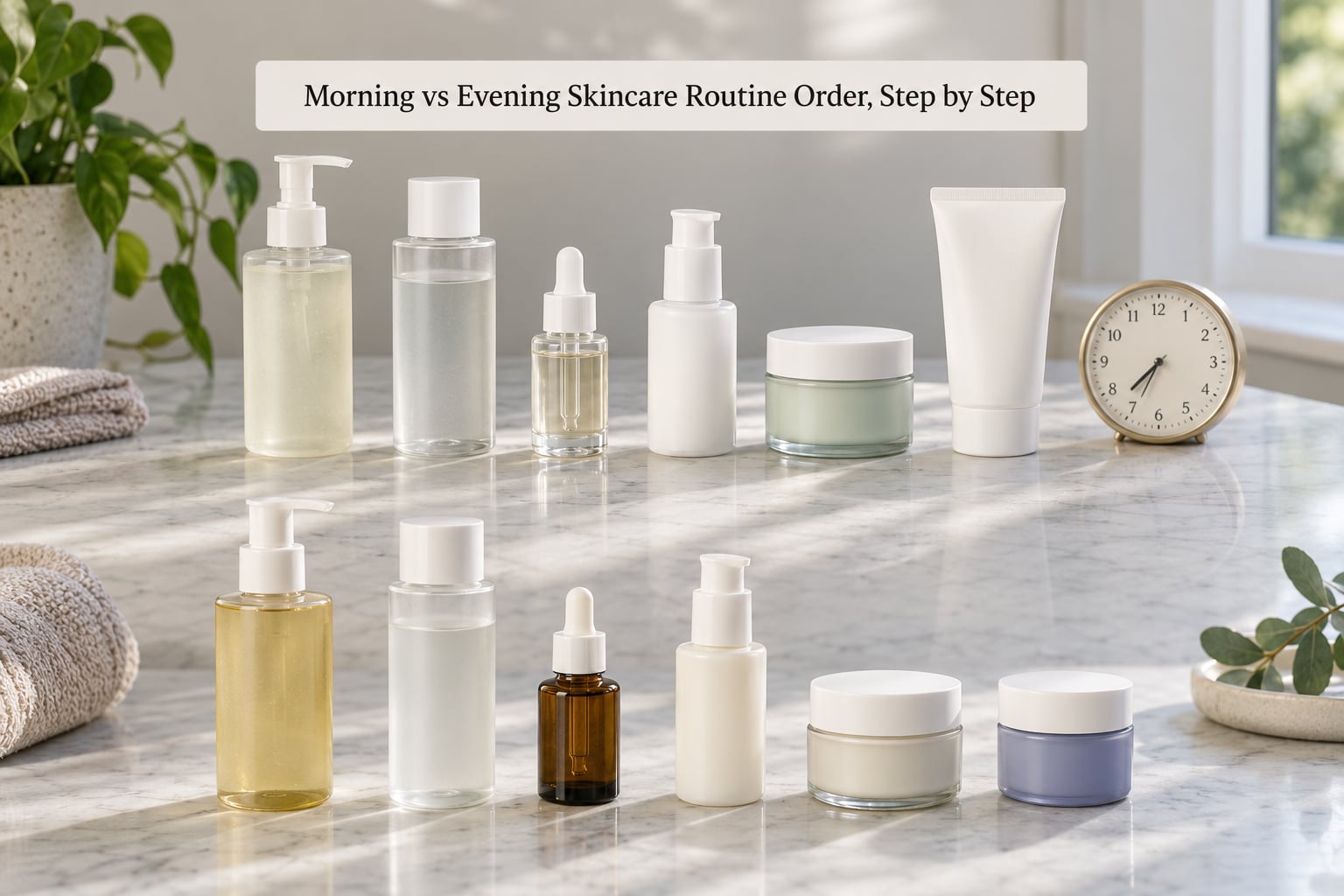
| Step | Morning order | Evening order |
|---|---|---|
| 1 | Rinse with water or gentle cleanser | Remove sunscreen and makeup with an oil or micellar water |
| 2 | Optional toner or essence | Second cleanse with a water-based cleanser |
| 3 | Vitamin C or antioxidant serum | Treatment serum such as niacinamide or peptides |
| 4 | Eye product | Active: retinol or exfoliating acid, 2 to 3 nights a week |
| 5 | Light moisturizer | Spot treatment or a mask, on the nights you are not using an active |
| 6 | Sunscreen, the final layer | Night cream, then optional face oil |
Read that table straight down and the logic is obvious: the morning adds one mandatory closing step, and the evening adds two optional opening steps. That is the whole difference, once you strip away the packaging.
Evening Routine: Order, Products, and Reasoning
The evening is where the extra steps live, because the skin is bare and you have time. The order runs from removing what you put on in the morning, through treatment, to a seal on top.
- Remove sunscreen and makeup. Sunscreen is designed to sit on the surface, so a cleanser alone often will not shift it. An oil-based cleanser, balm or micellar water does the job quickly.
- Cleanse again. This second cleanse finishes the job and stops you feeling tight or filmy. Skip it only if your skin is dry and sensitive, in which case one thorough oil cleanse is often enough.
- Toner or essence, optional. It preps damp skin so the layers after it spread more easily. It is not a cleanser, whatever the bottle says.
- Treatment serum. Niacinamide, peptides and hyaluronic acid sit well here. Hyaluronic acid applied to damp skin works best.
- Active, on some nights only. Retinol or an exfoliating acid, two or three nights a week rather than every night.
- Spot treatment or mask. On the nights you are skipping the active, this is the slot.
- Moisturizer, then optional face oil. The oil goes last and only a few drops, pressed in rather than dragged across the face.
Layering discipline matters more than the length of the list. Three actives in one routine is one too many, and applying an acid over a retinoid is the fastest route to a compromised skin barrier. If you want both, alternate them on different nights rather than combining them.
How to Choose Products for Each Time of Day
| Product type | Morning only | Evening only | Works in both |
|---|---|---|---|
| Sunscreen | Yes | No | Never at night, nothing to protect against |
| Retinol or retinoid | No | Yes | Technically possible but increases sun sensitivity |
| Exfoliating acids | No | Yes | Only if you never leave the house in daylight |
| Vitamin C serum | Preferred | Acceptable | Works both, but protects against daytime stress |
| Hyaluronic acid | Yes | Yes | Fully interchangeable |
| Niacinamide | Yes | Yes | Fully interchangeable |
| Gel cleanser | Yes | Optional first step | Fine in either slot |
| Rich night cream or oil | Causes pilling under SPF | Yes | No, keep it at night |
| Spot treatment | Works, but covers less of a day | Preferred | Evening gives it hours to work |
A few ingredient combinations are worth separating. Vitamin C and retinoids in the same routine is the classic pairing people ask about, and the honest answer is that the irritation is often the low pH of L-ascorbic acid rather than the retinoid itself. Many people use one in the morning and one at night without trouble. AHAs and retinoids together on the same night is a harsher combination and a common cause of peeling. Benzoyl peroxide and vitamin C in one routine neutralize each other, which is a waste of both.
Where exfoliation goes depends on the active. AHA exfoliation smooths texture and leaves skin more photosensitive for a day or two, so night is the sensible slot. BHA works inside the pore and is about oil and congestion, so it can go either way if you are diligent about sunscreen. Cleansing acids like glycolic and lactic belong at night; an enzyme or polyhydroxy acid cleanser works fine in the morning.
Common Skincare Routine Mistakes
Applying sunscreen too late, or too little. Two finger lengths for face and neck is the standard that dermatologists quote. Half that amount is the most common reason people burn through a bottle in three weeks.
Stacking actives without a schedule. Retinol three nights running on top of an acid cleanser is how skin gets unhappy. Start one new product every two weeks, and give your skin rest nights.
Using too many steps. A long routine usually collapses within a month, and the products that sit unused cost money. Four solid steps every day beats eight steps for three weeks a year.
Skipping moisturizer. Even oily skin loses water overnight, and oil on the surface is not the same as water held inside the skin. A gel-cream takes seconds and settles under sunscreen.
Cleansing too aggressively in the morning. A harsh foaming cleanser on dry skin leaves it stripped, and many people respond to tightness by layering more product later. If your face feels tight after rinsing, that is the signal.
Copying a routine that belongs to someone else. A ten-step routine built for oily, acne-prone skin will congest dry skin. The framework transfers; the products do not.
Treating spot treatment as a morning habit. An active dab applied at 7am has been wiped off by lunch. Evening gives it hours of contact time.
If you want a rotation rather than a straight nightly plan, skin cycling is the version worth knowing. Dermatologist Whitney Bowe popularized a four-night cycle: exfoliate on night one, retinoid on night two, barrier-supporting moisturizer on nights three and four, and nothing else. It is a structured way to use actives without stacking them, and it suits anyone who gets irritated by daily retinol.
People on night shifts ask whether to swap the routines. You do not have to. Sunscreen belongs whenever your skin meets daylight, including a shift that ends at 7am, and the “evening” routine belongs to whenever you finally clean off and sleep. The clock is less important than the exposure.
Which Should You Choose?
Choose a short morning and a fuller evening. That is the answer for most people, because the morning is where you are exposed and the evening is where you have time.
If you only have time for one routine, keep the evening one and add sunscreen to it when you are outside during the day. Evening skincare is where treatment products do their work, and sunscreen is a one-step habit you can do in a sink in thirty seconds.
If you are new to skincare entirely, this is the whole thing: gentle cleanser, light moisturizer, broad-spectrum sunscreen in the morning, and one active serum at night two or three times a week. Add a richer night cream only when your skin asks for it.
If your skin is oily or acne-prone, keep textures light in both slots and put your spot treatment at night. If your skin is dry or mature, add an occlusive layer at night and treat the morning more gently. If your skin is reactive, shorten both routines and prioritize the barrier.
If you travel or work in dry air, the morning moisturizer matters more than the evening one, because the daytime hours are when water leaves your skin. After a workout, rinse and treat the evening as a second morning routine, and apply sunscreen whenever you are back outside.
Two habits beat anything else: patch-test a new product on a small area for a few days first, and see a dermatologist about anything persistent, painful or changing. This article is general information, not medical advice.
Frequently Asked Questions
Should I use the same skincare products in the morning and evening?
Mostly, yes. The same cleanser, moisturizer and most serums work fine in both slots, and buying a full duplicate set is unnecessary. The two real differences are sunscreen, which is a morning-only step, and strong actives like retinol or exfoliating acids, which belong at night where they have hours of contact time and do not leave skin more sun-sensitive. Some people use vitamin C in the morning and the same tube at night without issue.
What is the correct order for morning skincare?
Work from thinnest to thickest: rinse or cleanse, then toner if you use one, then a treatment serum such as vitamin C, then eye product, then a light moisturizer, and always broad-spectrum SPF 30 or higher as the final layer. Let each layer settle about a minute, and give vitamin C roughly 15 minutes before sunscreen so it has time to absorb into dry skin. Two finger lengths is enough sunscreen for your face and neck.
What is the correct order for evening skincare?
Start by removing sunscreen and makeup with an oil or micellar cleanser, then do a second water-based cleanse. Follow with toner if you like one, a treatment serum, then your active such as retinol or an exfoliating acid two or three nights a week. Finish with a night cream, and add a few drops of face oil last if your skin is dry. Everything goes on in the same thinnest-to-thickest order as the morning.
Do I need sunscreen if I use skincare products at night?
No, and applying it at night is wasted product. Sunscreen protects against UV exposure, and there is none while you sleep. It belongs in the morning, reapplied every two hours when you are outdoors. The one night-time exception is retinaldehyde, which some dermatologists suggest for people who struggle to apply morning sunscreen, since its own photoprotective effect lasts about 24 hours after use.
Can I use retinol or exfoliating acids in the morning instead?
You can, but it is the harder option. Both increase sun sensitivity, so using them in the morning means wearing sunscreen with real reapplication discipline that same day. Applying them at night keeps the sensitive window while you are indoors and asleep. If your schedule makes mornings unreliable, work retinol into an evening routine rather than skipping sunscreen, and start at a low concentration twice a week before building up.
How many skincare steps do I really need each day?
Four in the morning and four or five in the evening is enough for most people. Morning: cleanser, treatment serum, moisturizer, sunscreen. Evening: cleanse, treatment serum, active a few nights a week, moisturizer. A toner, eye cream and essence are optional extras rather than required steps. Consistency matters far more than length, so choose a routine you will still be doing on a busy Thursday night.
Bottom Line
Pick one morning sequence and one evening sequence and stop adjusting them. Morning: cleanse, treat, moisturize, sunscreen, with sunscreen last every single time. Evening: remove sunscreen, cleanse, treat, seal, with retinoids or acids on two or three nights rather than every night.
Patch-test anything new on a small area first, and talk to a dermatologist about anything that persists or changes. Most routine problems are order and overloading, not a missing product.