If you have ever searched how to choose comfortable heels for long days, you have probably been handed the same three-word answer: keep them low. That advice is half right. The shoes that actually hold up through a wedding, a work reception, or a full office day are decided by three things: how wide the heel is, how high your foot really sits inside the shoe, and how much room the toe box gives your toes. Get those three right and a heel does not have to be a compromise.
This guide takes about ten minutes to read and will save you a lot of blisters. It covers how to match a style to your schedule, what to test in the store, how to wear a new pair in before you need it, and when it is worth giving up on heels entirely. Prices change constantly and every brand fits differently, so no brand recommendations here — just the mechanics that do not change.
Table of Contents
- What You Need
- How to Choose Comfortable Heels for Long Days
- Step-by-Step: Choosing and Testing a Pair
- 1. Match the Shoe to the Length of Your Day
- 2. Choose a Stable Heel Shape
- 3. Check Fit From Heel to Toe
- 4. Look for Supportive Construction and Cushioning
- 5. Try the Heels in Real Conditions
- Common Mistakes
- Frequently Asked Questions
- What is the most comfortable heel height for long days?
- Are block heels better than stilettos for walking all day?
- What features make heels more comfortable for extended wear?
- How long should I test new heels before wearing them to an event?
- Can shoe inserts make uncomfortable heels wearable for longer?
- How can I prevent blisters or rubbing from new heels?
- Conclusion
What You Need
Choosing heels well takes about twenty minutes of preparation. Most of it happens before you shop, and skipping it is why a “comfortable” pair turns painful by hour six.
- A realistic schedule. Write down how long you will actually be in the shoes, and separate standing time from walking time. A nurse on a ward is standing more than walking. A gallery opening is mostly standing still in one spot. A city trip is walking. These demand different shoes, and this distinction is the one most guides blur together.
- Your foot measurements, taken properly. Measure both feet at the end of a normal day, when they are at their largest, and write the larger number down. Feet swell through the day and that swelling is the reason a pair bought at noon feels tight by dinner. If you have never been fitted, a 10-minute session at a shoe store is worth more than any amount of online guessing.
- Your outfit, decided. Heel height changes what you can wear. A 3-inch block works with almost everything; a 4-inch stiletto narrows your options to a dress or a wide-leg trouser. Know the hemline before you shop, not after.
- Your problem feet, if you have them. Wide forefeet, high arches, flat feet, a bunion on one side, or a history of plantar fasciitis all change which shoe to look for. Note them before you try anything on.
- A hard floor and real time. Carpet hides everything. A store with a tiled aisle is worth the walk across town, and a ten-minute test beats a five-minute glance.
How to Choose Comfortable Heels for Long Days
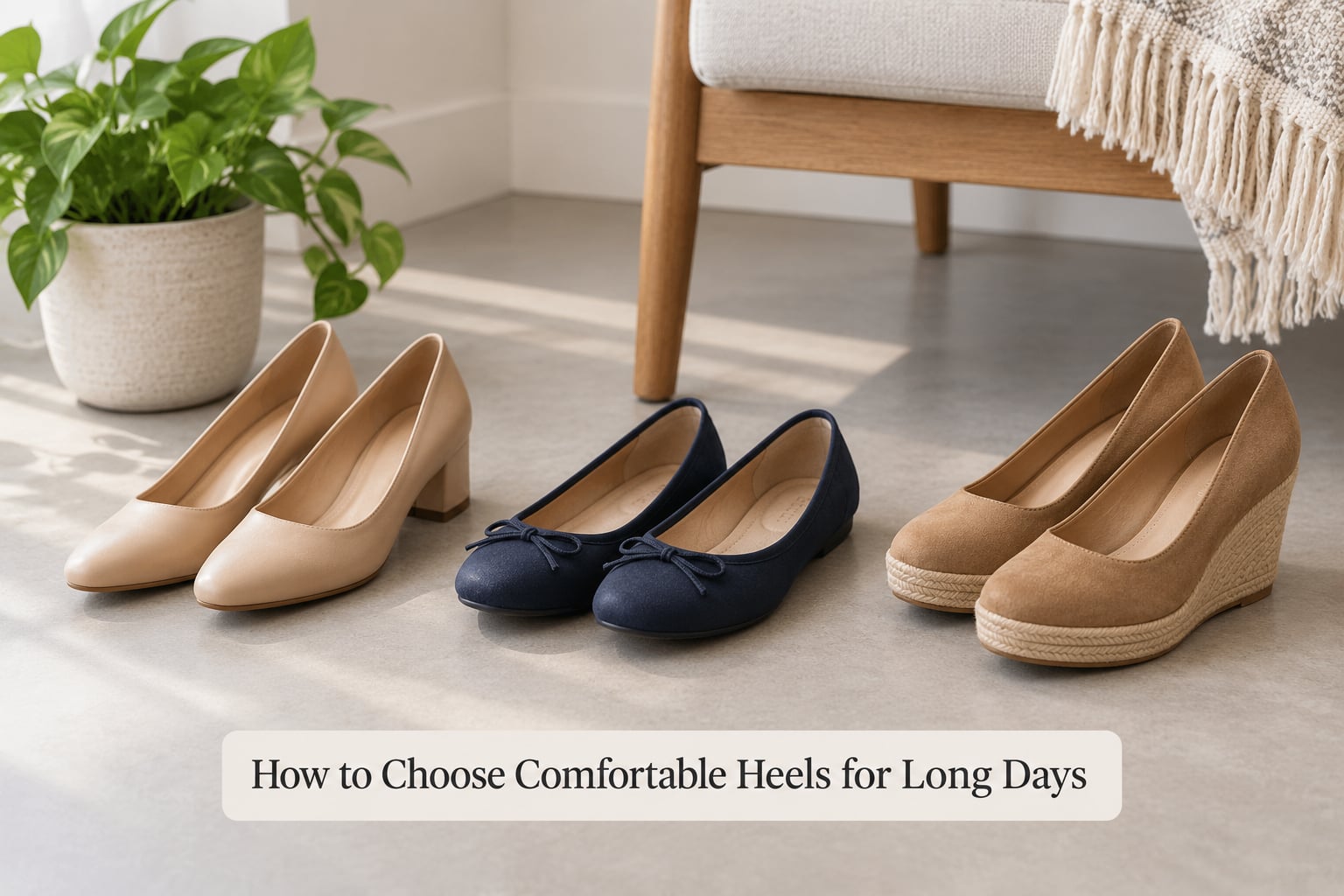
Comfort in a heel is a geometry problem, not a cushioning problem. Three measurements decide almost everything.
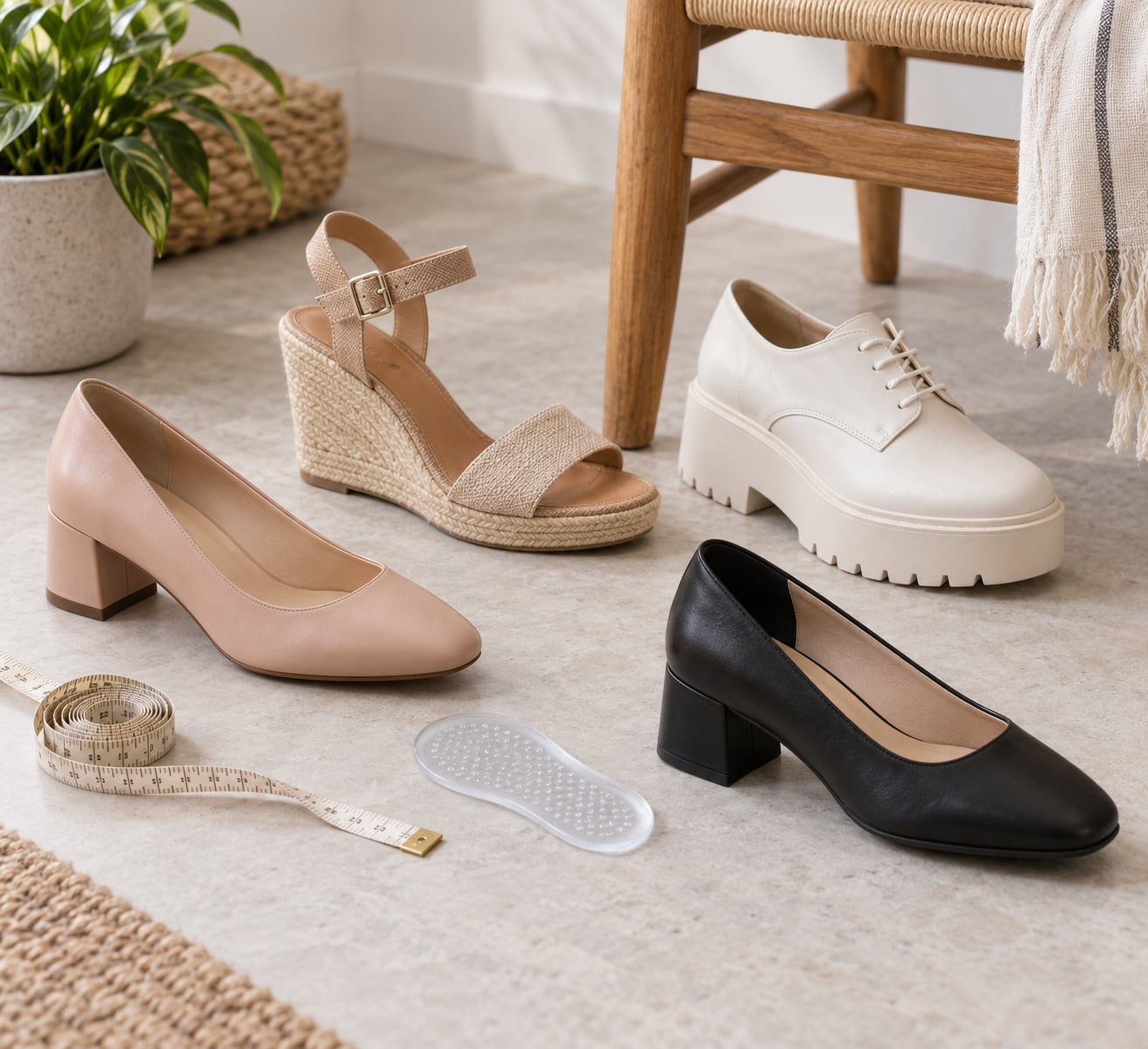
Heel width and base. The base of the heel is the footprint touching the ground. A wide base — a block or a chunky heel — spreads your weight over more square inches and gives the whole shoe lateral stability. A narrow stiletto puts your full weight on a few square centimeters and forces the muscles in your lower leg to hold the line for every step. That is why stilettos are not harder to stand in, exactly, but harder to walk anywhere in.
Effective heel height. This is the drop between the bottom of your heel and the bottom of the ball of your foot, not the number on the product page. A wedge that reads 4 inches may put only 1.5 inches of drop under your foot because the whole sole is sloped. A platform does the same thing by holding the front of the foot up. Low effective drop is the single biggest comfort lever you have, and it is the one shoppers never check.
Pressure distribution. A good heel touches the foot at the heel cup, the arch, the ball, and the toes, in roughly that order. A bad one touches only the heel and the ball, and the ball takes everything. When the foot rests on a steep slope, the calf tightens, the forefoot carries your full load, and the joints under the ball of the foot absorb the shock. That is where blisters, calluses, and the pins-and-needles feeling come from.
Get the effective drop modest, the base wide, and the pressure spread, and the height stops being the limiting factor. Most wearers who report genuinely comfortable long days are on 2.5 to 3.5 inches, but a lot of those numbers are the physical height, not the effective drop.
Here is how that maps to the days people actually have:
| Your day | Go for | Why it works |
|---|---|---|
| Office or meetings, lots of sitting | 2 to 3 inch block or a low kitten | Low effective drop, wide base, and the shoe only has to survive short walking bursts |
| Retail, teaching, serving, all-day standing | Elevated flat or a 1.5 to 2 inch block with a cushioned footbed | Standing rewards height far more than walking does; support matters most |
| Wedding or long event | Block or platform, 2 to 3 inches | Style and stability together, and you will mostly stand in one spot |
| City sightseeing, travel, cobblestones | Wedge, blocky platform, or a kitten with an ankle strap | Low drop plus grip; stilettos are a slip risk on uneven ground |
| Dancing and long nights on your feet | Wide block or wedge with a non-slip sole | Traction and stability matter more than height |
Notice that none of those recommendations start at 4 inches. If you want more height than that, buy the look through platforms and wedges rather than a taller post under the heel.
Step-by-Step: Choosing and Testing a Pair
1. Match the Shoe to the Length of Your Day
Start by naming the longest realistic stretch of standing or walking, not the event. A dinner service might run five hours of near-constant standing with almost no walking. A conference day might be eight hours of walking with only an hour standing still. The shoe that fails the first is not the one that fails the second.
Standing rewards height, because a raised heel reduces the load on the back of your foot while you are on both feet. Walking rewards a low drop and a wide base. So a low-profile pump can handle an evening where you are seated most of the night, and a cushioned flat is the safer answer for a day on the shop floor, where the same pump turns to misery by two hours.
A good rule: if you will be on your feet for more than three hours, stay under 3 inches of physical heel height. If you will be seated for much of the day, you can go higher than you think, because the shoe is doing less work.
2. Choose a Stable Heel Shape
Shape decides stability, and stability decides whether you can walk normally or shuffle. From most to least stable:
- Wedge. The whole sole is a continuous ramp, so pressure spreads across the entire foot almost like a flat. The lowest effective drop of any heel shape and the best choice for standing. Less forgiving of uneven ground, and the height is built in so a tall wedge is still easier than a tall stiletto.
- Block or chunky heel. A wide, usually tapered post that keeps your foot close to the ground. The most forgiving shape for a long day, and it takes a 3-inch height without complaint.
- Platform. Adds thickness under the ball of the foot, which reduces the effective drop. A 4-inch platform can be easier to walk in than a 3-inch pump because the foot is not tilted as steeply. Pair it with a block heel for stability.
- Kitten. Between 1.5 and 2.5 inches, narrow-ish, and lower than most people expect. Cute, unobtrusive with tailoring, and fine for a full day. Less stable than a block at the same height.
- Ankle boot with a stacked heel. The boot shaft does the work a strap does, which is why walking-heavy days in a 3-inch block boot are so common among people who hate heels.
- Stiletto. Narrow, tall, and the least forgiving. It can look superb for a photo and ruin an evening. If you want it, keep it under 3 inches and limit it to a few hours on hard surfaces.
- Elevated flat or low platform sandal. A flat with a hidden 1-inch lift. Plenty of ballet flats have no arch support and no cushioning at all, which is worse for your feet than a decent low block.
Whatever the shape, check the heel seat: the shoe should hold your heel in a defined cup rather than letting it slide. A loose heel makes you clench and slide-shift with every step, and that rubbing at the back is the single most common source of blisters on new shoes.
3. Check Fit From Heel to Toe
Fit is where the money is, and it is the only part of this you get one chance to get right.
Size to the larger foot, and if you are between sizes, go up. The instinct to size down so the heel does not slip is backwards. A shoe that is too big makes you grip with your toes, which cramps them against the toe box over hours. A shoe that is one fraction too tight in width will rub on the sides of your forefoot from the first hour. If the two feet differ, buy for the larger one and accept a small size difference.
Toe room. You should have roughly the width of your own thumbnail between your longest toe and the front of the shoe. The toes need room to spread when they take weight, and a square or rounded toe box gives them far more room than a pointed or almond shape for the same nominal size.
Ball-of-foot room. Flex your foot inside the shoe. If the upper creases, if the sides of your forefoot bulge, or if you feel pressure on either side of the ball of the foot, the width is wrong. Width does not change much between styles, and fashion heels are notoriously narrow. Buying a half size up is often the only way to get a functional width.
Heel security. Lift your heel slightly inside the shoe. If it rises more than a few millimeters, you will slide. An adjustable ankle strap or slingback strap fixes this and adds stability, but the strap should sit above the ankle bone, not on it.
Foot-shape adjustments are worth a few extra words. If you have wide feet, prioritise wide-fit lines, square or rounded toe boxes, and soft leather that gives; skip anything with a synthetic upper that will not stretch. If you have high arches, a thin footbed with a real arch contour will stop the midfoot from sinking, and a strap or closed back will stop the shoe from sliding off. If you have flat feet, look for a contoured footbed with a raised heel cup, since a flat foot needs a defined edge to push against. If one foot is wider or has a bunion, compare both shoes on the floor, not the box.
4. Look for Supportive Construction and Cushioning
Cushioning is the least important factor and the one shoppers fixate on. It matters, but it comes after geometry. Still, once the shape is right, these are the details that decide hour eight:
- A cushioned footbed. Press both thumbs into the insole. If you can barely dent it, it is doing nothing. A footbed that compresses about halfway will soften the impact through the ball of the foot.
- Arch support that matches your arch. Support is not better in the abstract; it is wrong if it presses on a high arch or leaves a flat foot floating. A contoured footbed beats a flat one, and a removable one lets you add your own insert later.
- A flexible but structured sole. Your foot should be able to flex where the big toe bends. A completely rigid sole that runs from heel to toe is uncomfortable, and a completely floppy sole gives no support. Soles with a defined hinge at the ball of the foot are the sweet spot.
- A real heel counter. The stiff cup at the back that stops your heel from rolling. A soft or thin back is why cheap shoes let your foot slide and why the friction lands on your skin instead of the shoe lining.
- Upper material. Leather and suede soften and adapt. Stiff plastics and patent finishes do not. If the shoe is unlined, a plastic or patent upper, expect zero break-in and treat the fit you have in the store as the fit you will have all day.
- Outsole grip. A rubber sole, especially with a textured or patterned bottom, protects you on stairs, wet pavement, and cobblestones. This is a safety feature rather than a comfort one, and it is worth more attention than most people give it.
Brand claims on the box mean very little. A pair advertising all-day comfort with a 4.5-inch stiletto, a thin paper footbed and a plastic upper is not an all-day shoe, and no amount of marketing changes the geometry. Test it in person for five minutes on a hard floor.
5. Try the Heels in Real Conditions
Try on at the end of the day, and test them as if you were already in them. Ask for a shoe, do this sequence, and walk away from anything that fails it:
- Walk, do not stand. Most retail fitting rooms invite you to stand still, which tells you almost nothing. Walk the length of the store, turn, and walk back.
- Stand on one leg. Lift one foot for a slow count of ten. This is the test that exposes heels with a weak base or a loose heel cup better than walking does.
- Do a step. Put your full weight onto the shoe on a step. If the arch collapses or the heel twists, the construction is too soft for the load.
- Sit and flex. Sit down and press your toes forward. Cramming, tingling, or rubbing means the toe box is wrong and time will not fix it.
- Re-check after ten minutes. Take them off, look at your feet, and check for redness or marks. Redness that fades is fine. Redness that stays, or a mark in the shape of the toe box, is your answer.
Then wear them in before the day that matters. A gradual ramp is the only break-in method that actually works:
- Day 1: 60 to 90 minutes at home, walking on carpet or a soft surface, with thick socks.
- Day 2 to 3: 2 to 3 hours, including a hard surface, plus one full standing session of 30 minutes.
- Day 4 to 5: A half day of normal use on the surfaces you actually walk on.
- Day 6 to 7: A full day, ideally including stairs and a commute.
If the shoe still hurts after a week of steady wear, the fit is wrong. Nothing else needs changing, and no amount of wearing-in rescues a bad fit or a steep drop.
Common Mistakes
- Buying for the look and checking the footbed later. Cushioning cannot fix geometry. Judge heel width, effective drop, and toe box first, then see whether the footbed is any good.
- Choosing a narrow or pointed toe box. This is the number one complaint in reader discussions about fashion heels, and it is the fastest route to blisters on the sides of the toes. Round or square is wider at the same size.
- Wearing a brand-new pair straight through an event. The heel counter will be stiff and the leather unformed. A week of short wears prevents the blister that ruins the photo.
- Picking a tall, narrow heel for a walking-heavy day. If the day is mostly walking, the heel should be under 3 inches with a wide base. If you want more height, get it from a platform or wedge.
- Assuming break-in will fix a bad fit. Leather gives, plastic does not. Pain that comes from a narrow width or a steep pitch will still be there on day 30.
- Shuffling instead of walking. Short, heel-to-toe steps place the roll through the whole foot and keep the pressure centred. Stomping and flat-footed sliding drives impact straight into the forefoot. Take shorter steps and land heel to toe.
- Standing in one place all night. Shifting weight, flexing your toes under the ball of the foot, and taking a sit-down break every 45 minutes make more difference than most people expect.
- Ignoring pain that lasts more than a day or two. Persistent forefoot pain, swelling, numbness, or pain that changes how you walk is not a shoe problem to solve by breaking in. See a podiatrist, and bring the shoes with you.
A small kit helps with the ordinary version of the problem. Gel insoles add shock absorption under a flat footbed. Heel cushions and gel pads take pressure off a heel that feels bruised after a standing shift. Ball-of-foot cushions or forefoot pads are the single most useful insert under a higher heel. Anti-blister gel sheets protect the exact spot where the shoe rubs, and taping the toes together with a strip of athletic tape or slipping a hydrocolloid blister patch between them is a well-known trick among people who dance. Bring the flats you would change into, and accept that the change is not failure.
Frequently Asked Questions
What is the most comfortable heel height for long days?
Roughly 2 to 3 inches of physical height is the range most people wear comfortably for 8 to 10 hours, especially with a wide block base. Effective height matters more than the label: a 4-inch wedge or platform can be easier than a 3-inch pump because it reduces the drop under your foot. Above 3.5 inches with a narrow heel, plan on swapping to flats partway through.
Are block heels better than stilettos for walking all day?
Yes, and the difference is larger than the height suggests. A block heel has a wide base that spreads your weight over more surface area, so you need less effort from your calf and ankle to stay stable. A stiletto concentrates weight on a tiny footprint, which makes every step a balance task. For walking-heavy days, a block or wedge at the same height will almost always win.
What features make heels more comfortable for extended wear?
In order of impact: a wide heel base, a low effective heel drop, a roomy rounded or square toe box, a contoured cushioned footbed with a defined heel cup, an adjustable strap or closed back that stops the foot sliding, and a rubber outsole for grip. A soft leather upper helps too, since it moulds to your foot. Cushioning alone changes much less than geometry does.
How long should I test new heels before wearing them to an event?
Give yourself at least a week. Start with 60 to 90 minutes at home on a soft surface, build to 2 to 3 hours including a hard floor, then a half day of normal use, then a full day with stairs and a commute. The goal is to discover rubbing spots before the event rather than during it, and to let the heel counter soften enough that it stops catching at the back of your foot.
Can shoe inserts make uncomfortable heels wearable for longer?
Inserts help with cushioning and pressure, not with geometry. A forefoot or ball-of-foot pad, a heel cushion, or a contoured arch insole can add an hour or two by absorbing shock at the ball of the foot and stopping the heel from shifting. They will not rescue a 4-inch stiletto, a narrow toe box, or a shoe that is simply too small. Fix fit and shape first, then add an insert.
How can I prevent blisters or rubbing from new heels?
The friction is usually at the heel counter, the sides of the forefoot, or the ball of the foot. Wear thick socks for the break-in period, walk rather than shuffle, and take short heel-to-toe steps. Put anti-blister gel sheets or athletic tape on the spot before you wear them, and stop the moment you feel a hot spot rather than pushing through it. A hot spot is a blister forming.
Conclusion
Start with the longest stretch of standing or walking you will realistically do, then buy for that. A wide block or wedge at 2 to 3 inches, fitted to your larger foot with a thumbnail of toe room and a defined heel cup, is the pair most people can wear for a full day. Wear it in over a week, walk heel to toe, and keep the flats nearby.
Comfort is the sum of fit, effective height, heel base, cushioning, and your own foot. Change any one of them and the total moves. If the pain lasts more than a day or two after a full day in heels, book a podiatrist and take the shoes with you.