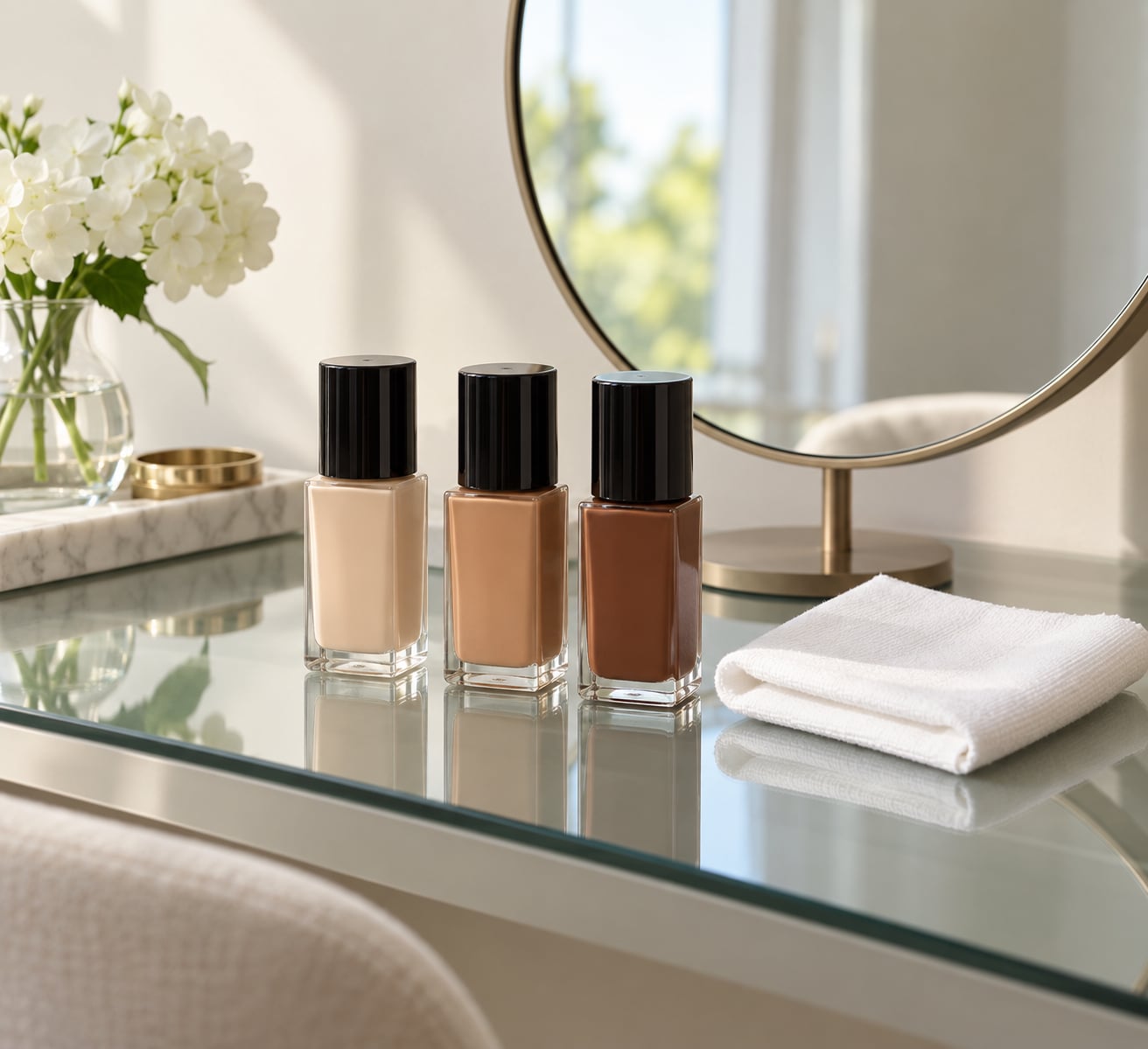
To match foundation to your skin tone, swatch two or three shades along your jawline, let them sit for a minute so the formula can oxidize, then step into natural daylight. The right shade is the one you stop noticing: it blends into both your face and your neck without an edge. That whole process takes about five minutes once you know what to look for.
Most shade disasters come down to two things. People swatch on the back of the hand, which is almost never the same tone as the face, or they judge a shade in the warm yellow light of a bathroom or a store counter and then see it properly for the first time in daylight.
This guide walks through the process I use, tested across my own skin and the recurring questions that come up in makeup forums: undertone tests, depth, oxidation, uneven tone across face, neck and chest, and what to do when you are shopping with no chance to swatch. Everything here is a beauty method, not medical advice, and any new formula deserves a patch test on your inner arm first. Reviewed and updated for 2026.
Table of Contents
- What You Need
- Step-by-Step: How to Match Foundation to Your Skin Tone
- 1. Determine Your Undertone
- 2. Check Your Skin Depth
- 3. Swatch Three Similar Shades
- 4. Let the Formula Oxydize
- 5. Test the Shade in Natural Light
- 6. Check the Finish and Wear
- Common Mistakes
- Frequently Asked Questions
- How do I find the right foundation shade when my skin tone changes with the seasons?
- Can I use foundation that matches my neck but looks lighter on my face?
- What does it mean when foundation oxidizes after I apply it?
- How can I match foundation to my skin tone when shopping online?
- Should I choose a matte or dewy foundation for dry skin?
- What should I do if no foundation shade looks like an exact match?
- Conclusion
What You Need
You do not need a pro kit. You need about five things, and four of them are already in your bathroom.
- A foundation you already own, or a set of samples. If your current bottle is a good match, the shade name and code on it is the single most useful piece of information you can carry into a new brand.
- Natural daylight. A window, not a lamp. Overcast daylight is the most honest light there is, since there is no warm bulb tinting everything.
- A mirror you can move. One that lets you look at your jawline and neck from about a foot away rather than six inches.
- Tissue or blotting paper. For letting a swatch set and for checking oiliness later in the day.
- Two or three candidate shades in a similar depth. Buying a scatter of depths guarantees you compare the wrong variable.
- A clear-skinned patch. The jawline where the face meets the neck, or the inner arm if you are testing something new.
Start with clean skin or skin that was moisturised a few minutes ago. A heavy layer of moisturizer changes how a formula sits and how much it oxidizes, which makes your read on the shade unreliable.
Patch test anything you have not used before: a small amount on the inner arm, left for 24 hours. Foundation goes near the eyes and on skin that can be reactive, and a shade you love on paper can still irritate you. If you see redness, itching or swelling, wash it off.
Step-by-Step: How to Match Foundation to Your Skin Tone
Set the conditions before you start, because most mismatches happen in bad conditions rather than with bad shades. Stand near a window in daylight, bare-faced or with only moisturizer on, and decide in advance which three shades you are testing. All three should sit at roughly the same depth.
A successful match looks like this: at arm’s length in daylight you cannot find where the foundation stops and your skin starts. Turn your head both ways, and the jawline should not change color. If you can see the edge without hunting for it, the match is not there yet.
1. Determine Your Undertone
Undertone is the hue sitting underneath your skin: warm (golden, yellow, peach), cool (pink, red, blue) or neutral (a balance of both). It is completely separate from depth, which is how light or dark your skin is. A deep skin can be warm, and a fair skin can be cool.
Four quick checks will point you in a direction:
- Veins on the inner wrist. Blue or purple leaning cool, green leaning warm, a mix leaning neutral.
- A white sheet of paper. Hold it next to your bare face in daylight. Yellow next to white reads warm, pink reads cool, in-between reads neutral.
- Jewelry. Silver and white metals usually flatter cool skin, yellow gold usually flatters warm skin, and if both look fine you are probably neutral.
- How your skin behaves in sun. Skin that tans golden or bronze rather than pink or red usually has a warm base.
These are guides, not rules, and plenty of people read neutral from the same wrist. Treat the tests as a way to narrow the shelf rather than a verdict. If two shades at the same depth look equally good on your jawline, the neutral one is usually the safer pick.
One exception worth knowing: you can wear a foundation that is slightly warmer than your skin. Warm-leaning shades with a hint of peach sit well on many cool undertones because they add life to pink skin. What does not work is a strongly yellow or strongly pink shade in the wrong depth. The warmth has to be mild.
2. Check Your Skin Depth
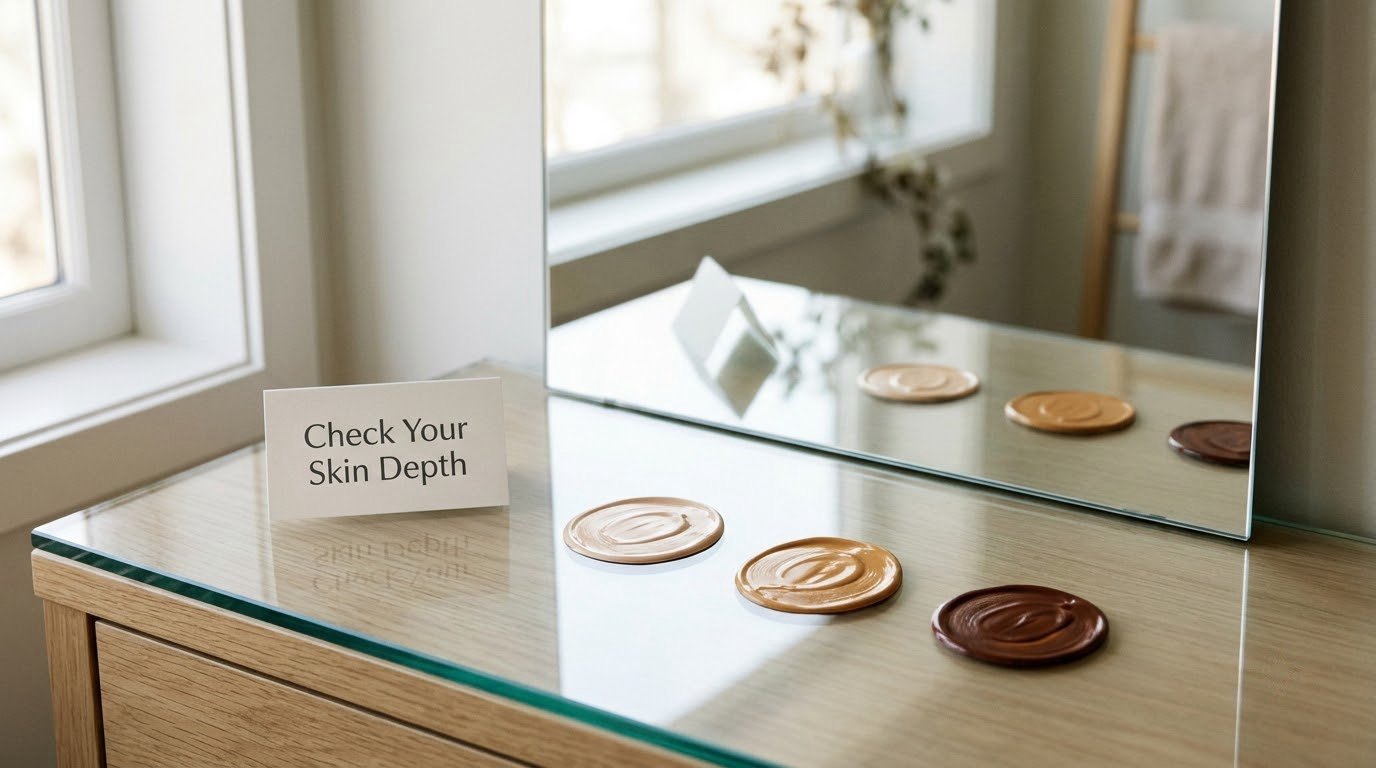
Depth is where most shade numbering lives, and it is the layer people guess at worst. Compare the foundation to the skin on your jawline and neck, never the back of your hand. Hands and wrists are frequently a shade or two off from the face, which is exactly why counter swatching misleads so many people.
Brands generally bucket depth into six ranges: fair, light, medium, tan, deep and rich. Those labels vary by brand, so the number on the bottle matters more than the word. A 2N in one line can be lighter than a 2N in another. Read the depth number first, then the letter code.
A practical shortcut: take the shade you think is right, then take the one one step lighter and one step deeper. Those three are your test set. If none of the three sits at your jawline, the range you are shopping in does not cover your depth and you need a different brand or a custom mix.
3. Swatch Three Similar Shades
Dots work better than one thick stripe. Put three small dots of each shade along the jawline from your ear toward the middle of your chin, leaving a finger’s width between them. Thin layers dry down more evenly, so you are comparing color rather than coverage.
Blend each one with a fingertip, not a sponge, and tap rather than drag. Dragging pulls the product around and leaves a thinner film in places, which makes a shade look patchier than it really is.
Wait about sixty seconds before you judge anything. Most liquid and cream formulas need that time to settle into the skin, and any settling changes the color you see. Judge the shade after it has set, not while it is still wet and glossy.
4. Let the Formula Oxydize
Oxidation is the slow shift a formula makes after it hits air and the oils on your skin. Pigments react, and the shade moves warmer, darker or more orange. A shade that looked softly neutral in the bottle can turn noticeably orange in about fifteen minutes, and some formulas keep shifting for the rest of the day.
Long-wear, matte and powder-heavy formulas tend to oxidize more, because they are designed to sit for hours without moving. Lightweight, dewy and silicone-forward formulas tend to stay closer to their original color. This is why the shade that looked perfect on your hand can look flat and dull on your face by lunch.
Give it a full sixty seconds before deciding, and if the shade you chose started darker than you wanted, consider that it may land correctly after oxidation. Some people deliberately go half a shade deeper for this reason. The reverse also happens, which is why a shade that looks too light at first glance deserves a second look after a minute.
5. Test the Shade in Natural Light
This is the step that catches everything the earlier steps let through. Bathroom bulbs, store spotlights and mirror LEDs all add warmth, which makes a too-orange or too-pink shade look acceptable indoors and obvious outside.
Walk to a window. Check the forehead, the cheeks, the sides of the nose, the jawline and the neck, in that order, because that is roughly where a mismatch announces itself first. Look for three things: a visible edge at the jawline, a shift in color across the center of the face, and any difference between the face and the neck.
Take a photo with your phone in daylight, with no filter. Filters correct color, and the camera on most phones now does too. A straight photo of your jawline in neutral daylight is the most honest record you can make, and it is also the reference photo you will want later when you shop online.
6. Check the Finish and Wear
Shade and finish are separate decisions, and the finish changes how a shade reads. Natural and satin finishes sit somewhere between matte and dewy. Radiant and dewy finishes reflect light, which makes the skin look lighter and more even. Matte finishes absorb light, which makes the same shade read deeper.
Choose by how your skin behaves, not by trend. If your cheeks and T-zone are oily by midday, a matte or natural finish will hold up longer. If your skin feels tight and flaky by evening, a dewy or radiant finish will look better and wear more comfortably.
Then wear the shade for a full normal day. Watch your cheeks around hour three and your T-zone around hour five. Check whether the jawline still looks invisible at the end of the day, and whether any tightness, stinging or flaking showed up. Dryness and irritation are real signals, not things to push through, especially with a new formula or a deeper shade that needs more blending.
Common Mistakes
Swatching on the hand or wrist. Hands are often deeper, pinker or more weathered than the face. The correction: swatch along the jawline, from ear to chin, and always compare with your neck.
Picking a shade by the number alone. Shade codes are not standardized across brands, and the same number can mean different depths and undertones in different lines. The correction: use the number to narrow the shelf, then judge by eye on your jawline.
Ignoring oxidation. You test, it looks fine, and by afternoon it is orange. The correction: wait at least a minute after applying, and re-check at the end of a full wear day before you commit to a bottle.
Judging in artificial light. Warm bulbs forgive warm casts and hide a pink one. The correction: make the daylight check a hard rule, every time, even if it means standing by a window in a car park.
Buying the shade that is merely close. Some brands carry a wide range, some carry six shades that all sit in the same depth. The correction: if the closest option leaves a visible edge, keep shopping rather than convincing yourself it will be fine.
Changing too many variables at once. Testing a new brand, a new formula, a new finish and a new shade together means that when it fails you cannot tell which change caused it. The correction: hold the formula constant while you fix the shade, then hold the shade constant while you test a finish.
Matching only when your face, neck and chest disagree. If your face is paler than your neck, or you have redness, breakouts or tan lines, one shade will not do the whole job on its own. The correction: match to the area you will actually be covering, then use a cream corrector on redness, a green or peach corrector on discoloration, and a translucent powder to set. Shade matching on uneven skin is a correction problem as much as a color problem.
Forgetting the seasons. Your depth shifts with sun exposure and hormonal changes over the year. The correction: keep two shades, one for the darker part of the year and one for the lighter, and blend them across the jawline in the transitional months. Most people find that works better than hunting for a new perfect match twice a year.
Frequently Asked Questions
How do I find the right foundation shade when my skin tone changes with the seasons?
Keep two shades rather than one. Most people buy a shade for the lighter part of the year and one or two steps deeper for after summer, then blend them across the jawline during the shift. Test both in daylight, since a shade that matched in winter can look orange by March. If you tan unevenly or your skin changes with hormonal fluctuations, expect to re-check rather than assume one bottle lasts all year.
Can I use foundation that matches my neck but looks lighter on my face?
Yes, and it is often the right call. If your neck is darker than your face, matching to the neck first keeps the jawline from reading as a hard line when you turn your head. Then correct the face separately: a light corrector or a sheer tinted layer over the matched shade evens out the difference. Apply in thinner layers at the jawline, blend downward, and check the transition in daylight before you leave the house.
What does it mean when foundation oxidizes after I apply it?
Oxidation is the shift a formula makes once it meets air and the oils on your skin. Pigments react and the shade moves warmer, darker or more orange over the next several minutes, sometimes longer. Longer-wear, matte and powder-heavy formulas shift the most. Judge a shade after at least sixty seconds, and re-check it at the end of the day. If you notice redness, itching or swelling, wash it off and stop using it.
How can I match foundation to my skin tone when shopping online?
Start with a foundation you already own that matches well: type its brand, shade name and code into the retailer’s shade finder, or ask an assistant tool to translate it into the new range. Read reviews from people with a similar depth and undertone to yours, and use the return policy as part of the plan. Order a sample size first if one exists. Take any daylight photo you use for shade comparisons with no filter applied.
Should I choose a matte or dewy foundation for dry skin?
Usually dewy or radiant, or a natural finish that sits between the two. Matte formulas absorb light and hold back the sheen, which tends to emphasize flaking and make the skin feel tight over a long day. If your skin is dry but still produces oil in the T-zone, a natural finish with a translucent powder set only on the center of the face is a good middle ground. Patch test first, and stop if it stings.
What should I do if no foundation shade looks like an exact match?
Decide which flaw you can live with. Too orange means you need a cooler or more neutral shade; ashy or grey means you need more warmth or a deeper shade; too light means you need a step deeper or better blending. Two things help a lot: mix two shades, either yours or from the same brand, in small amounts on the back of your hand until the cast disappears, or move to a brand whose range covers your depth at all. Sample sizes reduce the risk.
Conclusion
Start with this: pick two or three shades at your depth, swatch them along your jawline, wait a full minute for the formula to oxidize, then walk into daylight and turn your head. The shade you cannot see at arm’s length is your match, and wearing it through one ordinary day tells you more than any counter ever could.
Skin changes with sun, seasons and hormones, so treat a shade as something you re-check rather than something you solve once. When a shift happens, mixing your two closest shades across the jawline is usually faster than starting over.