
Burnout rarely arrives as a single dramatic crash. It shows up quietly, weeks before you would call it burnout: sleep stops paying you back, small things start costing more than they should, and work you used to enjoy turns into something you push through on autopilot. Learning how to spot burnout before it hits means treating those small changes as data instead of as a personality flaw.
The World Health Organization classifies burnout as an occupational phenomenon shaped by chronic workplace stress that has not been successfully managed, and it describes it across three dimensions: energy depletion, growing mental distance or cynicism toward the job, and a drop in performance. The good news buried in that definition is that all three show up as observable changes long before anything feels unmanageable. Here is a practical way to watch for them.
Table of Contents
- What You Need
- Step-by-Step: How to Spot Burnout Before It Hits
- Step 1: Establish Your Normal
- Step 2: Check the Physical Warning Signs
- Step 3: Look for Emotional and Mental Changes
- Step 4: Notice Changes in Behavior and Work
- Step 5: Test Whether Rest Actually Restores You
- Step 6: Name the Pattern and Choose an Intervention
- Common Mistakes
- Frequently Asked Questions
- How do I know if I am burned out or just tired?
- What are the earliest signs of burnout?
- Can burnout cause physical symptoms?
- How can I help a friend or coworker who may be burning out?
- When should I see a doctor or mental health professional for exhaustion?
- How do I recover from burnout without making my schedule even busier?
- Start With One Honest Check-In
What You Need
Nothing here needs a purchase or an app subscription. What it needs is a reference point, because burnout is defined by change over time, not by how bad a single Tuesday felt. A rough week is normal. Three rough weeks in a row, with no bounce back between them, is a pattern worth taking seriously.
Before you go further, gather three things. First, look back over your last four weeks in your calendar and notice where the hours actually went, not just what got finished. Second, start a two-week log, even a rough one in your phone notes, with three columns: how you slept, your energy from one to ten, and one sentence about your mood at the end of each day. Third, pick somewhere private to keep it, so you stay honest.
Two weeks feels slow when you are impatient to feel better. It is still the fastest reliable read you can get, because memory flatters exhaustion and quietly edits out the bad weeks.
Step-by-Step: How to Spot Burnout Before It Hits
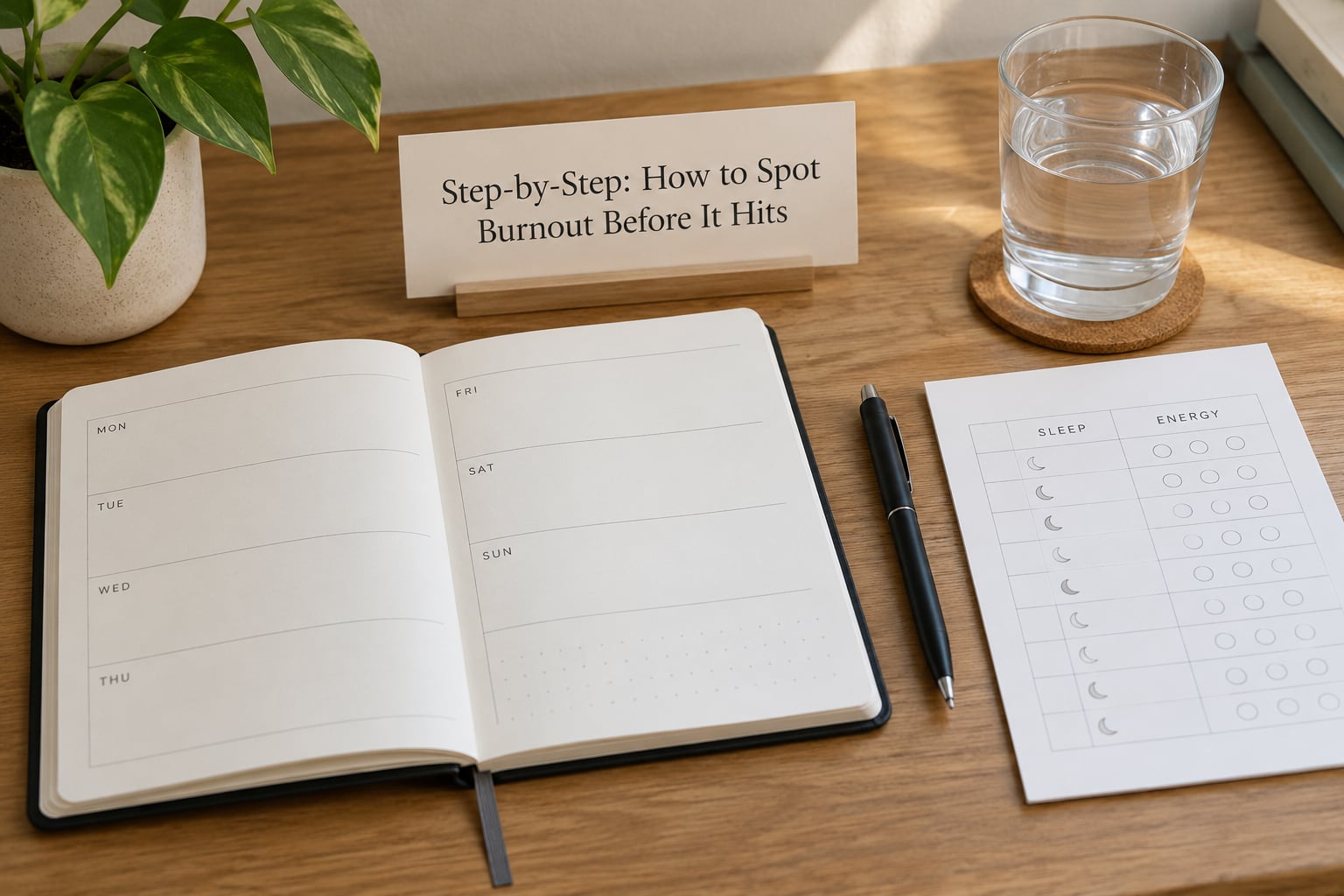
Step 1: Establish Your Normal
Write down what a normal week looks like for you right now: your typical sleep length, how focused you are on a good day, how motivated you feel about your work. Then compare the last two weeks against it. The comparison point has to be your own realistic recent average, not some idealized version of yourself with better boundaries and a color-coded planner.
If your honest baseline is already six hours of sleep and three deep-work blocks, then a week with two deep-work blocks is a signal, not a failure. Action after this step: pick one measure, sleep or focus or motivation, and write down your own number for it. You need a starting value to notice movement.
Step 2: Check the Physical Warning Signs
The body is usually the first place burnout registers, and it gets dismissed as a rough stretch far more often than it gets taken seriously.
- Sign 1: Sleep stops restoring you. You are in bed for seven or eight hours and get up tired, or you fall asleep exhausted and wake at 3am with your mind running through the day’s unfinished items. Trouble falling asleep and trouble staying asleep both count.
- Sign 2: Fatigue that survives the weekend. Two days off used to reset you. Now Monday arrives and nothing has actually changed. Rest happened, and it did not reach whatever is depleted.
- Sign 3: Tension and small physical complaints. Tension headaches, jaw clenching, a stiff neck from a bad hunch over a laptop, stomach upset or digestive changes that arrive during deadline weeks, restlessness at night, and getting sick more often than you used to. Cleveland Clinic lists headaches and gastrointestinal issues among common burnout signals.
Action after this step: if any of these are new, persistent, or getting worse, book an appointment with a doctor rather than assuming it is stress. Physical symptoms deserve real medical attention, and they are also sometimes the earliest and most reliable signal you will get.
Step 3: Look for Emotional and Mental Changes
These are the ones people notice last, and the ones that quietly cost the most in performance.
- Sign 4: Your patience shortens. A short email that would not have bothered you last month now gets a reply you regret. Irritability and shorter patience with people you actually like is a change worth logging.
- Sign 5: Cynicism and detachment creep in. You start skipping the parts of the job you used to like, rolling your eyes at meetings, mentally checking out during creative reviews. In freelance work the version is subtle: you stop pitching, stop caring about outcomes, treat every brief as just a transaction.
- Sign 6: Numbness and brain fog. Apathy, difficulty concentrating, forgetfulness, the sense that you are on autopilot. Many people describe finishing familiar drives or emails with no memory of deciding to start them.
Action after this step: write down the moment you most recently snapped at someone and what was actually happening in the hour before it. Fatigue plus a demand is usually the real story, not a character flaw.
Step 4: Notice Changes in Behavior and Work
Behavior changes are easier to measure than feelings, which makes them the most reliable thing to track.
- Sign 7: Procrastination and avoidance. Starting gets harder even on tasks you are genuinely good at. You reorganize, polish, and research instead of delivering. Small delays start stacking into missed deadlines.
- Sign 8: Sloppy work and missed details. Typos in work you used to proofread twice. Skipping the step that normally makes your work good. Taking longer on simple tasks because you cannot hold the thread.
- Sign 9: Withdrawal and escape urges. Cancelling plans, avoiding messages, dreading the thought of going in. Fantasy about walking out, quitting, or disappearing for a week. Withdrawal is often misread as needing space when it is depletion.
Action after this step: find one task you have been pushing for more than a week and either do the smallest version of it today or send the message that asks for its deadline to move. Both count as action.
Step 5: Test Whether Rest Actually Restores You
If you are working through this list because you want to know how to spot burnout before it hits instead of how to push through it, this is the clearest question in the whole process. Ordinary tiredness is cured by rest. Early burnout is the point where rest stops doing its job reliably.
Track what happens after your weekend, after a full night’s sleep, after a genuinely light day, and after a real vacation. If you recover most of the time, you are tired. If you have not recovered properly for several weeks in a row, that is not a bad week any more, it is a pattern. People often expect a weekend to fix months of strain, then assume the problem was imaginary when it is still there on Monday.
Action after this step: write one sentence answering whether the last three rest periods actually restored you. One sentence, yes or no, is enough.
Step 6: Name the Pattern and Choose an Intervention
Once several signs line up across physical, emotional, and behavioral categories, you have two honest choices: add recovery or remove demands. Adding recovery means protecting sleep, carving out something genuinely restful each week, and treating it as a scheduled item. Removing demands means declining the nonessential project, delaying the launch, saying no to the favor, or moving a deadline.
Support counts too: a peer, a manager, a client, a therapist, or an employee assistance program if your employer offers one. Independent workers have no HR department or manager to flag it, which is why a self-check you actually run matters more for them, not less.
Spotting the pattern is not the same as diagnosing it, and none of this is a diagnosis. This guide cannot tell you whether what you are experiencing is burnout, depression, or something physical. That is a conversation for a qualified professional. Your job here is noticing the pattern early enough to act on it.
Common Mistakes
Normalizing exhaustion. Treating constant tiredness as proof of commitment is the most common mistake in this list, and it is the one that delays recognition the longest. If your baseline has quietly dropped for two months, that is information, not a badge. Fix: compare this month to two months ago and say the number out loud to someone else.
Waiting for a crisis. Deciding you will deal with it when it becomes serious. Burnout is easier to address when the signs are inconvenience-level. Fix: set your own threshold in advance, such as two weeks of unrestored sleep, and treat hitting it as a decision point rather than a feeling to debate.
Relying on weekends alone. A weekend can carry you through a bad week. It cannot carry you through a bad quarter, and relying on it teaches your system that recovery is optional. Fix: add one midweek recovery block, even 30 minutes with no screen and no task attached.
Comparing your stress to someone else’s. Every workplace has people who look fine and people who are barely holding it, and you are comparing your inside to somebody’s outside. Fix: compare yourself to your own last month, which is the only data set you actually have.
Responding by quitting abruptly. Leaving can be the right move, but an unplanned exit during early burnout removes income, structure, and routine at the exact moment you need all three. Fix: if leaving is the goal, line up the next thing first, then leave.
General wellness habits help but they do not replace changing the conditions that caused the problem. Movement, regular meals, limiting alcohol, and staying connected to people all lower the load. No routine compensates for chronic overload indefinitely, and if you are dealing with a mental health condition, a clinician can help you build one that actually fits.
Frequently Asked Questions
How do I know if I am burned out or just tired?
Tiredness follows effort and clears with rest. Early burnout is when rest stops reliably clearing it: a full weekend passes and your energy does not come back, sleep no longer restores you, and changes in patience, focus and motivation last for weeks instead of days. Track your recovery after rest for two weeks. If you keep arriving back at the same depleted baseline, that pattern matters more than any single tired morning.
What are the earliest signs of burnout?
The earliest signs are usually physical and easy to wave off: sleep that no longer restores you, fatigue that survives a weekend, tension headaches, jaw clenching and gut changes. Right behind them come shortened patience, cynicism about work you used to enjoy, brain fog, and drifting avoidance of tasks. The sign that gets noticed last is withdrawal, because it looks like needing space. Any one of these means little. Several across categories over weeks is the pattern to act on.
Can burnout cause physical symptoms?
Yes. Chronic stress commonly shows up as headaches, muscle and jaw tension, restless or unrefreshing sleep, stomach and digestive problems, changes in appetite, and getting sick more often. These are among the earliest signals burnout produces, and they are routinely dismissed as normal. If a physical symptom is new, persistent, or worsening, see a doctor. Do not assume it is burnout, because some symptoms need real medical attention.
How can I help a friend or coworker who may be burning out?
Name what you noticed without diagnosing them: you have seemed exhausted for weeks, or you seem frustrated in meetings lately, and I am worried. Then listen rather than fixing. Practical help matters more than advice, so offer a specific thing, such as covering a task, taking a deadline off their plate, or making a shared lunch happen. Do not promise to keep it confidential if reporting is required at work, and do not take their symptoms to a manager yourself.
When should I see a doctor or mental health professional for exhaustion?
See a doctor when fatigue is new, persistent, or accompanied by physical symptoms such as headaches, digestive changes, sleep problems, or frequent illness, since those need proper medical assessment. Consider a mental health professional when exhaustion lasts more than a couple of weeks, when you cannot function or concentrate, when you feel hopeless, or when low mood extends beyond work. In the US you can call or text 988 for crisis support at any time.
How do I recover from burnout without making my schedule even busier?
Recovery usually comes from removing something, not adding a program. Protect sleep as a fixed appointment, strip out one nonessential commitment, and tell at least one person your load is unsustainable so it is not a private problem. Add recovery in small, boring pieces, such as a daily walk or a protected morning with no inbox. Expect weeks rather than a weekend, and keep logging your energy so you can see whether the changes are working.
Start With One Honest Check-In
Open your calendar for the last seven days and count the late nights, the skipped meals, the tasks that got pushed. Then pick one change you noticed in your body, your mood, or your work habits. Just one.
From that, choose a single move to make today: a boundary with a person, a recovery habit to protect, or a conversation you have been putting off. Put a date in your calendar for when you will check whether it worked, then repeat the same check next week. Burnout gets spotted the same way every time, in small observable shifts, and the person who catches it first is usually the one willing to write things down.